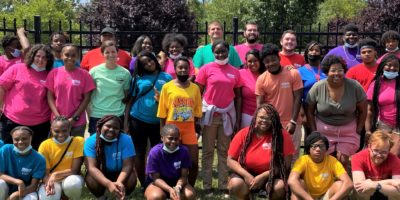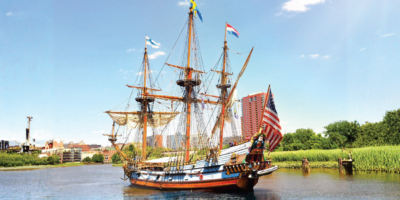

Above: The German Hanseatic Trader (above) is one of the many treasures the Forneys gathered during their travels. At right, students learn about the exhibit.
By Ken Mammarella
Photos by Jon Caspar
In 1975, Bob and Marilyn Forney started collecting maritime models. Their first was a Pukeberg crystal paperweight of the Kalmar Nyckel, a Swedish ship that in 1638 brought the first Europeans creating a permanent settlement in Delaware.
In 2014, they gave them to the Kalmar Nyckel Foundation, with all 73 displayed in the Watercraft of the World, a permanent exhibition at the Copeland Maritime Center at the Kalmar Nyckel Shipyard, located near where the Swedes landed on Wilmington’s Seventh Street peninsula.
“It’s all so fascinating, fabulous and fantastic,” says Sam Heed, who curated the exhibition.



“Every time we’d go some place, we’d look for a model,” Marilyn told this reporter in 2016 about their travels, which took them around the world at least five times. “It was a treasure hunt.”
And if they came up empty while browsing antiques stores, artisans’ workshops and waterfront retailers, they commissioned models or made them.
They embedded themselves in the community and the culture, Heed says. Most models were created near where the watercraft were used.
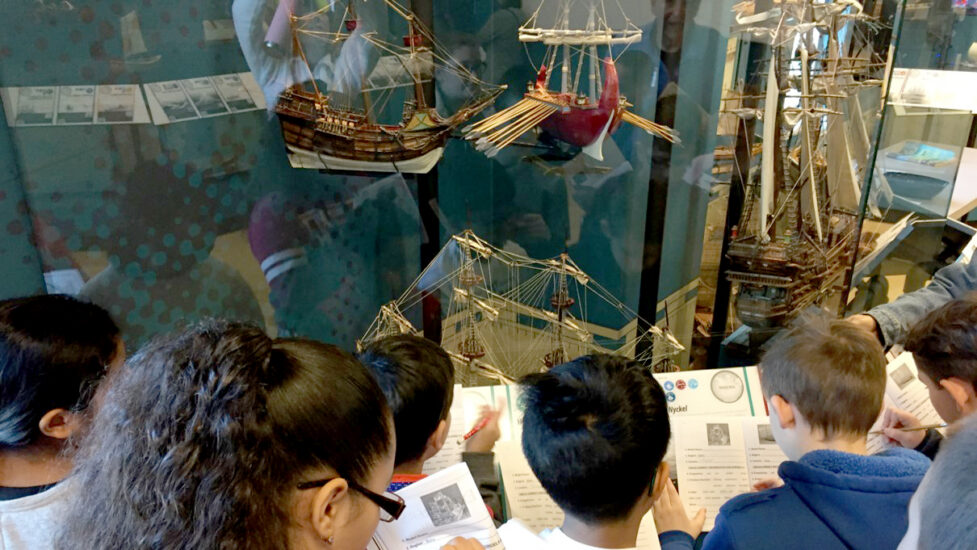
Students learn about the exhibit.
Some items are rare, Heed says. Others are museum-quality, hence why the Smithsonian Institution in Washington and the Field Museum in Chicago both expressed interest. And some are made for tourists. But they all have stories, and “that’s where the collection has power,” Heed says.
They’re organized roughly geographically in glass cases in the gallery, with a huge floor map offering a dramatic way to understand the world. The models are made mostly of wood, with some using metal, cloth, ropes, strings, jade and shells.
The smallest, with an extreme length of one and a half inches, is a Japanese boat called a wasen, made by Bob Forney. The largest is a Hanseatic trader from the Baltic Sea, with an extreme length of 41 inches.
Some models are generic types, like a fishing boat, made as a souvenir by kids who live on Inle Lake in Myanmar. Some are specific ones, like the HMS Endeavour, which in 1770 reached Australia. Heed gave the model to the Forneys so the collection would represent every continent.
The foundation has organized them into 13 overlapping types of watercraft: ancient, artifact, earliest exploration, fishing, merchant, oar, paddle, pleasure, replica, sail, shipping, spirit, warfare, it explains on the website KalmarNyckel.org/Forney-collection.
Over the years, the foundation has been offered many models but has accepted only a few, including a model of the Kalmar Nyckel, made by Thomas Gillmer, the naval architect who designed the full-size Kalmar Nyckel replica launched in 1997. It also accepted from the Delaware Historical Society a 1963 model of the Saugus, a monitor built in Wilmington, and volunteer Dan Mitchell’s model of the Ceres, the first ship of the Wilmington Whaling Co.
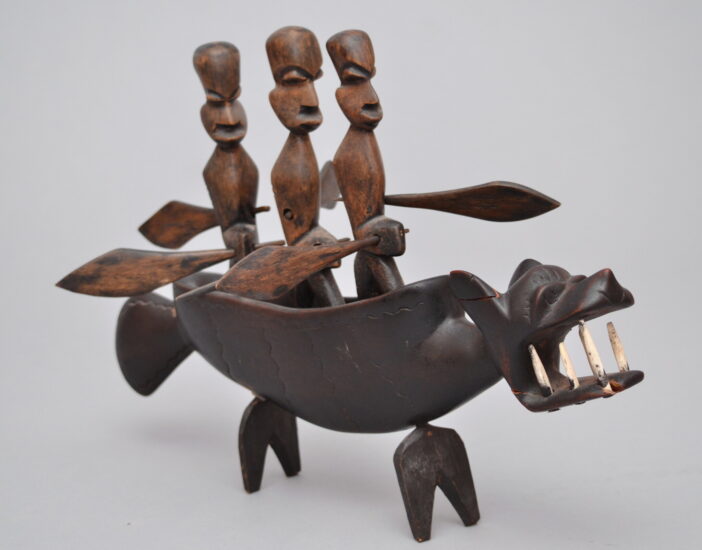
The models featured in the exhibit are made mostly of wood such as this Gambia Fantasy Ship.
The gallery merits three spots on the museum’s audio tour: one of the Forneys, one on the collection and one on spirit boats, which are “something ethereal and usually associated with funerals,” Heed says. A granddaughter made a Haida spirit canoe.
“The collection represents their appreciation of maritime history and culture,” Heed says, “at times far off the beaten path.”
The Forneys were both chemical engineers and met at Purdue University, where the chemical engineering building was renamed in 2002 in Bob’s honor. Bob was also a senior vice president at DuPont Co., and Marilyn was a philanthropist, with her obituary noting that she focused on prison reform, mental health advocacy and affordable housing.
Bob — whose grandparents were born in Sweden — died in 2016; Marilyn in 2023.
— The Forney collection is one of the attractions at the Copeland Maritime Center at the Kalmar Nyckel Shipyard, 1125 E. Seventh St., Wilmington. The center is open Wednesdays-Saturdays and summer Sundays, plus or minus various holidays. Admission is $10 for adults. There’s also a book about the collection, also called Watercraft of the World.
 “This assemblage of model ships and boats were collected as mementoes of a series of trips to foreign lands,” Bob and Marilyn Forney write in an introduction posted in the gallery. “At the outset, it was planned that all would be sailboats, relatively small, and acquired from local craftsmen when possible.
“Needless to say, none of these stipulations proved suitable. While we have not included any powerboats in this collection, a number of attractive models powered by paddles or oars proved irresistible. We have not actively sought warships, but we found some models too historically important to pass up.
“We have been to all of these places, and many more, but we did not acquire all the models in the places as we were visiting. In places like Antarctica or the Galapagos it wasn’t practical, and the models were acquired elsewhere. A few of the models represent one particular ship. Most of the models represent a type of watercraft, of which many might have been made. A small number depict an artist’s view of some aspect of their religion or culture.
“Besides representing a cultural or historical event, each of these models is attached to a personal memory from our travels. In addition, we find each of these models beautiful, and have enjoyed admiring them. We now hope that they will be admired throughout the years as a tool for learning and as an appreciation for the native craftsmanship that is fast disappearing from the world.”