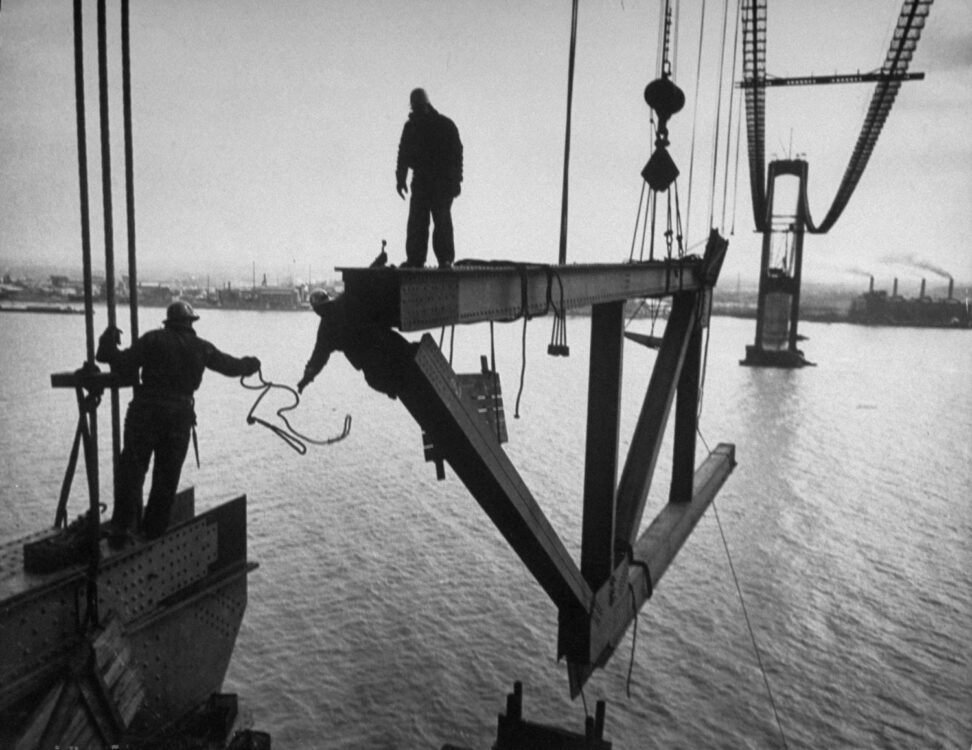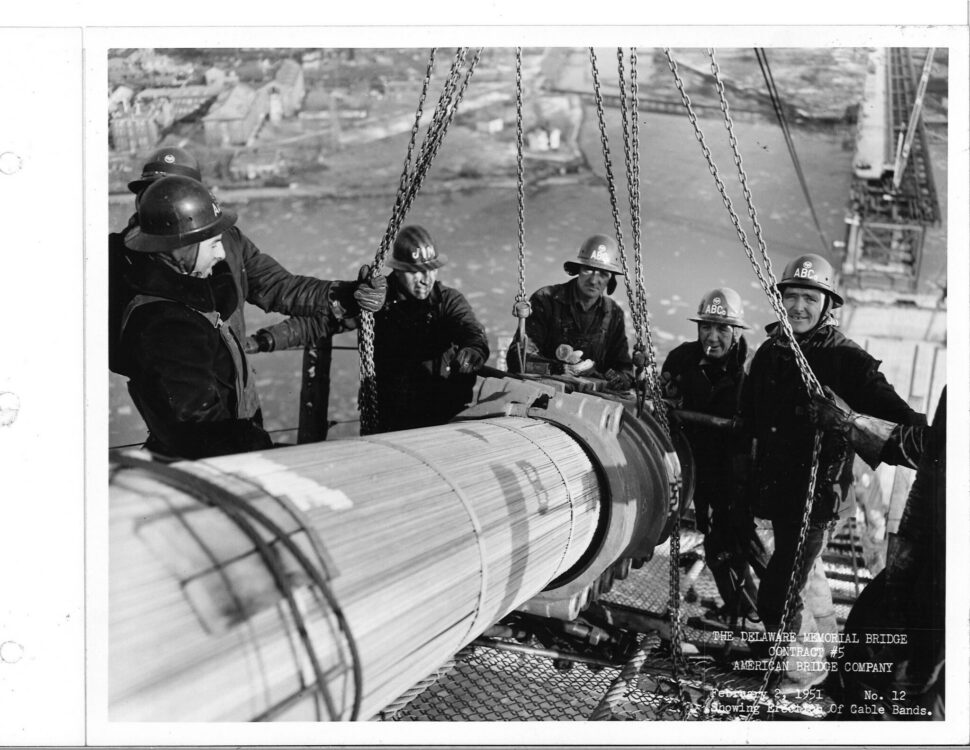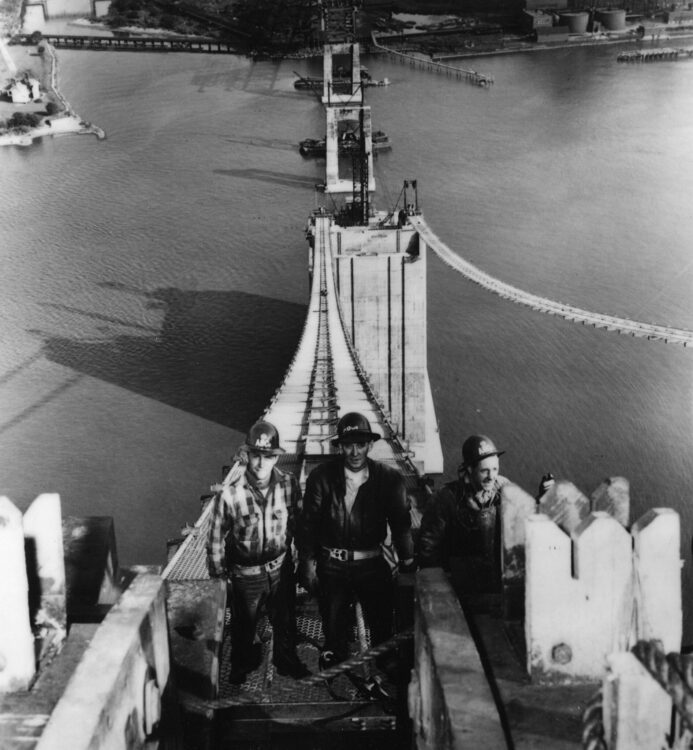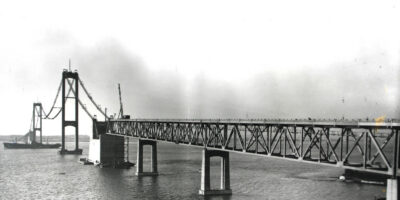

Above: Demand for a bridge connecting New Jersey and Delaware grew after World War II. So, in 1945 authorization was given to build what we now know as the Delaware Memorial Bridge. This photo was taken in November, 1950.
By Kevin Noonan
Photos courtesy Delaware River & Bay Authority
First, they had to build it. Then they had to expand it. And now they have to protect it.
The Delaware Memorial Bridge recently celebrated its 75th birthday, and even though most people take the bridge for granted as a familiar landmark they’ve known their entire lives, the DMB had a difficult birth and has dealt with many challenges as it aged.
“That’s true of a lot of traffic infrastructure,” says Vince Meconi, the CEO of the Delaware River and Bay Authority. “You might use it on a daily basis and just accept that it’s there. If it’s not working, that’s when it gets your attention.”



Few people today know the history of the bridge and all the hurdles that had to be cleared before it opened for traffic in 1951.
Before there was a bridge, ferry services connected Delaware and New Jersey. Prior to the dawn of the automobile those ferries carried people, horses, and livestock, and in Delaware they would continue their journey by stagecoach and, later, the New Castle-Frenchtown railroad.
That changed in the early part of the 20th century, when horsepower replaced horse power. With the advent of the automobile era in the 1920s — along with more and better roads — there were two ferry services linking the two states. On the Delaware side, both were located in New Castle — the White Line terminal was at the end of Delaware Avenue; the Wilson Line at the end of Chestnut Street.
The ferries became an important stage for Americans motoring up and down the East Coast and cars lined up on Route 40 to board the ferries and continue their way through New Jersey. Many New Castle businesses took advantage of the growing influx of car traffic, including a local meat market that sold millions of hot dogs to ferry customers.
Still, the ferry service was time consuming and only a certain number of cars could make the passage each day. And stormy weather could shut it down completely. So, public demand increased for a bridge that could handle more daily traffic and do it much quicker.
But if history had been written differently, cars today would travel under the Delaware River instead of over it. In 1926, the Wilmington Deepwater Tunnel Company proposed a two-lane tunnel under the river. But studies showed that a four-lane bridge would cost about the same as a two-lane tunnel, so eventually the bridge option was chosen.
Build It and They Will Come
Various studies were conducted regarding the feasibility of building a bridge, and even though most people wanted it, there was opposition from a couple of powerful groups. One was the Port of Philadelphia, which was concerned that construction of the bridge and then the bridge itself could impact navigation on the river. The other opposition came from the U.S. Navy and U.S. Coast Guard. They believed the bridge could be the target of an enemy attack, which potentially could cause the bridge to collapse and block ships’ access to and from the Philadelphia Naval Yard.
But the demand for a bridge grew after World War II, when it was obvious that Germany and Japan weren’t going to be invading America. So, in 1945, the Delaware State Highway Department was authorized to build and operate a bridge across the Delaware River, and it continued to run bridge operations until 1962, when the Delaware River and Bay Authority was created to oversee both bridge and ferry services (Cape May-Lewes and Fort Delaware) in the state.
That didn’t end debate and dispute about the bridge. William J. Miller Jr., who served as executive director of the DRBA from 1964-2019, wrote a book about the project, Crossing the Delaware, and he says politics, as usual, was the reason.
“The General Assembly decided to select a name for the crossing,” Miller writes. “It was suggested that the crossing be named for President Franklin D. Roosevelt, who had died in 1945 at about the time the legislation was approved. But the Republican governor of Delaware, Walter W. Bacon, firmly objected to the idea.
“A reasonable compromise was quickly agreed upon. It would honor the men and women from Delaware and New Jersey who gave their lives in World War II.”
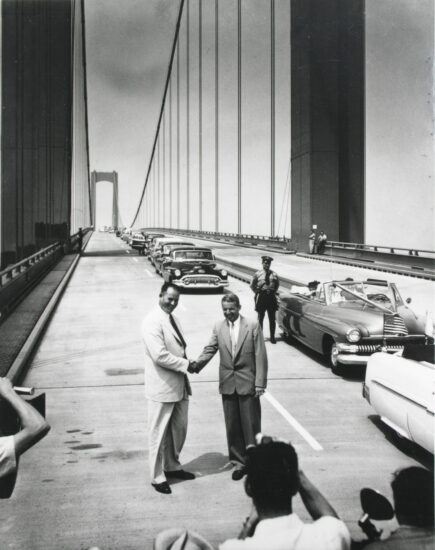
The Governors of Delaware and New Jersey headed the procession of cars across the new bridge, at that time the 6th largest in the world. The first paying customer, Omero C. Catan of Teaneck, NJ, paid his one-way 75 cent toll on August 16, 1951.
Finally, in 1948, construction of the Delaware Memorial Bridge began. It took two years and $44 million to complete, and at the time was the sixth longest suspension bridge in the world. It opened to traffic on Aug. 16, 1951, at 12:01 a.m. — with a toll of 75 cents — and was an immediate success.
“It was a day for governors to make speeches, for politicians to shake hands, for engineers to sigh in relief, and for bystanders to applaud,” Miller says.
By 1955, nearly eight million vehicles crossed the bridge annually, which was almost double the original projection, and by 1960 that increased to more than 15 million and it became apparent that one span wasn’t enough. So, in 1964, construction began on a second span, approximately 250 feet from the first. It cost $77 million and opened on Sept. 12, 1968, 21 years after work began on the original bridge.
And whereas the first span was dedicated to the men and women who lost their lives in World War II, the second span was dedicated to Americans who made the ultimate sacrifice in the Korean War and Vietnam War. Also remembered are the nine men who lost their lives during the bridge’s construction — six died while building the first span and three died on the second span.
Bridge Over Troubled Waters
Building the bridge was one challenge. Protecting it is another and the DRBA has had to deal with many challenges over the years, including one they’ve recently addressed. In July of 2023, the DRBA began the installation of a ship collision system that was completed in August, which coincided with the 75th anniversary of the opening of the bridge. Protection was installed around each of the support towers, at a cost of $93 million, with $22.25 million coming from the federal government.
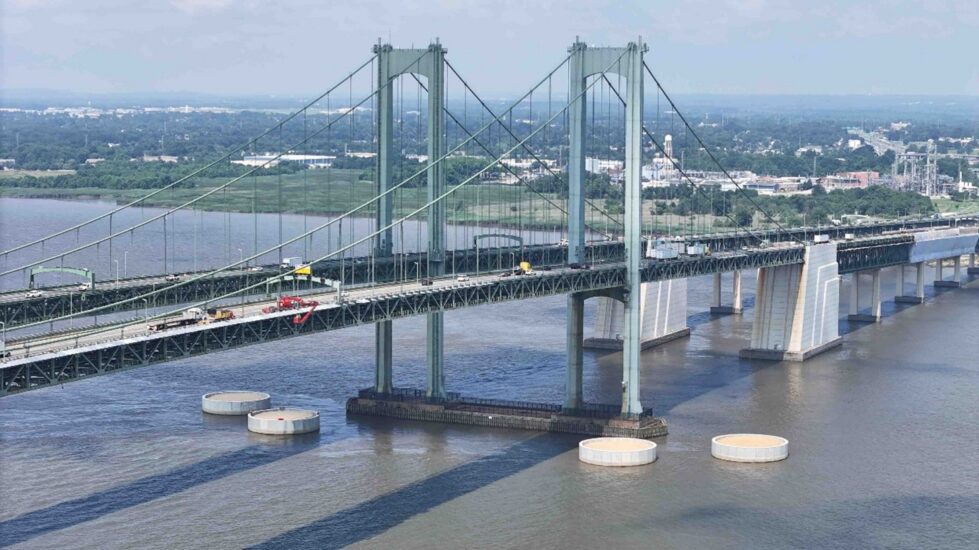
The bridge today after the completion of its Ship Collision Protection System.
The wisdom and value of that decision was tragically highlighted in March of 2024, when a ship lost power and without steering control it rammed into highly trafficked Francis Scott Key Bridge that crosses the Patapsco River leading into Baltimore. The bridge collapsed and six lives were lost — putting the spotlight on bridge safety and what could be done to avoid another tragedy.
“This has been in the planning for quite a few years [since 2016] when we put it on our capital improvement program,” Meconi says. “It takes a long time to a) get the funding, b) get the permits and, c) construct it. In fact, it was under construction when the [Key] bridge collapsed.
“Obviously, it was very expensive,” Meconi adds. “We had to make a major commitment to this and it’s the most expensive project we’ve ever done on the bridge.”
Today, more than 100,000 cars travel across the Delaware Memorial Bridge daily and more than 36 million annually. It took a long time to plan and build the bridge, and 75 years later it’s still a vital link for motorists as they travel along the East Coast.