

By Bob Yearick
Shout-Outs
Let’s change it up a little by starting with two kudos:
• To Hannah Chang, of The Philadelphia Inquirer, quoting Penn’s freshman quarterback Miles Teodecki: “I got to see my parents for the first time in a couple [of] weeks, so that was awesome.” Chang, or an editor, corrected the young man’s quote by inserting of. “Couple of” means a grouping of roughly two or three, while “couple” strictly means a pair or only two.
• To Lindsey Bahr, of the Associated Press, who, in a review of You Can See Everything, Nathan Fielder’s documentary about Theranos founder Elizabeth Holmes and her partner, Billy Evans, wrote this: “Fielder homes in on oddities in the couple’s relationship.” The rare instance where this term, which usually appears as “hones in,” is used correctly.
Media Watch
• Speaking of which, here’s the AP’s Dave Campbell writing about Minnesota University quarterback Drake Lindsey: “The 6-foot-5 Lindsey honed in on his strength and conditioning, cutting fat and adding muscle . . .”



• Ralphie Aversa, USA Today: “The other three sharks still rib on [Kevin] O’Leary for the scene [in Marty Supreme] in which his character, Milton Rockwell, spanks Marty (Timothée Chalamet) with a ping pong paddle.” We can rib (tease) our friends, and rip on, or simply rip, our enemies, but we don’t rib on anyone.
• Gabe Lacques, USA Today: “Suffice to say, the Rays likely won’t come near the $2,300 get-in record Milwaukee set for Game 1.” The correct phrase is “suffice it to say.”
• Brendan Morrow, USA Today, about Academy Award winner Mikey Madison: “In fact, the star’s brother, Miles, who sat next to her at the Oscars, had an actual dream that forecasted the evening’s events.” Forecast is the preferred past tense of to forecast. Language guru Bryan Garner calls forecasted “a solecism that spread during the 20th century.” Forecasted is correct, however, as an adjective in such constructions as “The forecasted sales depend on marketability.”
When Will it Dawn on Them?
The misuse of don to mean “wear,” instead of its actual meaning, “to put on,” continues apace. Two recent examples from reporters who, I’m pretty sure, weren’t present when an actress and a quarterback were getting dressed:
• USA Today, writing about Keri Russell at Paris Fashon Week: “The Emmy-nominated and Golden Globe-winning actress donned an oversized white button-up shirt, a short black skirt and black heels.”
• Alex Coffee, in The Inquirer: “It was his freshman year, and Johnson was a lanky quarterback, donning athletic shorts and cowboy boots, with a jug of water by his side.”
The Ol’ He/Him Problem
Writers continue to choose the wrong pronouns as the objects of prepositions and verbs. To wit:
• Ralphie Aversa (once again): “And when it comes to delivering information to an audience, Hannity believes there’s one main difference between he and his colleagues in cable TV news.”
Later in the same story: “Contract terms between he and Fox have been kept under wraps . . .” In both cases, the pronoun should be him.
• Hate to follow the language-challenged Aversa with Larry McMurtry (RIP) and Lonesome Dove, the greatest western novel, and one of the greatest American novels, ever written, but: “The leg hadn’t rotted off, but it had rotted sufficiently that the family got nervous about blood poisoning and persuaded he and Call to saw it off.”
Department of Redundancies Dept.
• The Inquirer, quoting Eagles running back Saquon Barkley: “‘My whole entire mindset is, we have a little issue going on right now,’ he said.” Many of us utter this irritating phrase without recognizing that the two words are synonymous.
• Reader Walt Frank says an ad for Earth Breeze on the FoxNews phone app claimed that their household product did not contain “artificial synthetic dyes.” One definition of synthetic: produced artificially.
• USA Today, reporting on the Emmy Awards show: “Matthew McConaughey and Woody Harrelson, stars of Apple TV’s upcoming Brothers, made mention of [mentioned] running ahead of schedule while presenting the evening’s last award of the night . . .”
Word of the Month
milquetoast
Pronounced (and often misspelled as) milk toast, it’s a noun meaning a weak, timid person who is easily led. The name (without the capital M) derives from Harold T. Webster’s early-20th-century comic strip The Timid Soul, in which the character is named Caspar Milquetoast.
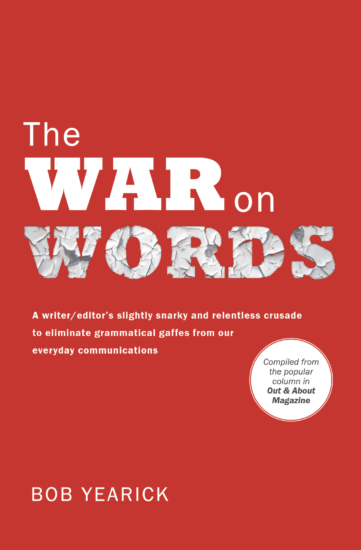 Buy The War on Words book at the Hockessin BookShelf, at Huxley & Hiro Booksellers, or on Amazon. Or email me at ryearick@comcast.net.
Need a Speaker for your Organization?
Contact me for a fun presentation on grammar: ryearick@comcast.net.