


By Bob Yearick
Media Watch
• Erin Jensen, of USA Today, is among the many writers who don’t know how to spell the past tense of “to lead,” which is led. In a story on Hoda Kotb, she got it wrong twice: “The next month Kotb lead a tearful interview, in which Guthrie spoke about the family’s nightmare.” Later in the story: “Looking ahead, Kotb has an interview with retired NFL quarterback Drew Brees — who lead the New Orleans Saints to their sole Super Bowl victory in 2010.”
• Ralphie Aversa, USA Today, quoting Judge Judy: “I think in the middle of the country, there are more people who long for the 1950s then long for the 2030s.” This is on the writer; I’m pretty sure the judge knows the difference between then and than.
• Jon Hoefling, USA Today, describing the Milwaukee Brewers’ MLB-best 74-46 record. “Yet despite their impeccable record going into Aug. 12, . . .” A team that loses 46 games does not have an impeccable (perfect) record.
• Andrew Egger on the Bulwark blog, courtesy of reader Larry Hamermesh: “It would be easy to laugh all this off as just desserts for venal Senate Republicans and the latest demonstration of the president’s incredible vanity.” Egger seems to be referring to an after dinner treat, instead of what he feels the Republicans deserve — just deserts (with two, not three, s’s).


• Joseph Santoloquito, in The Philadelphia Inquirer, writing about high school football: “Here’s a look at what has happened so far, including a peak at what is ahead for two major programs.” Joseph obviously hasn’t reached his peak as a writer. He meant peek — a quick look, or glance.
• Headline in the Lock Haven (Pa.) Express: “CMHS alum graduates from Marine Corp training.” That’s Corps — a main subdivision of an army in the field, consisting of two or more divisions. “Corp.” is an abbreviation for corporation.
• NFL analyst Troy Aikman recently committed the dreaded double comparative by opining that tight end Zach Ertz “couldn’t be more happier to join his old team,” the Philadelphia Eagles.
Playing Fast and Loose with the Language
Journalists seem to be on a campaign to stretch the language, giving new meaning to words and phrases that have been around forever. Some of these forays into the linguistic netherworld are more successful than others. Here are a few recent examples:
• Vaunt —This usually appears as “vaunted,” an adjective meaning “praised or publicized”; e.g., “the vaunted Notre Dame football team.” That’s why I noticed when Patrick Ryan, in USA Today, used it as a verb: “[Actor Josh] Hartnett isn’t one to vaunt about his acting process, and he detests the idea of Method actors.” Using it to mean “to make a vain display of one’s worth or attainments,” Ryan was correct — except that there is no need for “about” in that sentence.
• Litany — Too often, writers use it to mean simply “many,” when its actual meaning is “a prolonged or tedious account or list.” Inquirer columnist Marcus Hayes went to it twice in a recent column. I have a problem with the first one: “[Saquon Barkley] dashed up the middle for 42 yards, forcing a litany of missed tackles along the way.” This doesn’t convey the sense of “prolonged or tedious.” Later in the column he wrote: “ [Landon Dickerson] exited college with a litany of surgeries.” This fits the way it’s usually employed, to give a sense of a long, repetitive list of complaints, problems, or grievances.
• Shunned — I question this use of the word by Ralphie Aversa (again), in a review of Sylvester Stallone’s book, The Steps: “Stallone is shunned from agency after agency.” He may have been shunned by agency after agency, but more accurately, he was shunted (turned off to one side) from agency to agency.
• Fastidious — Pat Forde, writing in Sports Illustrated about the Indiana football coach: “Consider the office desk of Curt Cignetti: organized, fastidious and, . . . clearly the domain of a pre-internet mind.” A desk cannot literally be fastidious (extremely or excessively careful or detailed ); only a person (or, maybe, an animal) can. Forde may be taking literary license by transferring the human trait to the object, but it’s stylistically jarring and debatable.
Word of the Month
cromulent
Pronounced krom-u-lent, it’s an adjective meaning acceptable, adequate, or satisfactory; often used humorously or ironically, as in “The movie was a perfectly cromulent way to spend a rainy afternoon.”
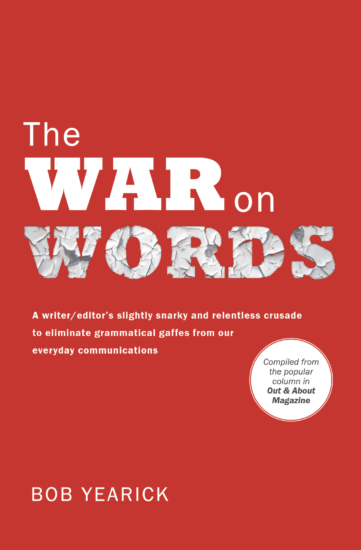 Buy The War on Words book at the Hockessin BookShelf, at Huxley & Hiro Booksellers, or on Amazon. Or email me at ryearick@comcast.net.
Need a Speaker for your Organization?
Contact me for a fun presentation on grammar: ryearick@comcast.net.