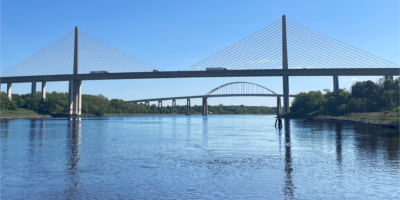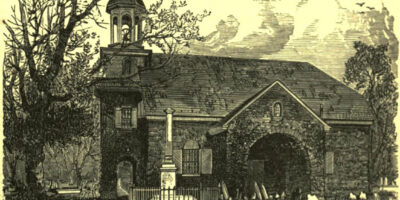

Above: Traffic zooms down Route 1, across the William V. Roth Jr. Bridge, which spans the relative calm of the C&D Canal at St. Georges. Out & About file photo.
First in a Three Part Series: The Route Along New Castle County
By Jim Miller
What do Blackbeard, St. George, and Rochambeau have in common? Their stories and legends are tied to the places connected by Route 1.
You’ve packed your bags, filled up the tank, and have all you need for your beach-bound journey to Southern Delaware this summer. There’s just one more obstacle between you and the sun, sand, and tasty waves — the 100-some miles off roadway along Delaware’s Route 1.
And let’s face it: The drive can be a slog.
But take comfort: While the old adage “getting there is half the fun” hardly applies to sitting in Friday rush-hour congestion, that doesn’t mean the ride down has to be corporal punishment, either.





Whether you are heading to Lewes, Rehoboth, Dewey, Bethany, South Bethany, or Fenwick, here are some intriguing tidbits about the places we all pass along the way — stories that might stimulate a lively discussion among your passengers or, if you are rolling solo, get your imagination going (particularly when everything else is stopped).
The waypoints of Route 1 connect places with compelling histories and legends of pirates, dragon slayers, heroes of the Revolution, and more.
So, buckle-up. It’s going to be a wild ride…
The Path To Victory
 The journey south starts along a path central to our country’s history. At the point where Route 1 starts — at the intersection of DE 7 and DE 58 — it converges for nearly a mile with the Washington-Rochambeau Revolutionary Route (W3R), most prominently around the area where both routes pass the Christiana Mall.
In total, W3R comprises 680 miles of roads stretching from Newport, Rhode Island to Yorktown, Virginia. This National Historic Trail marks the route taken in by more than 4,200 French soldiers, led by Jean-Baptiste de Rochambeau, and includes where they met up George Washington’s Continental Army in New York then continued south to Yorktown.
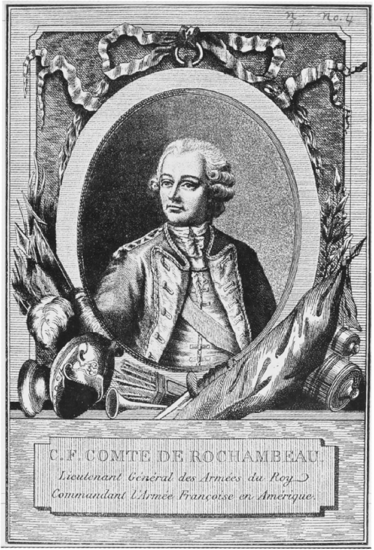
1791 engraving of Comte de Rochambeau, whose forces aided George Washington’s army at Yorktown.
Fourteen weeks after leaving Newport, Rochambeau and his troops proved vital to securing the surrender of General Cornwallis’ British troops, who had turned Yorktown into a heavily fortified garrison.
Rochambeau was undeterred. With Washington’s troops and the addition of more forces, their number now totaled close to 20,000. Most of the coalition were French and were well-experienced when it came to laying siege to a city. In fact, Rochambeau had taken part in 14 sieges before Yorktown.
Considering their situation, Washington was wise to let the French leaders do most of the strategic planning. The eventual success of the three-week siege at Yorktown secured a major victory and became a turning point in the war.
So, the next time you’re jammed up in traffic by the I-95 off-ramp — and it feels like there’s more movement in the Christiana Mall parking lot than in the southbound lanes of Route 1 — take heart: Thousands of Revolutionary War soldiers passed by this very spot on the way to victory. Their finish line took weeks to reach. Yours is just hours away…
St. George, The Dragon Slayer
About 12 miles south of Christiana, you’ll approach the town of St. Georges and the memorable-looking, yellow-cabled Senator William V. Roth Bridge, which spans the Chesapeake & Delaware Canal.
St. Georges was incorporated in 1825, but at least a century before that, colonists settled along the creek from which the town got its name: St. George Creek.
Predating the settlement, there had been loose talk of a canal connecting the Delaware River and Chesapeake Bay. Dutch mapmaker Augustine Hermann was among the first to suggest the idea of a canal back in 1661 — probably because, being Dutch, he wasn’t used to drawing maps that didn’t have canals in them.
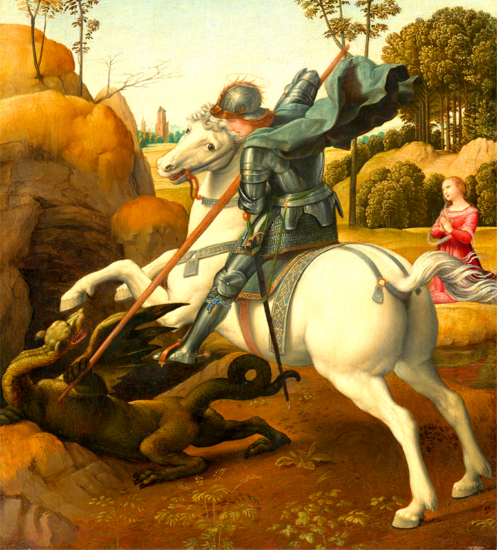
Rapheal’s Saint George and the Dragon.
In the 1780s, Benjamin Franklin and John Adams became supporters of the idea, and helped move the needle with a visit to Wilmington in 1788. Still, another 14 years would pass before the formation of the Chesapeake & Delaware Canal Company.
The company’s surveyors determined that easiest way to build the canal was to dig a trench between the landscape’s existing waterways. The eastern-most waterway utilized was St. George Creek (a much smaller part of which still exists today in the marshlands of the Augustine Wildlife Area). The canal ended up taking 27 years to complete.
But this still leaves us with an important question: Exactly who is St. George?
For starters, St. George is and has been the patron saint of England for nearly 680 years. His presence is so interwoven in the country’s tradition that his emblem was incorporated in the British Flag, which essentially is St. George’s cross (two stripes running north-south) combined with Scotland’s St. Andrew’s flag (two stripes forming an X).
But it’s the legend of St. George that comes into play with the Delaware landscape. As the story goes, a swamp-dwelling dragon has been terrorizing the people of the city of Silena, forcing them to make live sacrifices to it — first livestock, then eventually, the town’s children. Upon visiting the town, St. George is horrified and vows to hunt down the dragon in its swamp. After defeating the beast, the dragon slayer is rewarded with treasures by one of the city’s noblemen. Our hero declines, requesting the money go to the town’s poor, instead.
This brave feat and humble gesture constitute a large part of St. George’s sainthood and legend, which has been honored in many varied cultures across the Western world.
As it turns out, this legend is also honored in Delaware. About a mile before you reach St. Georges, you’ll see a sign for an otherwise ordinary marshy creek, that runs nearly parallel to the canal.
The name of that creek? Dragon Run.
And, just as it did then, that creek runs through a swamp on its way east to the Delaware River.
Blackbeard Singing in the Dead of Night
Heading south from St. Georges, between Odessa and Smyrna, you pass to another creek with a legend to it — one more closely aligned to a terrorizing dragon than a saintly hero.
Folklore has it that Blackbird Creek was originally called Blackbeard Creek, named for or by the nefarious pirate who made a career for himself plundering ships up and down the East Coast. The story dates back to at least the late 1930s, as it’s mentioned in The Ocean Highway, a 1938 book sponsored by Charles L. Terry, Delaware’s Secretary of the State at the time.
“The name is believed to have been originally Blackbeard Creek,” the book states, “named for a notorious pirate of the early 18th century, who, according to tradition, used the lower creek as a harbor and its banks as a cache for booty.”
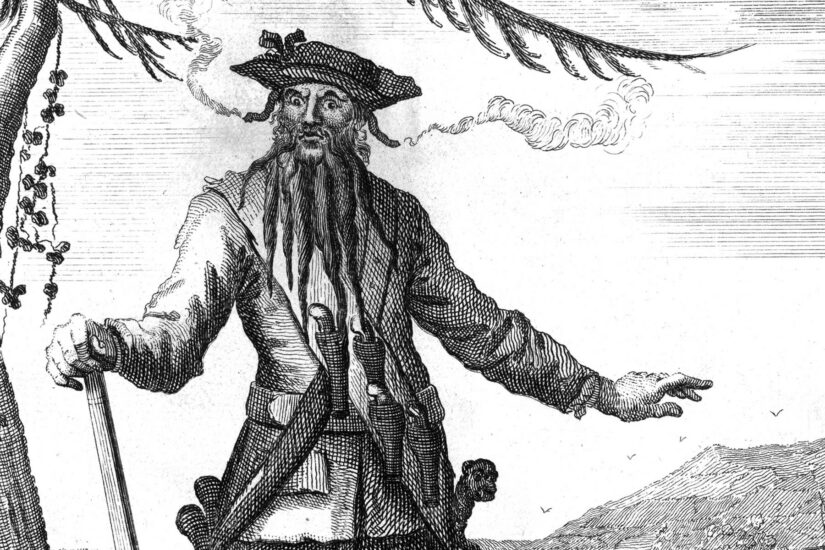
An early 1700s engraving of Blackbeard, a pirate who often used theatrics like tying burning match-cord from the brim of his hat.
Although Blackbeard’s career was short — he captained his own ship for less than three years between 1716 and 1718 — he cast a long shadow across colonial coastlines and throughout history, itself, as a January 4, 1893 edition of Wilmington’s Daily Republican illustrates. “A Dreaded Pirate,” reads the headline of a front-page story, followed by the sub-head: “Blackbeard Looked Enough Like Satan to Be His Brother.”
“Perhaps a greater demon never prowled the seas or walked the earth in human form,” the story reads mid-way through, dripping in dramatic prose. “Even in personal appearance he was hideous and repulsive, nature having stamped him both as a physical and moral monster.”
The question remains: Did this moral monster lurk in the waters of Blackbird Creek? And if he did, did he bury treasure there?
Yes, there is evidence of Blackbeard being in the Delaware Bay in 1717. Documented support exists on the Queen Anne’s Revenge Project site, created by the research team that discovered one of Blackbeard’s ships, Queen Anne’s Revenge, off the coast of North Carolina in 1996. Among the several sources cited, there is an October 24, 1717 edition of the Boston News-Letter which says “[a ship] with 150 passengers was taken at the mouth of the Delaware Bay by a pirate sloop called the Revenge, which formerly sailed out of Philadelphia.”
The article matches the timeline of an account in the local book, History of Delaware County, written in 1884. In it, author Henry Graham Ashmead writes “Blackbeard with his crew often visited Marcus Hook, where, at the house of Swedish woman there… he was accustomed to indulge in the wildest disorder and drunken debauches.”
However, while Blackbeard sailed up down the coast of Delaware, there is no historical account of him specifically being in Blackbird Creek — nor did this author find any mention of “Blackbeard Creek” during an extensive search of more than 20 maps dated from 1847 to 1749 (available via Library of Congress, University of Delaware, and Delaware Public Archives). All depictions of the creek in question were either labeled “Blackbird Creek” or not labeled at all.
Dreaded Pirate or Pussy Cat?
Scottish author Angus Konstam has written more than 100 books about maritime history, many on the subject of pirates. In addition to being a fellow of the Royal Historical Society, he was inducted into the International Pirate Hall of Fame last year. In his 2006 book, Blackbeard: America’s Most Notorious Pirate, Konstam wrote about that the myths surrounding Blackbeard. In a 2024 interview with Aspects of History, Konstam shared his findings:
“It turned out there was no evidence Blackbeard actually killed anyone — at least not before he fought his final battle in November 1718,” Konstam said. “He was something of a pussy cat really.
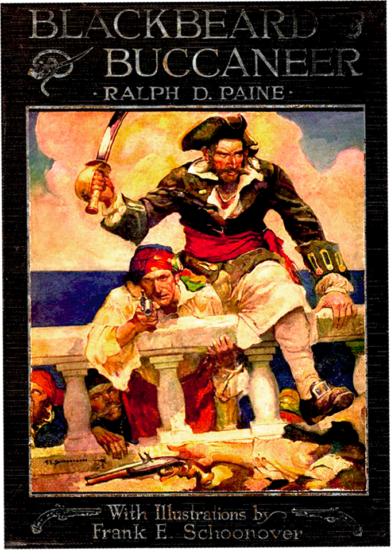
The cover of Blackbeard: Buccaneer,
illustrated by Frank Schoonover, a member of Howard Pyle’s Brandywine School and Delaware Art Museum contributor.
“However, Blackbeard didn’t need to kill his victims. Instead, his reputation was built on his appearance — his long beard, his long hair tied up in plaits, with bits of burning match-cord hanging from the brim of his hat. It was all designed to intimidate.
“Blackbeard built up a fearsome reputation, but it didn’t involve random killings. After he died, his myth was augmented by other stories, and like most pirates, the fiction and romance of the character almost completely obscured the real pirate at the center of it all.”
What about Blackbeard burying treasure along the banks of Blackbird Creek?
“Pirates didn’t really bury their treasure,” Konstam said in the same interview. “For starters, most of their plunder was in cargo goods: like rum, wine, cloth or sugar. Anything valuable was divided up among the crew. So, unfortunately black spots and treasure maps came from the wonderfully fertile mind of Mr. Robert Louis Stevenson.”
Despite Kostam’s last statement, at least one famous pirate buried treasure. And that pirate’s story partly inspired Stevenson to write Treasure Island — the very book that Konstam says helped first plant the idea of black spots and treasure maps in the public’s collective imagination.
That pirate was none other than Captain William Kidd, who does have a significant Delaware connection and whose story we’ll get to a little further down the road…
Until next month: Safe travels and enjoy the ride!
“The Wild Waypoints of Route 1” series is brought to you by: