

Above: Thomas Wallace is community vice president/senior executive director of the Wilmington YMCAs. Photo by Jim Coarse.
By Bob Yearick
With a competitive bodybuilder’s physique in a three-piece suit, Thomas Wallace is a walking, talking metaphor for his job title: community vice president/senior executive director of Wilmington’s Downtown YMCAs — Central and Walnut Street.
The soft-spoken Wallace, who would never describe himself in such terms, leads an organization that traditionally has aided its members in their quest to build muscle and improve their health, but in recent years is more focused on being a bridge to a better life for those in the community it serves. His job thus requires him to be as comfortable in the staid atmosphere of corporate and nonprofit boardrooms as he is in the testosterone-fueled cacophony of gyms and weight rooms.
And he is.



A native of Wilkinsburg, a borough of Pittsburgh, the 43-year-old Wallace had what he calls “a challenging upbringing” in the 1980s and ‘90s. As a member of the notorious LAW (Larimer Avenue Wilkinsburg) gang, he had some run-ins with the police. (At the top of a sleeve of ink on his right arm, gang tats from those dark days are buried under the names in a family tree.) Luckily, his high school football coach saw Wallace’s potential, mentored him, and helped him earn a scholarship to Edinboro (Pa.) University, where he played free safety, met his future wife, and graduated with a degree in elementary education.
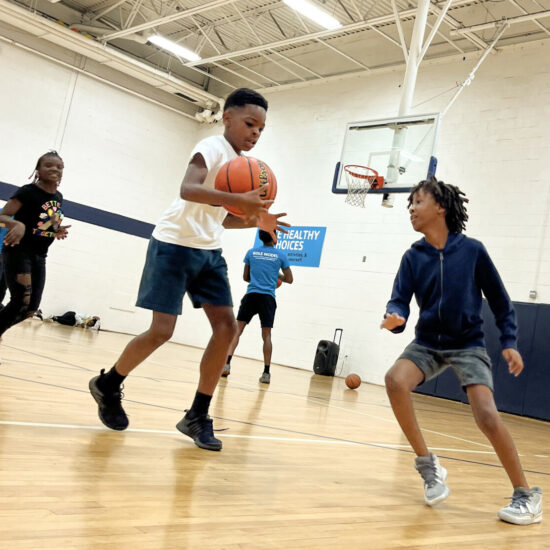
Youngsters hoop it up at the Walnut Street YMCA.
Two decades ago, after a few years as a teacher, Wallace joined the staff of the Pittsburgh YMCA and quickly rose through the ranks to become executive director of the Baierl Family YMCA of Greater Pittsburgh in 2011, making him the first African American to hold a position of leadership at that Y. He came to Delaware in 2019 as director of the Western Y on Kirkwood Highway, and assumed his current title last year.
Both of the facilities in Wallace’s charge are teeming with activity while they continue to evolve. Because of the demographic they serve, they are perhaps more focused than any of the state’s other six branches on the three ambitiously altruistic “promises” established by State Director Jarrett Royster: “Ensure every child is on a pathway to success; improve individual family health; unite communities and inspire action for good.”
In pursuit of those goals, neither of the downtown branches is your father’s YMCA.
No Blood, No Foul
For decades, noontime was perhaps the busiest period at the Central Branch. Located at the corner of Washington and 11th streets, it was a convenient haven for downtown office workers looking to unwind and burn calories.

Teens get a lesson in food preparation.
Runners, beginning with the fitness boom of the 1970s and ‘80s, crowded the elevated track (26 laps to a mile), while looking down on a basketball court where office workers, bankers, lawyers, cops, the occasional politician, and others waged no-blood-no-foul half-court games.
In the top floor handball/racquetball courts, Ruly Carpenter, owner and president of the Philadelphia Phillies from 1972 to 1981, bested all handball challengers, including World War II veteran and uber-Salesianum-booster Guido Schiavi. And in the cramped basement, where future Mr. Universe Kalman Szkalak sometimes bestrode the weight room, the sounds of clanging iron resounded off the walls.
By the ‘90s, banks and corporate offices had begun moving out of the city, and the noontime crowd dwindled. Meanwhile, such programs as spinning, yoga, Pilates, and kickboxing were introduced, along with water aerobics and other pool exercises.

Both Downtown YMCAs have pools and offer swim classes.
As it did to so many downtown businesses, the pandemic dealt yet another blow to Central when even more workers left town to do their jobs from home. Three years later, most have not returned. YMCA branches throughout the state lost members, and they continue to chase their pre-pandemic numbers, a goal that even Royster admits is probably unattainable, especially at Central.
“We have a unique challenge there because the downtown market has been disrupted,” Royster says. “Downtown business is only 60 percent of what it was pre-pandemic. I’m not sure that it is ever going to return to what it used to be.”
Staying Flexible
Wallace concurs with his boss. He estimates that the noontime crowd, with its formerly “very robust business demographic” is now “about a quarter of what it was before the pandemic,” although spin classes, Zumba, and other activities still attract participants.

A mural at Walnut Street created by Christian Kanienberg.
Wallace understands that Central must stay flexible, and continue adapting to its membership. “The Y has always been innovative in its programs,” he says, pointing out that both basketball and volleyball were invented by YMCA officials (at two separate Massachusetts branches in the 1890s — a few years after a Boston Y staffer coined the term “bodybuilding”).
“But we have gotten into the habit of prescribing,” he says. “We come in and say, ‘this is what the people want,’ and then we don’t get the participation we anticipated. Our membership base has changed. With that in mind, we’ve taken a step back and we’re identifying needs.
“We’ve brought in consultants and put out surveys to the community. Now we’re sifting through that data and putting it into a strategic plan to serve the needs and the wants of our membership.”
Wallace says a committee has analyzed the survey data and the next step is implementation of innovative programs, with Central serving as a testing ground — “a beta group, if you will.”
180 ‘Transitional’ Rooms
In addition to extensive exercise facilities, the Central Branch contains 180 “transitional housing” rooms on the second, third, fourth and fifth floors of the six-story, 95-year-old building. As the droll Village People anthem suggests, the YMCA is “a place you can go . . . when you’re short on your dough,” and nationally, the Y began providing affordable housing in the 1860s, largely for young men moving from rural areas to jobs in major cities. Those who have stayed at Y residences throughout the country include journalists Andy Rooney and Dan Rather, civil rights leaders Dr. Martin Luther King Jr. and Macolm X, and novelist Jack Kerouac.
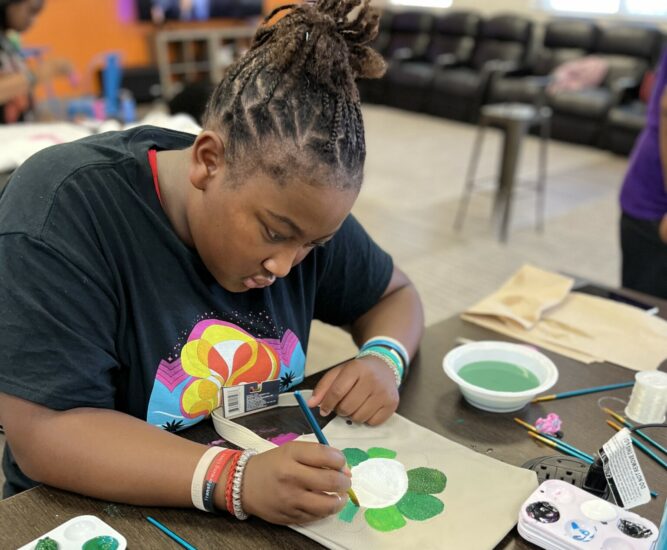
Art classes in the Barclays Teen Center.
There may be a Rather or a Kerouac currently at Central, but if so he likely won’t be there long. “It is transitional housing,” Wallace says, “so occupancy fluctuates. It’s currently at about 80 percent.”
Some residents move on to other housing, and some are evicted, primarily for nonpayment of rent or for violating their lease, which requires no smoking, no alcohol, and no drugs.
Thirty-four “tempo rooms” (no lease) rent for $600 a month. While current residents are paying $480 per month on a one-year lease, the rate for new residents is now $525. Renters must have an income, and the average is about $9,000 per year. Anyone earning $40,000 or more is ineligible.
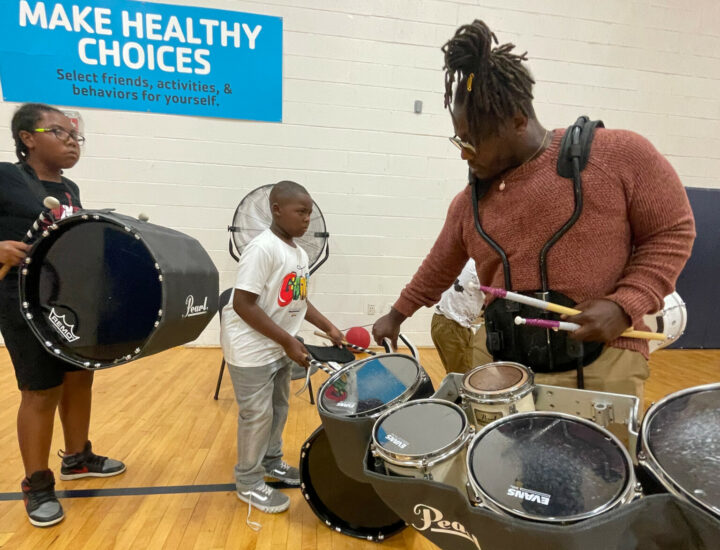
Music is also a big part of the YMCA’s youth programming.
Royster says that some $500,000 in funds from New Castle County helped to refurbish the rooms recently.
Indeed, the Central YMCA Residence experienced a groundswell of support in 2023 from not only the county but other community partners, including the City of Wilmington and Attorney General Kathy Jennings and Lt. Gov. Bethany Hall-Long’s Opioid Settlement Distribution Funds. The support was earmarked for rental assistance, wrap-around services, and cosmetic upgrades.
Jimia Redden, Central’s executive director of Housing, proudly gave Out & About a tour of the freshened facilities, which include a lounge, chapel, medical area, and laundry. There is a common bathroom/shower room and a microwave on every floor. The men can keep a crockpot, but not a hot plate, in their rooms. Redden says the Y conducts crockpot cooking sessions for residents and holds Bible study in the chapel.
The Mission Market
Says Royster: “Our goal is to fill 100 percent of those beds and provide premium service to those men. We have been more intentional about partnering with other agencies to provide wraparound services — everything from mental health counseling, drug addiction counseling, and finding support for some of their primary needs, like food and clothes.”
Residents — and the community in general — need go no farther than Central’s lower level to find such basics. The YMCA Mission Market, opened on Sept. 1, 2022, is a free store, available to community members in need who present an ID at the door. It stocks shelf-stable and frozen food, clothes, paper goods, and more. Donations were provided by community members and partners, including the Brandywine Hundred Rotary Club, Planting to Feed, Inc., Wawa, Giant, and Starbucks.
Wallace credits his predecessor, Jesus de La Salas, the YMCA of Delaware’s current vice president of Social Responsibility and Corporate Partnerships, with creating the Mission Market. He says it is being evaluated and may be reconfigured, but he is all-in on its purpose. “I fell in love with the Y because of the social services like Mission Market,” he says.
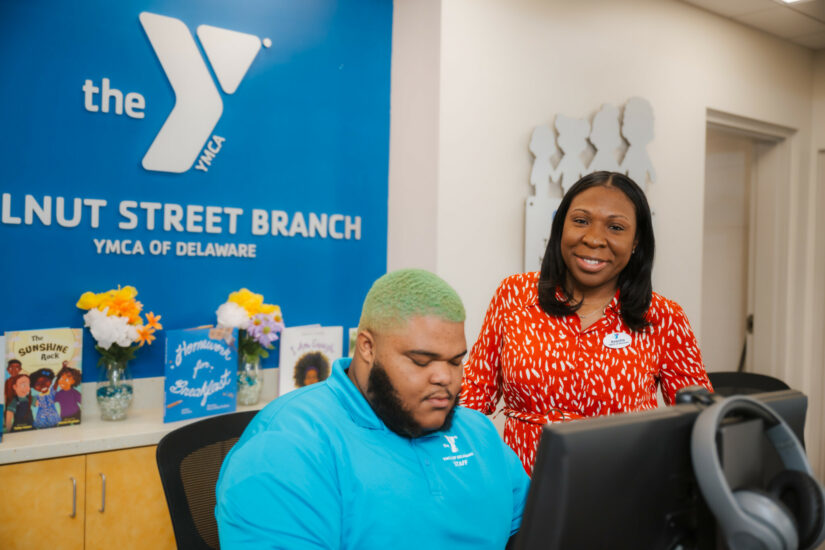
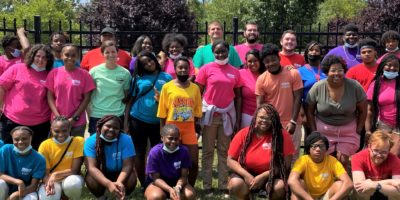
Executive Director Anesha Law says the Walnut Street YMCA building averages over 200 kids in and out per day. Photo by Jim Coarse.
Walnut Street
Wallace also oversees Walnut Street — which, as he readily points out, has traditionally been known as “the Black YMCA.” Formerly a full-service branch and fitness center, it became a Youth Resource Center in January of 2011. Under the guidance of Executive Director Anesha Law, it lives up to that sobriquet by providing a varied menu of programs and services dedicated to minority children in a city of 71,000 with a Black population of 53.7 percent.
Located at the corner of Walnut and 11th streets, in Wilmington’s Eastside neighborhood, the branch dates back to 1940. That original building was demolished in 1998 and a new Y was erected on the same site. The tower and relief friezes, depicting Marian Anderson, Booker T. Washington, and Dr. George Washington Carver, were the only original features retained in the new building.
Membership is free. That enticement plus Walnut Street’s numerous activities make it a magnet and a haven for many city youngsters.
“We average 200 kids in and out of the building per day for all of the programs,” says Law.
Walnut Street offers preschool and before and after school care as well as a teen after-school program. The building is open until 9 p.m. on Friday and 6 p.m. on Saturday for the Safe Haven program. “These are students 13-17 years old,” says Law. “They can play in the gym, work out in the fitness center, or hang out in the Teen Center,” where food is provided by Chick-Fil-A. The number varies, but she says about 100 kids register for a typical weekend.
Weekends are also for Youth in Government, which attracts up to 100 students from across the state. Says Wallace: “It’s affectionately known as the YIG program — we love our acronyms. It introduces youth to politics. A number of times a year they go to Dover and go through the parliamentary and legal process for a weekend. They do a takeover on both House and Senate sides and go through the same procedures that elected officials do, creating policy that they debate.”
He says this election year “is exciting for us, because our job is not to select one side — we’re simply trying to expose them to all sides.”
Two other programs, Black Achievers and Teen Workforce Development, help youth improve their academics and develop educational and career awareness with the guidance of mentors. Teen Workforce Development conducts workshops focusing on life skills and job readiness, including resume writing, financial literacy, stress management, conflict resolution, etiquette, and public speaking.
A Taste of Camp Life
“We also have a Summer Day Camp program that’s aimed at making sure students have a productive and safe place to go for the summer,” Law says. “We partner with Hanby Outdoor Center and the Western Y, and each day of the week we send some kids there to get a taste of outdoor camp life.”
Law also points out the STEM lab, which is supported by Barclays Bank. It serves as the home of Royster’s new twice-a-month podcasts.
A native of Washington, D.C., Law is a diminutive bundle of energy who has always worked for nonprofits, joining the YMCA in 2017. When she talks about Walnut Street, her operative adjective is “amazing.”
“Working here is amazing. We have an amazing team, a team that is passionate about what they do, on a mission to make sure the students are safe, that they have a responsible adult in their lives, and that we’re preparing them for their next step — whether it’s college, high school, elementary school, or the working world.
“Working here you feel good, you see the impact of the work. This place is amazing.”
YMCAs of Wilmington Timeline

Courtesy of YMCA of Delaware
1875 First Association in Delaware organized in Wilmington with weekly meetings held in the Scott Methodist Church.
1878 The Annual Report stated that 76 services were held in the Y’s rooms, 12 cottage prayer meetings were held in destitute parts of the city, 15 open-air meetings, 20 visits to the county jail, 3,000 tracts distributed and 24 religious meetings held at the alms house.
1879 The Association was disbanded for unknown reasons.
1889 The Wilmington YMCA was reestablished on May 14, with the following notice in the Wilmington Evening Journal: “All young men are invited to attend the meeting in the Delaware Avenue Baptist Church, this evening, for the organization of the Young Men’s Christian Association. It is proposed to effect a permanent organization. A constitution will be adopted and a board of directors elected.”
1890 Charles Baird was the first Board President and Isaac T. Johnson was the first General Director.
1891 The YMCA of Wilmington was incorporated and received a charter from the State of Delaware on April 7. The first home of the YMCA was purchased on April 21. It was the Ebbitt House at 1005-07 Market St., a two-story building located near the present Market Street entrance of the Du Pont Building. The YMCA leased some land for an athletic field at Riverview near 30th Street, east of Market Street.
1906 The Market Street property was sold to the Du Pont Company in 1903 and vacated in 1906. Temporary quarters were secured in a church building where the library now stands.
1908 A new five-story building was opened on Oct. 2, at the northeast corner of 10th and Orange Streets (where the Nemours Building now stands).
1929 The present Central Branch building on Washington Street was opened in November, to replace the 10th and Orange Street building acquired by the DuPont Company. Minor alterations were made to the Health Club facilities in 1940 and 1954, and an area under the building was excavated in 1940 to provide more program space.
1940 The Walnut Street Branch, a gift from H. Fletcher Brown, was opened on Sept. 22 for use by both the YMCA and the YWCA. This work was accomplished under the leadership of Alva E. Lindley, who was beginning his 22nd year as general secretary.
1946 The YMCA joined the United Community Fund of Wilmington, now the United Way, and has participated in these joint financial campaigns ever since.
1948 The YMCA Community Services Department was established to extend Y programs throughout New Castle County through Indian Guide Tribes, Junior and Senior Hi-Y Clubs, and day camps.
1953 Alva Lindley retired in January after 34 years of service as General Director. Henry Kohl assumed leadership and served as General Director until 1970.
1956 With the extension of services throughout New Castle County, the YMCA of Wilmington changed its name to YMCA of Wilmington and New Castle County.
1963 The Board approved a $2,500,000 Capital Campaign with the planning, preparation and fund raising during the period of June, 1963 to July, 1964. Some $2,915,000 was raised and realized from investment earnings and other sources.
1966 Central Y renovations are completed in the fall. Renovations were underway at Walnut Street, and were completed in 1968.
1967 A period of time for developing programs with new and renovated facilities. More emphasis on developing center-city work and plans for coordinating the Central and Walnut Street youth services.
1971 The Board authorized a total organization review, assigning Eugene R. Perry chairman of a Task Force to determine program goals and organization to fulfill priority needs. John Davis served as general director during this period, from 1970 to 1973.
1972 The Group Services Branch was organized as a non-facility unit with responsibility for work with high school age youth and Indian Guides.
1975 Because of high inflation and soaring costs, the Group Services unit was disbanded, with high school age programs reassigned to suburban branches.
1977 The Brandywine, Camp Tockwogh and Central Branches were operating at capacity. Walnut Street Branch completed reorganization of staff and lay deployment. The Long Range Planning Committee initiated a series of six-year goals and planned for future facility needs.
1979 Initiated a $5.8 million Capital Development Fund Campaign to renovate and expand present Y Branch facilities. Expanded DIAL program to include drug and alcohol prevention programs throughout the total state. Over 55,500 individuals were served in a variety of programs throughout the year.
1980 Completed the second phase of the Capital Development Fund Campaign for a total pledged of $3,503,000. Interest earned through the end of the year totaled $244,000 for a grand total of $3,747,000. By year-end, the Association served 26,855 members, 3,668 registered program participants and 29,677 other program participants for a total of 60,200 different persons. 43.1% of this total were female, 56.9% male, 45.7% youth, and 54.3% adults.
1981 Architectural work began for the facility expansion projects at Brandywine, Central and Western Branches. Renovation projects underway at Camp Tockwogh, Central and Walnut Street.
1982 Capital construction work began at the Central Branch and continued at the Brandywine and Western Branches. Renovation work continued at Walnut Street Branch.
1983 The Central Branch opened its new men’s and women’s fitness center and newly renovated male and female locker rooms. The Y Board of Directors and the Trustees of the Hanby property came to an agreement to have the YMCA operate a joint day camp and new sports center for Brandywine, Central and Walnut Street Branches on a long-term lease, with both start-up funds and operating funds being provided by the Hanby Trust. The International Partnership between Wilmington and Athens was formalized by a meeting in Athens, Greece, of staff and volunteers from both Associations. After a year of intensive study, the Boards of Wilmington and New Castle County YMCA and the YMCA of Southern Delaware approved their intent to merge into a state-wide organization.
1984 On Feb. 1, the YMCA of Wilmington and New Castle County officially became the YMCA of Delaware, with two new Branches – Central Delaware in Dover and Eastern Sussex Family in Rehoboth. This merger produced the first statewide, incorporated Association in the country.. New squash and racquetball courts were completed at the Central Branch.
1985 On Jan. 1, 1985, the Resource Center of the Central Branch became the YMCA of Delaware’s eighth Branch statewide. On July 1, the Resource Center Branch assumed the operation and publication of The Eye magazine, the only youth-published magazine in the state, with a monthly circulation of 75,000.
1986 Child care programs became the YMCA’s fastest growing program area. Central Branch, in collaboration with the Visiting Nurse Association, opened a sick child care center, “Sniffles and Sneezes.” The YMCA of Delaware continued to grow, with a year-end budget of 6.3 million dollars.
1989 A Year of Celebration: The YMCA of Delaware, and all eight Branches across the state, celebrated 100 years of service to Delaware. A Dinner/Dance Association party was held at the Wilmington Country Club on May 19 to commemorate the anniversary. All branches found unique ways to hold their own celebrations. Walnut Street focused on its 50th Anniversary with a Youth Festival in May and a community celebration in September, with guest civil right leader Julian Bond as the speaker at the Black Achiever in Business and Industry Awards. Two new Fitness Centers opened at Central and Walnut Street.
1990 The Resource Center was awarded a grant that enabled it to offer drug and alcohol prevention programs to all eight Branches. During the year, Black Achievers and their corporate sponsors hosted Career Workshops and Field Trips for more than 150 at-risk teens.
1991 Hundreds of Delaware teenagers benefited from Y programs such as Youth in Government, Model United Nations, the National Affairs Conference, Delaware Teen Conference, Peer Counseling Program, and Youth Leaders Club. This year was the most successful ever for the Black Achiever in Business and Industry Awards Program, which has become one of Delaware’s most recognized youth guidance and development programs. Guest speaker Mrs. Coretta Scott King presented awards to 31 recipients. The Central Branch, with partial funding from federal development dollars through the City of Wilmington, was able to reopen the sixth floor of its residence facility, adding 20 needed rooms, for a total housing capacity of 158 rooms at the Central and Walnut Street Branches. The Eye magazine was honored by the Delaware Valley YMCA regional program agency as an outstanding youth leadership development program for 1991.
1994 The Central Branch was awarded a grant from the United Way to provide the Youth Violence Prevention Initiative program – a structured recreational, social, and tutorial program for teens from the west end of the city.
1995 Marks a milestone in our journey as we’ve joined with YMCAs across the world to adopt character development education as our number one priority. The identification of four character values – caring, honesty, respect, and responsibility – and their implementation into every program we offer, is the culmination of our commitment to the future. In September, the YMCA of Delaware Board of Directors approved a $9.5 million capital campaign to improve services and programs in the New Castle County area. In 1995, the Bear/Glasgow Family branch officially came into existence with a day camp for children at Lum’s Pond.
1998, The original Walnut Street YMCA was demolished to build a new YMCA on the same site. The tower and relief friezes, depicting Marian Anderson, Booker T. Washington, and Dr. George Washington Carver, are the only original 1939 remnants used in the new building.