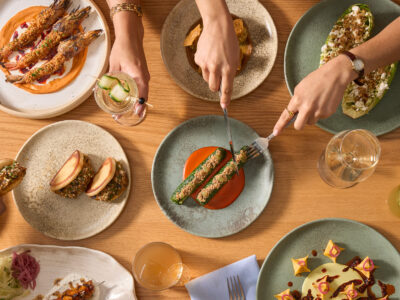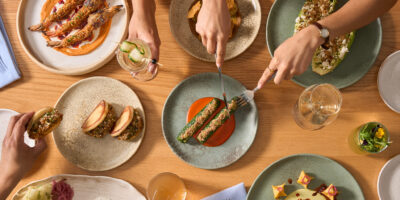

Above: Last fall, Longwood Gardens’ 1906 restaurant reopened in a new space overlooking the fountain display. Everything from the cocktails — there is now a bar — to the cuisine pays homage to the Brandywine Valley attraction. Photo by Evan Sung.
By Pam George
Barbara Cairns felt as though she was in a restaurant in another country. Italy, perhaps? Or maybe Portugal? She and two friends soaked in the cosmopolitan atmosphere while sharing a creamy pâté. And when Cairns finished her French omelet with Maine lobster and bearnaise sauce, she fought the urge to linger.
“I could have sat longer,” says the Kennett Square resident. “It was like being in good Parisian bistros.”
However, there were gardens to explore. The ladies dined in the recently relocated 1906 in Longwood Gardens, which has received positive reviews from many guests.



“I went with my husband in December, and it was delicious,” says Heather Cox of Newark. “The chef came out and sliced truffles onto the mushroom soup, which was excellent. The space is beautiful.”
February is an ideal time to taste the difference. For one, the highly anticipated 32,000-square-foot West Conservancy is a warm, colorful refuge in winter. For another, admission tickets for Longwood’s Winter Wonder season (Jan. 17-March 23) are discounted at $25 for adults (ages 19-64), $22 for seniors (ages 65+) and college students (with valid ID), and $13 for youth (ages 5-18).
The discount is welcome considering 1906 is not a cheap eat. You’ll pay $49 for halibut and $27 for a cheeseburger. But the view of the fountains and atmosphere are worth top dollar.
“It has a New York vibe,” says seasoned hospitality veteran Xavier Teixido of Harry’s Hospitality. Bill Irvin of Snuff Mill Restaurant, Butchery & Wine Bar praises the wine list, which you can peruse in the 40-seat lounge or at the 24-seat bar.
In short, there is nothing like 1906 in the Brandywine Valley — or the Greater Philadelphia area, for that matter.

Halibut in miso-beurre blanc sauce flecked with roe is under the Fauna/Ocean menu sections. Others include Flora and Funga (mushrooms and truffles). Photo by Pam George.
An Integrated Work of Art
It’s not surprising that 1906 has a New York state of mind. New York-based Restaurant Associates manages Longwood’s food and beverage program, while New York-based Weiss/Manfredi designed Longwood Reimagined, which covers 17 acres and includes the new conservatory, the restaurant and an adjoining event space.

The new 1906 at Longwood Gardens has a private table with a prix fixe menu. There is also space for a bar and lounge. Photo by Becca Mathias.
“We started this incredible adventure with Longwood over a decade ago,” says Weiss/Manfredi cofounder Marion Weiss. “At that time, we worked with Longwood to create a masterplan that would better illuminate the gifts of the cultural campus, bringing Longwood into the 21st century and expanding the visitor experience with a rejuvenated marriage of landscape and architecture.”
The project encompasses the Cascade Garden, Bonsai Courtyard, Waterlily Court, Orchid House and The Grove, a collection of art and learning studios, offices, and a library. When the designers pondered the relocation of 1906, they nixed the idea of a freestanding building that might block views. “We chose a more radical approach,” says Michael Manfredi.
Indeed, workers moved thousands of cubic yards of soil behind a retaining wall to a nearby meadow. In short, they carved out rooms under the conservatory terrace to accommodate the 6,100-square-foot restaurant and 5,184-square-foot event space.
The new rooms have arched windows floor-to-ceiling windows fronting the main fountains. (Those in the back can watch the waterspouts in the rear bronze-framed mirrors.)
Form and Function
The new 1906 has 240 seats — 100 more than in the previous location in the Terrace building, which still holds the café. The fine-dining section was renamed 1906 in 2009 to mark the year Pierre S. du Pont purchased the property. Without his intervention, rare tree species in the existing arboretum would have gone to a lumber mill.
Will Brown, the current culinary director, was 14 when he joined Longwood as a busser. After graduating from the Culinary Institute of America, he elected to stay with Restaurant Associates, which moved him to Atlanta before bringing him back to his hometown.
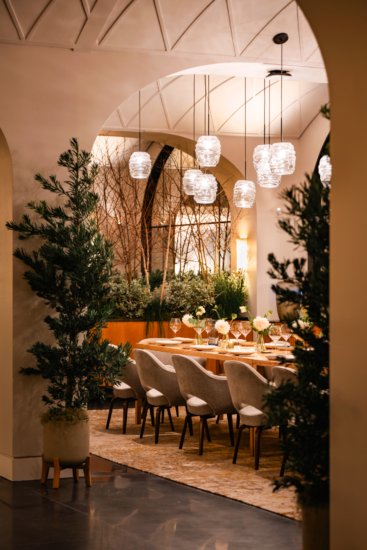
Arched entrances and a series of vaulted ceilings help manage the sound in 1906’s dining room. Photo by Holden Barnes.
Brown has been present for several restaurant renovations, but relocating 1906 is by far the grandest. Tremendous thought — and dollars — went into the restaurant’s creation, and the proof is in the details. Simply step into the walnut-lined reception area off a grand foyer, and you’re struck by a series of vaulted ceilings with a garden trellis pattern.
The vaults have a practical purpose: they distribute sound. “On the Friday after New Year’s, the place was packed, and the sound at our table was wonderful; we could hear each other well,” notes Cairns, who was seated in the middle of the dining room.
Shades of green are everywhere, from the fluted oak-backed banquettes to the foliage that defines the seating sections. Murals of the meadow reinforce the link to nature, and the throw rugs designed by Weiss/Manfredi resemble dappled light under tree canopies. Together, these elements produce a sense of ease and relaxation, even when the dining room is full of families.
The room could appear fussy between the murals, the velveteen pillows, and the growing case. Minimalistic Mid-Century Modern touches keep that from happening. Sleek wood tables were custom-made in cooperation with Delaware’s Challenge Program, a vocational training organization for youth. (The wood came from fallen Longwood logs.) Meanwhile, the mix of neat upholstered and rounded wood-backed chairs with clean lines would look home on a Mad Men set.
Flora, Funga and Fauna
Behind the scenes, famed designer Jimi Yui and Chef Ed Brown went to work on the kitchens. “Even in New York, it would be the greatest kitchen ever constructed for a restaurant — period,” says Gareth Tootell, regional director of operations at Restaurant Associates.
The 15,000-square-foot culinary space has dedicated places for production and finishing. For instance, halibut is butchered and portioned in the production area and cooked and sauced in the finishing kitchen. Broths, vinaigrettes and baked goods are all prepared in the production kitchen. Meanwhile, the expansive cooking line gives cooks plenty of elbow room.
Chefs and cooks use high-end Hestan pots and pans (a 10-piece set can retail for $2,670). “We have every bell and whistle you can imagine,” says Executive Chef George Murkowicz. “I’ve had creative freedom at other places, but this is the first time I feel like the sky is the limit. You can tell everyone is energized.”
He relishes ordering fish during peak season and serving it with fresh vegetables from the kitchen garden about 100 yards from the kitchen. In front of the restaurant and Fountain Room are 600 sage, rosemary and thyme plants for quick cuttings.
Not surprisingly, Longwood is a Certified Green Restaurant through the Green Restaurant Association. To become certified, a restaurant must earn points in several categories, including waste, energy, reusables and disposables and buildings/furnishings.
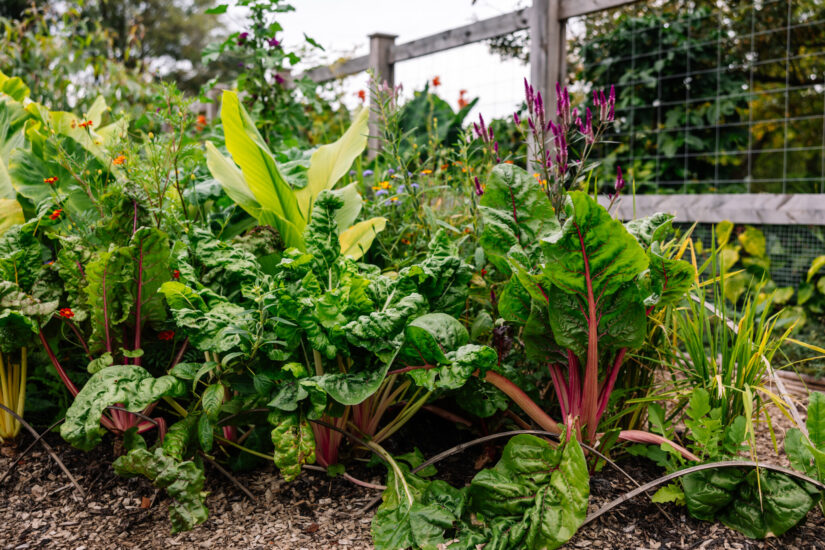
Chefs at 1906 can now leverage a kitchen garden in the Idea Garden. Planters in front of the restaurant hold herbs. Photo by Becca Mathias.
The food standards include points for food grown on site, items sourced from within 300 miles, vegan and vegetarian fare, and sustainable products, such as seafood. Longwood’s menu reinforces the brand, starting with the clever menu sections. Flora, for instance, includes must-try pull-apart brioche covered in garden seeds and sunflower seed “risotto” with ancient grains, blood orange and a poached egg.
Funga is all about mushrooms, and this season, winter black truffles have joined a mushroom Wellington and a bisque with hen of the woods, shiitake and black trumpet mushrooms. Fauna covers seafood and beef. Can’t decide? The $90 five-course chef’s tasting menu covers all three bases.
While the winter menu debuted last month, some items carried over. Take, for instance, halibut in a delicate miso-beurre blanc sauce topped with trout roe. However, the kitchen has a more restrained approach with the roe, and the sauce is flecked with fine herbs. Naturally, there is a crab cake.
Even the cocktail program changes throughout the year. “We really wanted to lean into the seasons, not just with fruits and vegetables, but also with color,” Tootell says. “Everything is intentional.”
An Evolution in Eden
When the restaurant opened in October, it served 300 guests a day. In short order, that number swelled to 700. Consequently, the staff has doubled. The more time spent in the expansive space, the more comfortable they get, says Murkowicz.
“We now have a better understanding of our business needs and how to prepare for them,” he says. For instance, the kitchen overestimates the amount of food needed on any given day to ensure there is enough.
The kitchen also handles an 18-seat private table with a prix-fixe menu, and there are special events. Consider the Valentine’s Day prix-fixe menu at $150 per person, which will be offered Feb. 14-16. Guests have course options. For instance, the main entrees are Wagyu strip loin and king crab, poached monkfish with scallop mousseline or trofie pasta with taleggio fondue. Hours will be extended during the weekend.
Dining at Longwood still includes The Café, where the traditional mushroom soup is served.
In warm weather, the Beer Garden is an extension of The Café dining rooms. During peak periods, there are concessions throughout the property, Brown notes.
Regardless of where you dine, you will experience the beauty that makes Longwood a destination. Winter Wonder, which runs until March 23, showcases the new West Conservatory. Additionally, Longwood features a roster of classes, seminars, and performances this month.
— More at LongwoodGardens.org