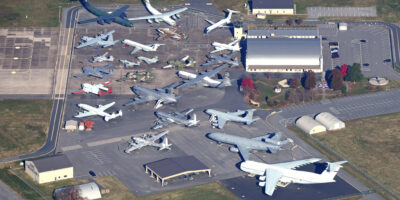

Above: Aerial photo of the many aircraft on display at Dover’s Air Mobile Command Museum. Photo courtesy AMC Museum.
Second in a Three-Part Series: The Route Along Kent County
By Jim Miller
Heading to the beach this summer? Take in these sights along the way and ponder the related tales about a museum with secret, freedom-seekers, and the ghost of a Founding Father.
On the road again…
In this series’ debut last month, we spelled out the problem: The drive to the beach can be arduous — taxing on you and any passengers you have along for the ride.
It’s not so much the mileage as it is the traffic, which can often test the patience of a saint (even St. George, the dragonslayer whom we discussed last month).






Our prescription for the maladies that road congestion brings: The art of conversation and storytelling. Both can take people’s minds off wherever they are at that moment, make their imaginations run wild, and maybe even inspire them.
With that we come to the stories along Route 1 in Kent County. Like last month’s focus on the wild waypoints in New Castle County, this one offers some tales of heroes of the Revolution and pirates — as well as a few more historical surprises.
Half a Billion Pounds of Apples
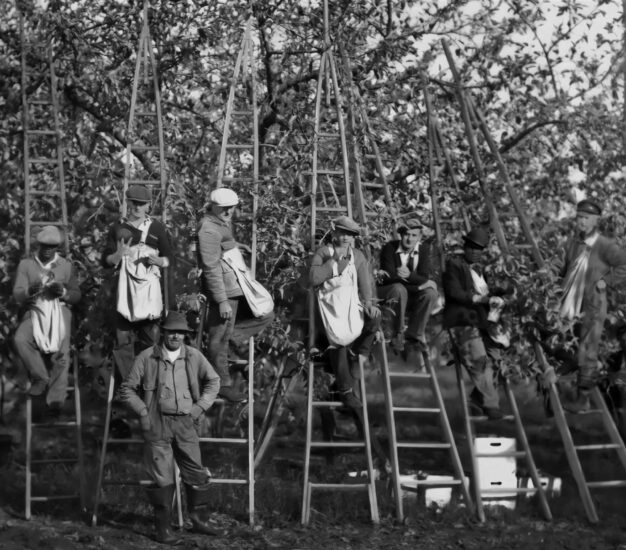
Workers at the W.L. Smith Orchard in Cheswold in 1932, back when state was a major apple producer. Photo courtesy Delaware Public Archives.
Over the county border, and just a few miles before you start to feel the rumble of the Dover Speedway during a NASCAR race, you’ll pass through mild-mannered Cheswold, a small town that once had a big reputation when it came to trees. In fact, the town’s name comes from the chestnut trees that grew near the train station back in the 1880s.
However, in the first half of the 20th century, it wasn’t the chestnut trees that defined Cheswold as much as it was apple trees. The town was virtually surrounded by thousands of acres of orchards.
It was a time when apples represented 15 percent of Delaware’s annual crop revenues. Massive shipments of Delaware apples were exported up and down the East Coast and as far north as Canada. The state’s industry would peak in the ‘40s, with one year’s yield topping 550 million pounds.
For reference, the state’s most recent annual yields have been around 15 million pounds — about 3 percent of what they once were.
A Branch and a Path to Freedom
One of the major water sources for those once-plentiful Cheswold orchards was Alston Branch, which currently flows under Route 1 then feeds into the Leipsic River. Alston Branch gets its name from John Alston, who owned farmlands farther north in Middletown in the 1800s, as did his cousin, John Hunn.
In addition to being Quaker farmers, both Alston and Hunn were well-documented operators of the Underground Railroad. And both men often assisted Samuel D. Burris, a free Black man from Kent County who also worked as an Underground Railroad conductor in the 1830s and ‘40s.
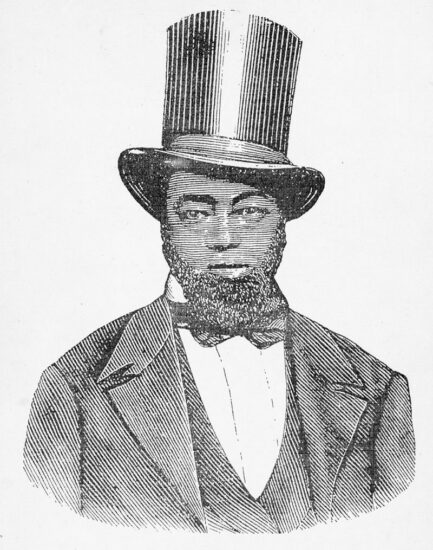
Samuel Burris was one of the conductors of the
Underground Railroad honored in a 2015 ceremony. Image courtesy Delaware Historical & Cultural Affairs.
Trudging through a snowstorm one fateful night in December of 1845, Samuel Hawkins and his recently freed family of seven followed Burris over the Maryland-Delaware border to find refuge at John Hunn’s farm, the southernmost stationhouse in the state. Unfortunately, before their arrival, they had been spotted.
At the farm, while tending to frost-bitten feet, the freedom-seekers were caught off guard when bounty hunters came knocking. The family was captured and later taken to jail.
Thanks largely to the intervention of Wilmington Quaker and Underground Railroad conductor Thomas Garrett and his lawyer, the Hawkins family was released on a judge’s orders. They found permanent freedom soon afterwards in Pennsylvania.
Garrett and Hunn would pay a hefty price for helping. Both suffered financially when they were sued by the owners of the former slaves. Garrett was able to pay for the damages brought against him; however, Hunn was left penniless, forced to part with his farm and other assets.
Regardless, both men continued their work helping escaped slaves find freedom.
“I ask no other reward for any efforts made by me in the cause than to feel I have been in service to my fellow-men,” Hunn wrote in 1872.
Yet, in a manner of speaking, Hunn did get some rewards, albeit posthumously. In 1900, six years after Hunn passed, his son John Hunn Jr. was elected governor of Delaware.
And, in April 2015, in a ceremony in front of Middletown High School, both Hunn and Alston were memorialized with state historical marker NC-210, which testifies to their contributions to the Underground Railroad.
The 2015 ceremony also saw the unveiling of two memorial benches: one commemorating the efforts of Burris as a conductor on the Underground Railroad, and the other honoring the Hawkins family’s path to freedom. During the ceremony, their histories were highlighted by members of the Toni Morrison Society.
These two benches — and others like them — are the centerpieces to the society’s Bench by the Road Project and commemorate “significant moments, individuals, and locations within the history of the African Diaspora.” Since 2008, the society has dedicated a total of 33 benches at sites across the country and one in Paris, France.
Middletown is the only site that has two benches.
A Museum Built Upon a Secret
Almost as soon as you get into Dover, you’ll start to see signs for the AMC Museum, which most likely will have you wondering: What exactly is the AMC Museum?
Although the museum has nothing to do with the major cinema chain, the story of its location could be something out of a movie. Driving south, you’ll see the Air Mobility Command Museum (AMC) to your far left as you depart Dover Air Force Base. From Route 1 you might be able to spot some of the 35 aircraft on display.
Admission is free, and up close, one can see the true elegance of older and smaller craft, like the L-2M Grasshopper, or the great size of the museum’s giants, like the C-5A Galaxy.
The AMC is the only museum in the world dedicated to airlift and air refueling history. It is also probably the only museum to utilize the space once used for a top-secret headquarters.
That’s right: As noted by state historical marker KC-88, for two years starting in 1946, Hangar 1301 served as a covert engineering facility for the development and testing of air-launched rocket weapons.
To visit the AMC Museum from Route 1, you’ll need to take Route 9 at exit 91, which is the same exit for Kitts Hummock, as the highway sign indicates. And just as you wondered what the AMC stood for, you’ll probably wonder at this point: What exactly is a Hummock?
Turns out a hummock is a small knoll or mound above ground elevation. And that fact might be the most straightforward part about the name Kitts Hummock — as we will soon find out.
But, first, a ghost story…
The Ghost Writer from 1776
Roughly a minute’s drive off Route 1, down Kitts Hummock Road, you’ll reach the entrance to the John Dickinson Plantation.
Being one of the wealthiest people living in the British American colonies didn’t stop Dickinson from risking his own neck. In December 1767, and during the four months that followed, Dickinson wrote and published a series of popular essays called Letters from a Farmer in Pennsylvania, which criticized Britain’s colonial policies, particularly taxation. Dickinson would go on to write the first draft of the Articles of Confederation in 1776 and, as a delegate from Delaware, he signed the U.S. Constitution in 1787.
As a result of his contributions, Dickinson earned the reputation as the “Penman of the Revolution.”
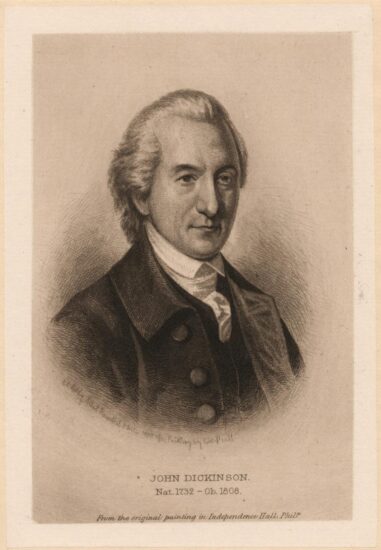
Founding Father John Dickinson, who some believe still haunts his old plantation. Image courtesy Delaware Public Archives.
Yet a question lingers: Did the Penman ever stop writing?
It’s been said that in Dickinson’s mansion, Poplar Hall, the sound of a quill scratching on parchment paper has been heard in the former den of the Founding Father. There’s more: Caretakers, historians, and visitors alike have reported shadowy apparitions in colonial attire, the sounds of footsteps and/or faint voices on the premises, and locked doors that mysteriously become unlocked.
Is the ghost of John Dickinson also readying for the 250th?
The ghost-hunting website Beyond Haunted draws another conclusion: “There is no clear evidence that John Dickinson’s spirit haunts the house, and historians are careful to avoid making that claim. However, some believe the [ghostly] activity could be connected to people who lived and worked on the land, rather than its most famous owner.”
Here it’s important to note two things about Dickinson: First, he owned as many as 59 slaves, making him one of the largest slave owners in the Delaware Valley. Second, following in step with early Quaker abolitionists, between 1777 and 1786, Dickinson emancipated every one of those slaves. In freeing all of his slaves within the span of his lifetime, he carries the sad distinction of being one of the few Founding Fathers to do so.
“What will be said of this new principle of founding a Right to govern Freemen on a power derived from Slaves?” Dickinson asked his fellow freedom fighters at the 1787 federal constitutional convention.
It’s a question that still haunts our country 239 years later.
A Pirate’s Private Beach?
For such a small place, Kitts Hummock sure has stirred up a lot of conflicting points of view — for historians, at least.
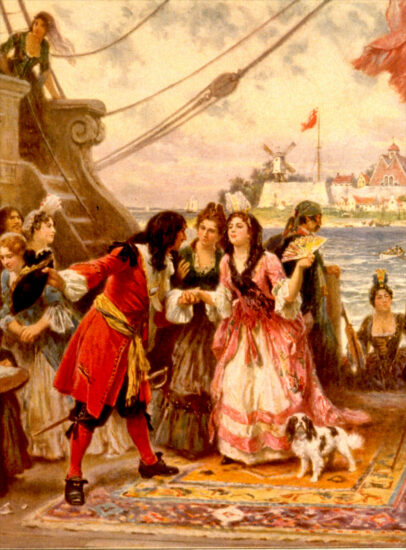
Captain William Kidd, the “gentleman pirate,” greets passengers aboard his ship, as depicted in an oil painting by J.L.G. Ferris. Image courtesy Library of Congress.
Legend has it the original name for Kitts Hummock was “Kidd’s Hammock,” with “hammock” being a name once used for a raised grouping of trees within a marshy area, and “Kidd” being a reference to Captain William Kidd (who popped up in last month’s segment as well, you might remember).
The Hammock part is true. In the 1888 book History of Delaware, J. Thomas Scharf recounts that on Jan. 5, 1738, Delaware Supreme Court Judge Jehu Curtis “took up a small tract of fast land and some march containing twenty acres named ‘Kitt’s Hammock.’”
But as for it once being Kidd’s Hammock before then?
Some noteworthy people have believed it’s possible. Alice Denny, the wife of Gov. William Denney, who served from 1921 to 1925, once wrote, “Tradition has it that Captain Kidd of pirate fame chose the hammock long years ago as a fine burying place for treasures captured off Delaware’s shore.”
Delaware author Hazel Wright Reynolds offered another possibility. In her 1982 book, Flower of Caroon Manor: History of Magnolia, Little Heaven, St. Jones Neck, Kitts Hummock, Reynolds wrote: “Former historians have taken it for granted that the name Kitts is a corruption of ‘Kidd’ — there is evidence to the contrary. As early as 1660, it was noted that the native Indian name of the Delaware River was Kit-hanne, meaning ‘great river.’ The Mohawks of New York State called the Delaware River the Maquas-Kittan.”
Whatever the case may be, please know that Captain Kidd will make another appearance in the final chapter of this series next month — perhaps not in a hammock, but definitely somewhere just off the coast of Southern Delaware.
Until then: Safe travels and enjoy the ride!
“The Wild Waypoints of Route 1” series is brought to you by: