

Above: Most of the 1001 podcast crew convened for a concert in the state of Washington last September. From l-r: Tom Monaghan, Allan McKinley, John Magrans, Marty Walsh, Rob Kassees and Phil Matarese. Photo provided.
By Matt Morrissette
Iconic pop artist Andy Warhol’s famous quote, “in the future, everyone will be famous for 15 minutes,” has proven true time and again — even as culture (driven by technology) has changed at lightspeed. In the current cultural landscape, it’s perfectly reasonable to speculate that Warhol might add the footnote, “or have a podcast.”
This is no surprise as the podcast is a perfect form in this era of convenience and solitude. One can listen on a walk, in the car during one’s commute, at the gym, or on a couch with earbuds in while a significant other binge-watches Netflix.
In the era of “content creation,” podcasts are as cheap and easy to make as they are to find and digest; and the format lends itself beautifully to most any human need or desire: true crime for voyeurs, how-to’s for the home improvement-challenged, self-help for the lonely or isolated, deep music or movie discussions for those seeking cultural connection, and so on.

It was a mutual obsession and bond over music (and the pandemic scaries) that led a group of Delawarean friends into the podcast space more than four years ago. From humble beginnings in a group text chain jokingly discussing The Doobie Brothers’ “What a Fool Believes” and its yacht rock magnificence, a bonafide podcast was born.
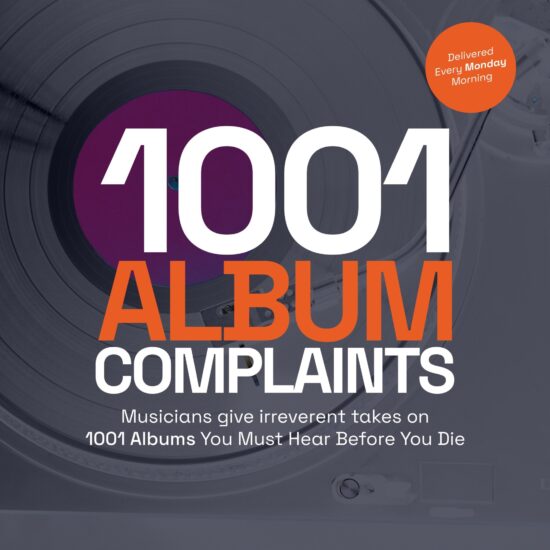
Drawing inspiration from the reference book famous among music aficionados, 1001 Albums You Must Hear Before You Die, the group launched a podcast hoping to provide the informative elements of an NPR broadcast coupled with freewheeling comedic flare. They called it 1001 Album Complaints.
The format in a nutshell: Musicians research and tell the backstory behind classic albums chosen randomly from the 1001 Albums book, pick them apart (as musicians do), then vote on whether you really need to hear these albums before you die.
This motley crew of Delaware natives features Phil Materese and Allan McKinley of local rock band MEGA, along with Rob Kassees, Tom Monaghan, Adam Laskowski and Marty Walsh. All are in their mid-40s and have known one another since attending University of Delaware or high school — a few since grade school. This shared history gives the leads to easy rapport and a shared sense of humor that gives the podcast its joy, warmth and humanity.
Kassees, who currently works in software development and resides in Sacramento, California, was looking for a project that satisfied his longtime interest in podcasting while getting to spend time with friends.
“I happen to be an early adopter of podcasts (as a listener) so I’ve always wanted to find a good angle for one, and when my co-host Tom (Monaghan) pitched me this idea of connecting to the 1001 Albums book, I thought it was a great way to do something sustainable,” says Kassees. “The co-hosts are my oldest and closest friends — all musicians, all guys I met either in high school or at UD, all Delawareans. Music was the glue that brought us together initially, and since then, we’ve played in a series of bands together on both coasts and are now (mostly) geographically separated. In short, we’re old friends that use the podcast as a great excuse to talk to each other across distance and to experience new music together like when we were teenagers.”
Matarese, who contributes axe and vox to Delaware’s own four-guitar army known as MEGA, is something of a podcast rookie, but he has a keen eye for the special qualities that the various members of the group bring to the table. After describing himself as the “most likeable and funniest (looking),” he elaborates.
“Kassees brings leadership, organization, and forward momentum. Monaghan (currently in California) has an encyclopedic memory and has strong opinions that he will defend to the death. Laskowski (a Pennsylvania resident) provides tech support and has the most diverse musical tastes. McKinley (Delaware) is a deep researcher and instigator. Walsh (currently in Oregon) has a strong point-of-view, excellent one-liners, and provides hipster credibility.”
Kassees says the group used their longstanding friendship and love of music as the foundation for the podcast.
A crucial element in the creation and growth of 1001 Album Complaints is Kassees’ studious fandom of the podcasts he loves and that formed his tastes in the medium.
“I love a lot of podcasts, but some of my favorites are Freakomonics, RadioLab, and This American Life. I also love comedy podcasts like Bad Friends, Your Mom’s House, and Conan O’Brien Needs a Friend,” Kassees says. “I’ve spent time with lots of podcasts over the years, and I had a clear idea of what I wanted out of our show; and it was to cross a well-researched, well-produced, story-driven show with a lighter, more conversational comedy podcast amongst friends. At the heart of all those comedy podcasts is a complicated and deeply personal relationship. I think that probably tells you a lot about me and about our show.”
Since the podcast’s start during the pandemic in 2021, podcasts have become as ubiquitous in the culture as reality shows on television and the medium’s marketplace as crowded as a Trader Joe’s on Sunday. This is a fact that Kassees has observed, yet he remains undaunted.
“Like in any saturated market, there’s a lot of people who are either barely trying or just not very good at it,” Kassees says. “ I respect anyone who is putting in the work, even if they sometimes fall short. Conversely, I have almost no respect for anyone who thinks just popping a mic in front of two people (famous or not) is enough to sustain my interest. I’m proud to say that 1001 Album Complaints is not ‘another show where middle-aged guys chatter on and on’ — we’ve honed our craft, created recurring segments, improved at writing material like our tweet length reviews, and we do legitimate research to prepare for every show.”
Distributed to all podcast platforms like Apple, Amazon, and Spotify, the podcast has found its footing after overcoming a first-year learning curve and has continually grown its listenership over the subsequent years to average around 60,000 per month, says Kassees. The show even has a paid Patreon presence where members discuss and debate each new weekly episode. At present, 119 of those are paid subscribers, with 387 members overall.
With so many podcasts to choose from (particularly music-related), it’s challenging for even a good show to find and connect with its intended audience, but Kassees seems to have figured out how 1001 Album Complaints has done just that.
“Our show’s secret sauce is definitely our decades-long friendship — that’s the part you can’t manufacture. We just got lucky and built around that strength.”