
Eric Sugrue is the restaurateur who can navigate both the beach and Wilmington
Eric Sugrue is an entrepreneur who relishes testing the water. His Big Fish Restaurant Group owns establishments from the resort town of Rehoboth Beach to the affluent suburb of Glen Mills, Pa. The newest, Trolley Square Oyster House, is located in the former home of Satsuma and the Del Rose Café, and he’s put the wheels in motion to build Taco Grande Mexican Grill and Tequila Bar on the Wilmington Riverfront.
Sugrue, who has lived at the beach since he was 7, has successfully navigated two diverse culinary scenes: the highly competitive—and seasonal—coastal market and the notoriously fickle New Castle County market. And as any restaurateur who’s tried it can tell you, that’s no easy feat.
“Eric is an example of a restaurateur with vision who’s not afraid to take chances and explore other markets,” says Scott Kammerer, president and CEO of Rehoboth Beach-based SoDel Concepts, which owns eight—soon to be nine—restaurants. “Big Fish Grill continues to be a successful concept, year after year, and he’s taken existing restaurants like Salt Air and Summer House to the next level.”
Sugrue is passionate about quality, says Steve “Monty” Montgomery, president of the Delaware Restaurant Association board of directors and a partner with Sugrue in Nick’s Fish House in south Baltimore. “When you dine in one of his establishments, you know you’re getting fresh, quality ingredients—not something that has been frozen or been sitting around,” says Montgomery, who also co-owns several Delaware restaurants, including the Starboard and Bethany Blues.
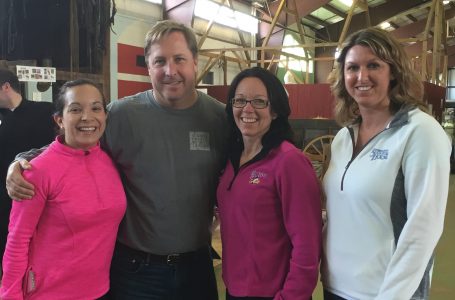
Sugrue with, from left, Lisa Breedlove, director of operations for northern locations, Holly Monaco, vice president &
COO, and Amy Polend, director of operations for southern locations. (Photo courtesy of Eric Sugrue)
Sugrue’s knack for finding the right market, the right location, and the right concept is rooted in experience. He was 13 when he became a busboy in a Rehoboth Beach restaurant. After earning a degree in business from the University of Delaware, he joined the Knoxville, Tenn.-based Cooper Cellar Restaurant Corp., owned by a family friend, which had several chain restaurants.




In 1997, Sugrue and older brother Norman Sugrue Jr. pooled their money, borrowed from family and friends, and took out a bank loan to open Big Fish Grill in a building that once housed The Crab House. An adjoining market—which offers proprietary sauces, spice mixes, fresh fish and vegetables, and takeout—followed.
Big Fish swam upstream in 2009 with the opening of a Riverfront location, which sits next to Iron Hill Brewery & Restaurant, and establishments began popping up in quick succession. FireStone Roasting House followed just around the Christina River’s bend, and a third Big Fish opened in 2010 next to P.F. Chang’s in the Brinton Lake Shopping Center in Glen Mills. Both serve the well-heeled shoppers who’ve maxed out their credit cards at J. Crew, Talbots, Pottery Barn and Anthropologie.
Although they have a similar décor—complete with nautical colors and mounted fish—the three Big Fish Grill restaurants have dissimilar layouts and individual attitudes. “We never intended them to be the same,” Sugrue says. “They’re different based on the demographics and the personality” of the location.” One has only to attend a lively happy hour in the Rehoboth location’s tiki-inspired bar, which did not carry over to its sister locations, for proof of that. It’s a far different vibe than the more sedate outdoor dining area in Glen Mills.
Always on the lookout
Sugrue is always on the lookout for new sites that can handle another Big Fish Grill, but they’re not easy to find. The concept and its larger-than-life décor won’t work as well in a small space. There’s another reason why Big Fish suits a large structure. Volume is a plus, given that seafood has a slim profit margin. To help cut costs and offer affordable menu items, the Big Fish Group opened a wholesale division, which also sells to other restaurants.
Not content to build a restaurant or concept from scratch, the Big Fish Group in 2006 purchased the iconic Summer House, where Sugrue had once worked. A Rehoboth Beach landmark since 1977, the restaurant had become a popular watering hole. The group also purchased Salt Air on Wilmington Avenue, which had opened to raves and then stumbled when the owner became ill.
Taking over an existing location has its own challenges. “You’re either trying to change its reputation or build upon it,” Sugrue says. “When we bought the Summer House, it was mainly known for burger night, Long Island iced tea night, $2 Miller Lites. They weren’t focused on food. We changed that. Now the bar complements the dining and the dining is not secondary to the bar.”
Salt Air was a great concept that wasn’t well executed, he says. Guests, vendors, and the staff had eventually soured on the restaurant in the owner-operator’s absence. “Taking that over was interesting,” he says dryly. But he was up to the task. Walk past the restaurant’s bank of glass windows even in winter and you’ll see packed dining rooms. There’s a lengthy waiting list come summer.
The 2014 opening of The Crab House in Rehoboth Beach, named for the first Big Fish’s former occupant, brought another seafood restaurant into the fold. Some may have considered it a risk, given that the Route 1 site had a series of failed restaurants. Sugrue, who owned the building, was tired of finding new tenants so he opted to open his own here. It initially was closed in the off-season. As of this summer, it’s now open all year except for a planned three-week hiatus.
A seafood menu creates high expectations and potentially high wholesale cost; people will only pay so much. And in a seafood restaurant, you can’t recoup the costs with veal specials—they largely go unnoticed. An Italian eatery, Bella Coast, built from the ground up next to the Charcoal Pit on Route 202 in Wilmington, was a logical addition to balance the restaurant group’s offerings. That will also be the case with Taco Grande Mexican Grill and Tequila Bar, the 6,000-square-foot restaurant that should open this year between Iron Hill Restaurant & Brewery and Big Fish Grill on the Riverfront.

General Manager Erik Holzbaur and Big Fish Group Director of Operations Lisa Breedlove
at Trolley Square Oyster House, which Sugrue hopes will become an intimate neighborhood
hotspot. (Photo by Joe del Tufo)
Testing the Trolley Square waters
The Trolley Square Oyster House is a return to Big Fish’s roots, however, Sugrue sees this space as more of an intimate neighborhood hotspot. “We want it to be a great little restaurant with high quality food. It will be a fun place to go all the time. I have a feeling that the same people will keep coming back, just like all the other places in Trolley Square. We really want to bring back the feel of the Del Rose, which had a very loyal clientele.” (One hopes the Del Rose’s chopped salad might appear on the menu.)
Those familiar with Satsuma will find new paint, lighting, and flooring. The footprint remains nearly the same—the space is only 15-feet wide, he notes. “We’re really just redoing what was there.” There’s now a raw bar, where you can slurp oysters and watch the shuckers.
As is the case with SoDel Concepts and Iron Hill Brewery & Restaurant, the Big Fish Group expands in part to promote and keep longtime employees familiar with the business. This year, Sugrue plans to put a food truck on the road that will pull from all the group’s menus. In addition, Big Fish now has Market Craft, a catering service that delivers food for a minimum of 20 people.
So what’s next? “No clue,” he says. “I don’t wake up in the middle of the night saying, ‘God, I want to open an Indian restaurant.’ I’m not a chef, and I don’t live in New York City, where if you offer quality food they will come.”
But you can bet that he’ll come up with something. “Eric is competitive with himself to find the absolute best way to put quality options in front of his customers for a great value,” Montgomery says. “Trust me. I’ve been eating with the guy for nearly 30 years; I owe him for 20 of these pounds in my own belly!”