
Above: Christiana Hilton’s proprietary bourbon, a collaboration with Maker’s Mark. Photo by Jim Coarse.
By Pam George
When you think of bourbon, you might picture Southern socialites at horse races. Or perhaps you envision a clubby tableau with a rocks glass, cigar and roaring fire. But bourbon is not limited to juleps, men’s clubs — or the South, for that matter.
In Delaware, fine restaurants hold bourbon dinners. Barbecue and burger restaurants tout extensive collections, and trendsetting bars serve creative bourbon cocktails. Now a hotel is getting in on the action. On Wednesday, June 11, whiskey lovers will gather at the Hilton Wilmington/Christiana in Stanton to try the hotel’s proprietary bourbon, a collaboration with Maker’s Mark.
Bourbon’s popularity isn’t ebbing anytime soon. “I don’t think it’s going anywhere,” agrees Ryan Minnick, a bartender at Bethany Blues in Lewes and Stingray Sushi Bar in Rehoboth Beach. “Restaurants have at least one or two bourbon or rye cocktails on their specialty list, no matter the concept. Everyone is trying to get their hands on as much as possible.”


Born in the USA
A distinctly American product, bourbon is in the whisky or whiskey family. Generally, whisky without the “e” comes from Scotland, Canada and Japan. Only whisky from Scotland is Scotch, and there are five regions: Speyside, Lowland, Highland, Campbeltown and Islay. In the United States and Ireland, whiskey with the “e” is favored. However, both spellings are considered correct.
The Scots and Irish brought their distilling skills to the New World, and in Kentucky, corn was an easier crop to grow than barley or wheat. Some maintain that the name comes from Bourbon County, Kentucky. Others point to Bourbon Street in New Orleans. Regardless, the mash must be at least 51 percent corn, which adds a note that appeals to bourbon aficionados. “It’s an all-natural sweetness,” explains Minnick, also a consultant.

Christiana Hilton manager Nikki Pierce traveled to Kentucky to get a first-hand look at the process. Photo by Jim Coarse.
Only bourbon made in Kentucky is true Kentucky bourbon. Compare it to sparkling wine from France’s Champagne region; if it’s not from that area, it’s not Champagne. However, bourbon can be made anywhere in the U.S. if the distilleries follow the rules.
“Pennsylvania is making great whiskey, and so is Chicago,” says Nick Georigi, who oversees the beverage program for Platinum Dining Group.
Bourbon is aged in new charred oak barrels or casks. The aging process is anywhere from four to six years, and anything after that is “luxury,” Minnick says. Some bottles contain bourbon from several barrels, while a single barrel refers to one source for the bottle. Small-batch bourbons contain a small amount from hand-selected barrels. They’re curated, if you will, for flavor.
The Personal Touch
To be sure, people passionate about bourbon do their research, which is how Nikki Pierce, the manager of the Hilton’s Market Kitchen & Bar, learned about the private select program. She and the hotel’s executive team traveled to Kentucky in January for a Maker’s Mark tour and tasting. “It’s an in-depth process,” she says.
David Dietz would agree. He followed the same steps to create the BBC Tavern & Grill Reverie Reserve, which was also made with Maker’s Mark.
“They take you to this beautiful tasting room on the side of a mountain, overlooking the water they use,” says Dietz, who owns BBC Tavern and Bar Reverie, sister restaurants in Greenville. The base bourbon is Maker’s Mark 46, which is aged with French oak staves, the narrow strips lining a barrel.
Participants then tasted samples treated with different kinds of wood. Some are charred with charcoal and others with UV light. “You see which ones you like, and then they’ll blend it for you,” Dietz explains. “Then you take a taste. You can spend hours doing it.”
In the rack house, representatives take the ring off a barrel, insert the selected staves into the bourbon, recap the barrel and replace the ring. “You sign the barrel with a big marker,” Dietz says. “That’s yours.” He waited several months for the additional aging process to create the flavor. The product was so well-received that he’s ordered more and plans to time his orders so he doesn’t run out.
In 2020, Minnick participated in the quest to develop The 100 for Bethany Blues. The name was inspired by the team’s $100 wager who could put together the winning blend. The product was a hit.
“It sold so fast that we bought a second barrel with the same recipe,” Minnick recalls. Bethany Blues has also collaborated with Eagle Rare and Woodford Reserve.
Steeped In Bourbon
When it comes to selection, many Delaware restaurants have remarkable offerings. For instance, Bethany Blues has more than 120 whiskeys, more than 50 of which are in the private stash collection. In large part, that’s because whiskey and bourbon pair well with spicy, sweet barbecue. Similarly, Limestone BBQ & Bourbon in the Stanton area has more than 200 bottles and plans to hold Father’s Day dinners this month. (Check the website for details.)
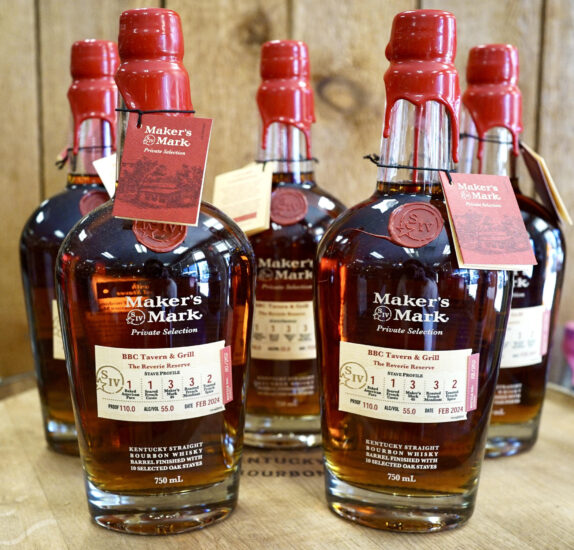
BBC Tavern & Grill’s Reverie Reserve. Photo courtesy BBC Tavern.
Bourbon pairs well with more than barbecue. Take steak, for instance, which explains why bourbon sells well at RedFire Grill. The Hockessin steakhouse holds annual bourbon dinners in the fall, limited to 50 guests. Farmer & the Cow’s tagline is “Burgers. Bourbon. Shakes.” The Wilmington restaurant carved out more space for its cache in its new 801 N. Wilmington St. site.
In Newark, Home Grown Café’s impressive bourbon collection includes 1792 Wheated, a 10-year-old Eagle Rare, and a 15-year-old Russell’s Reserve. The selection might surprise you, given that the restaurant is known for appeasing vegetarians and people on special diets. But bourbon now crosses a variety of culinary concepts. For instance, Above the Dunes in Rehoboth Beach, a casual eatery with burgers and crab cakes, won a Best of Delaware award for its bourbon selection. Bar Reverie has held bourbon dinners pairing bourbon-smoked oysters with Blue Run Reflection II, a Kentucky bourbon. Caffe Gelato, an Italian restaurant known for its wines, has hosted bourbon dinners featuring Pappy Van Winkle, which is aged 10 to 23 years.
Sip And Sample
If you want to dip your toes into bourbon — or whiskey, for that matter — start with a flight. Minnick recommends taking a few sips of each before adding a drop of water or pouring it over an ice cube. Sip is the operative word.
Just ask Dan Young, who led a study abroad program in Glasgow, Scotland, that included drams of Scotch. New to the spirit, he downed his like a shot. “It was one of the few record-scratch moments of my life,” recalls Young, co-founder and owner of the Leadership Excellence Academy for Nonprofits. “Everyone within 6 feet of me at the bar turned and stared.”
Now he knows to smell the liquid with one nostril and then another and sip as though he has a straw. “You ‘chew’ it all around your mouth,” he says. Some people put a drop on their hands, rub them together, and inhale.
Young and his wife, Jill, founded the Wilmington Whiskey Club to share their interest with like-minded people. It was just after COVID-19, and people were eager to get out.
“Since the pandemic, it seems like there’s been an uptick in the love of testing different bourbons and having fun trying different ones,” says Kenny Bartholomew, general manager of Limestone BBQ.
The club holds events about twice a month, one of which typically involves a nonprofit. For instance, the club had a whiskey tasting at Faithful Friends’s New Castle location.
“We took a tour and got to pet the cats and dogs,” Young says. The club also held an event to benefit the 100 Black Men of Delaware organization, which promotes leadership, mentorship, positive health outcomes and economic empowerment.
“We want to hold monthly whiskey and wealth events at the Bridge Art Gallery on lower Market Street to focus on wealth-building and community,” he says.
There is a $199 membership fee, which covers the tastings. However, non-members can attend the events for a fee, usually $20. The Farmer & the Cow also has a whiskey club.

The popular Paper Plane at Capers & Lemons. Photo courtesy Platinum Dining.
Cocktails are another way to experience bourbon. Limestone BBQ makes a cherry Old Fashioned with Maker’s Mark and Luxardo Maraschino Liqueur. Another classic, the Paper Plane, is a hit at Capers & Lemons near Greenville, Georigi says. “It’s one of my favorite cocktails. If you’ve never had one, do yourself a favor and try it.” Capers & Lemons serves it with a tiny paper airplane.
Summery takes include Limestone BBQ’s bourbon-lavender lemonade with Bulleit Bourbon, lemon juice and lavender simple syrup. “We finish it with a fragrant lavender sprig, so you get the taste, smell and visual,” Bartholomew says. Bartenders also substitute bourbon in classic cocktails. For instance, Limestone BBQ features a blackberry mule with bourbon served in a copper mug.
Sister restaurants Eclipse Bistro and Hearth Kitchen share “A Total Eclipse of the Hearth,” a twist on an amaretto sour with high-proof bourbon. “It’s a frothy cocktail that balances the sweetness and tartness of the lemon and the bitterness of the Amaro,” Georigi says. “You’re really lifting and brightening it — even the color bright.”
From a rocks glass to a copper mug to a coupe glass, bourbon is clearly versatile. “Personally, I don’t think there’s any wrong way to drink bourbon,” Dietz concludes.