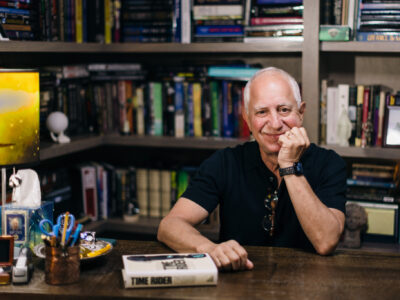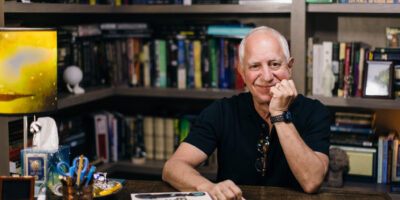

Above: Pacem co-directors (l-r): Carolyn Blitzer, Donna Jenkins, RaShana Pierce-Brown.
By Adriana Camacho-Church
Photos courtesy Pacem in Terris
Inside the Music School of Delaware in Wilmington, a piece of art framed in a black background stands out.
Created by 10-year-old Wynter Wilmore, the painting depicts a vase with flowers. It is her vision of what peace looks and feels like. It is painted in hues of mainly black, white, gray, and yellow.
“What inspired my art piece is showing love for my community and the beauty in life,” says the Kuumba Academy Charter School student. “The flowers represent these things because flowers are beautiful to look at and smell and can help you feel at peace.”


Wilmore is one of more than 560 students from 30 Delaware schools and organizations who submitted artwork for the Pacem in Terris ninth annual Visionary Peace Youth Art Exhibition. Colorful images of nature, earth, hearts, doves, people of different skin tones standing side by side, and a variety of other symbols, demonstrate what peace looks like to these artists ages 5-18.
Delaware Pacem in Terris, Inc. (Latin for “peace on earth”) is a Wilmington non-profit organization founded in 1967 during America’s conflict with Vietnam — a time of political and cultural division within the United States. It is the oldest and largest organization on the Delmarva Peninsula working for peace with justice.
Founded by an interfaith group of clergy and business leaders, the group aims to foster peace within ourselves and within our communities through programs and events that create connection and cooperation.
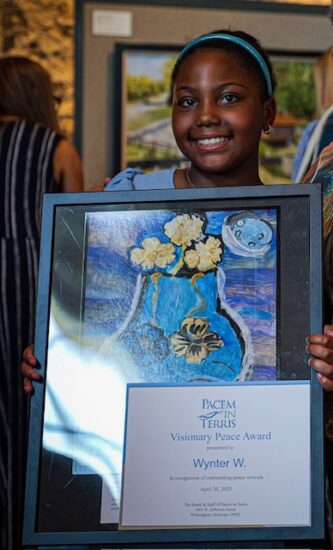
Kuumba Academy student Wynter Wilmore, 10, with a painting she created for Pacem in Terris’ current exhibition.
“Peace is not an abstract ideal,” says Carolyn Bitzer, co-director at Pacem. “It is something we live, breathe and build together. It starts in our neighborhoods, our schools and our hearts. At Pacem, art and education are powerful tools for transformation.”
Art is a vehicle for healing and social change, Bitzer says. “Youth visions of peace connect people. Connection matters because it helps us see that we are part of something so much larger than ourselves. It helps us understand what is common to us all, even as we respect one another’s differences. It motivates us to foster peace and well-being in ourselves, our communities, and the larger world.”
In 2017, the University of Pennsylvania released a study titled “The Socioemotional Benefits of the Arts.” Participation in arts programs was linked to improvements in youths’ tolerance for others’ perspectives. It showed that the arts boost emotional development, creative expression and mental health. The study linked the arts to safer communities, civic engagement, and social cohesion — creating a sense of belonging and shared values.
It’s estimated 200,000 viewers will visit Pacem’s art exhibition during this year. In 2024, the exhibition brought in more than 150,000 visitors.
We’ve seen a steady growth of viewers since the program began in 2016, says Bitzer. Since then, more than 4,000 students have participated.
From July through December school teachers and organizations submit the youths’ artwork to Pacem. In January, every piece of artwork is displayed at Wilmington Library.
Out of the hundreds of art pieces submitted, approximately 60 are selected by jurors for display throughout the year at 28 locations in Delaware. Jurors include the executive directors of The Delaware Contemporary and the City of Wilmington’s Office of Cultural Affairs, as well as local artists.
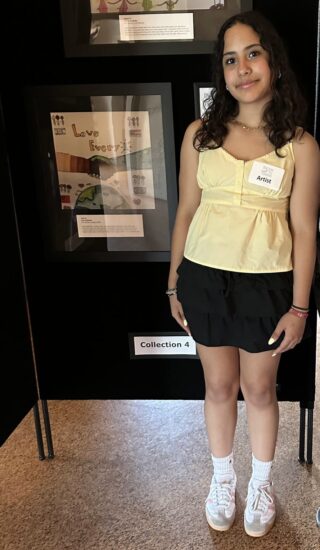
Cab Calloway student Sirla Posadas Romero, 12, is participating in the exhibition for the first time.
Exhibition locations include Sussex County Family Courthouse, Leonard L. Williams State Service Center in Kent County, Appoquinimink Library in Middletown, and Nemours Children’s Hospital in Wilmington. For a complete list of locations and dates of exhibitions, visit DePacemInTerris.org.
This year, Sirla Posadas Romero, 12, is participating in the peace exhibition for the first time. Her artwork currently hangs at the Lutheran Church of Good Shepherd in Wilmington. It shows the earth and humanity shaking hands. Humanity’s hand and arm depict different skin tones.
“I hope that I can teach people from different countries, races, and cultures to get along with each other and to spread peace and love,” says Romero, a student at Cab Calloway School of the Arts. “I would hope my art piece demonstrates that no matter who you are or where you come from, there will always be someone there for you spreading kindness.”
For Romero, art helps her connect to an inner peace and calmness.
“What peace means for me is my headphones, my art supplies, and my room,” she says. “I have peace when I am alone doing what I enjoy the most. As well as being surrounded by the people I love the most.”
“It is easy to get distracted by negativity and hatred, but art provides an opportunity to imagine a version of ourselves and our world that is positive, loving, and healthy, and that lifts one another up,” says Reverend Pamela Wat, Pacem’s board chair. “Having children and teens making that kind of art is good for them because it becomes a kind of meditation toward healing and peace.”
Next year, Pacem will display artwork outside of Delaware for the first time. Travelers will be able to view select pieces in Baggage Claim A of the Philadelphia Airport. The exhibition will appear for an entire year.