
Above: Lori’s Hands volunteers Susanna Lilly (l) and Alexandra Gearing (r) with 81-year-old Helen Spring.
By Adriana Camacho-Church
Photos courtesy Lori’s Hands
When Alexandra Gearing, 21, decided to pursue a career in healthcare, she knew Lori’s Hands would give her the hands-on experience she needed.
“Real-life experiences help connect the gap between what we learn in class and how it actually applies in the real world,” says the University of Delaware student. “It’s so important to be able to do things and see things firsthand to know if it is really a path you want to pursue. If there were no hands-on experiences with academics, then we are simply just learning, not truly understanding.”
Gearing is one of more than 700 student volunteers who have participated in Lori’s Hands since the program began as a club at the University of Delaware in 2009. In 2012, the club became a non-profit, and in 2020 and 2022, it opened chapters at universities in Baltimore and in Metro Detroit, respectively. It aims to improve both the social well-being of its clients and the confidence and preparedness of the students who serve them.


The program connects undergraduate and graduate students with older adults who live at home and suffer from chronic illnesses, such as cancer, Lou Gehrig’s Disease, or Parkinson’s. It trains students to provide non-medical, in-home support. In pairs, students visit their assigned community members once a week to help with home tasks, resource support, and to provide companionship.
Students from all majors, such as engineering, finance, social work, education, and the arts, sign up for Lori’s Hands.
“Every student leaves with greater empathy, stronger communication skills, and real-world exposure to aging, caregiving, and the impact of public policy,” says Sachi Menard, senior manager at the Newark Chapter. “Furthermore, students don’t have to attend the University of Delaware to participate. We’ve had students from almost all of the local colleges and universities participate in recent years. We’ve even had students who are local to Newark but go to school out of state volunteer during the summer months when they’re home on break.”
Since its inception, the organization has assisted 750 clients within the three states. Clients find out about Lori’s Hands through the program’s outreach efforts and referrals from healthcare agencies, providers, and community organizations.
“Our clients are living textbooks, offering the kind of wisdom and perspective that can’t be found in a lecture hall,” says Sarah LaFave, Lori’s Hands founder and board president. “Our organization plays a role in enhancing the strengths of both groups to meet the needs of the other.
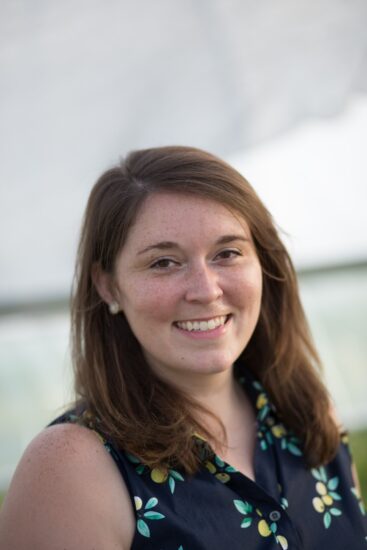
Lori’s Hands founder Sarah LaFave. More than 700 students have participated since she started the program in 2009.
“Both students and older adults are often dismissed or underestimated due to ageism. Our work flips that narrative. Students bring time, energy, curiosity, and problem-solving skills that directly support clients’ independence. Whether it’s swapping out a hard-to-reach lightbulb, finding affordable transportation, or getting fresh and healthy foods into the house every week, students become an essential part of their clients’ care circle. Clients, in turn, offer students unmatched insight into aging, chronic illness, and resilience.”
Helen Spring, 81, says that since UD students started visiting her seven years ago, her life has been much easier and more enjoyable. “They do many different things that are of immense help to me,” such as opening prescription bottles and food jars.
In turn, Spring shares her knowledge of things such as cooking simple meals. “I have them do the prep work and then the cooking. Afterwards we all taste test, and if they like it, I send them home with portions for a meal.”
Susanna Lilly, a UD student assigned to Spring, says that “by spending time with Helen in her home, listening to her stories, and helping with everyday tasks, I learned that compassion and presence can go a long way. It taught me that simply being there and offering a listening ear or a helping hand can make someone feel seen and valued. I’ve learned that building trust and treating each person as a whole is just as important as any treatment plan.”
According to a 2020 study by the National Academies of Sciences, Engineering, and Medicine, there is evidence that loneliness has wide-ranging adverse effects on health for older adults, including an increased risk of stroke, dementia, obesity, depression, anxiety, and premature death. A subsequent quantitative study showed that older adults reported less loneliness after engagement with students in the Lori’s Hands program.
On a financial level, Lori’s Hands helps prevent costly interventions, says LaFave. “For many of our clients, hiring a paid caregiver for basic tasks, like picking up mail, cleaning the kitchen, or grocery shopping, is financially out of reach. Yet these tasks are essential to maintaining independence and safety at home. Our student volunteers often fill this gap, providing critical support that helps clients remain in their homes and avoid premature moves to assisted living or nursing facilities.”
Data from the American Council on Aging (2021) indicates that the annual out-of-pocket nursing home costs for a semi-private room in Delaware averaged $147,278 in 2021.
Lori’s Hands is funded by foundation grants, corporate sponsorships, and individual contributions. LaFave, who currently works as an independent public health researcher, founded Lori’s Hands during her sophomore year at UD. She named the organization after her mother, who died from breast cancer when LaFave was in high school.
Currently, the organization is exploring aligning with others doing similar work and opening new chapter locations, including southeastern Pennsylvania. The program is committed to fostering intergenerational connections to address gaps in care and strengthen communities nationwide.
“We need consistent, equitable systems that treat aging as a public good, not just a personal issue,” says LaFave. “By investing in relationships and community-based support, we can make aging healthier, more dignified, and more cost-effective for individuals and for society as a whole.”
—To volunteer, visit LorisHands.org or email Contact@lorishands.org