

By Bob Yearick
Where Are the Editors?
• Austin Curtright, in USA TODAY: “The next Winter Games is only 18 months away, as they will be held from Feb. 6 to 22 in 2026.” He got the verb wrong but the pronoun right in the same sentence.
• Similarly, Curtright’s colleague, Tyler Dragon, wrote this about discus champion Valarie Allman: “She’s the first American women to win two gold medals in the women’s discus,” thus using women incorrectly and correctly in the same sentence.
• From a review of The Instigators, the Apple TV+ film with Matt Damon and Casey Affleck, in USA TODAY: “The mayor is frantically trying to break into a safe that harbors his elicit gains…” That should be illicit, of course. This mix-up occurs all too often. Elicit means to draw out or extract. E.g., “the detective elicited a confession from the suspect.” Illicit means illegal.



• Reader Joan Burke submits an online story from Getty Images about Jared Cooper, who got stuck 450 feet above the ground when his window-washing equipment jammed while he was working on a building in Mobile, Ala. The story noted that “Cooper wasn’t phased after getting stuck and said he planned to go to work [the next day].” That would be fazed.
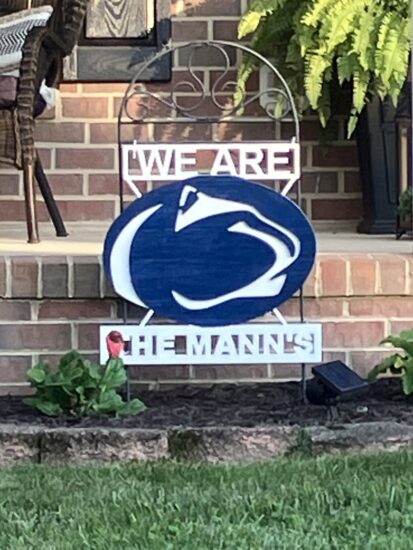
Son Tim alerted me to this Penn State alum who apparently doesn’t know the rule against inserting apostrophes in plurals.
• Larry Hamermesh submits this from Wdel.com and reporter Sean Greene: “Debris cascading down the creek, which was more like a raging rapid that day, struck the 120-year-old bridge, deeming it unsafe.” Says Larry: “That debris was quite discerning.” Deem means to judge or view in a specific way. Rendering or making would’ve been appropriate in this case.
• Illinois reader Judy Tribbey sends this notice from her local library: “This morning, the Morton Grove Chamber of Commerce moderated a panel of your elected officials who gave updates on projects effecting Illinois.” Remember, effect is almost always a noun, while affect is usually a verb. The correct word in this case: affecting.
• Rob Tornoe, in The Inky: “‘It had a big impact on my life, and I’m digging into it in an attempt to finally find out who was the murder,’ [Mike] Missanelli told The Inquirer.” Mike’s a smart guy, so I’m pretty sure he said murderer.
Apologies, but since we’re in the midst of a heated presidential race, this month’s column contains a few political items.
• Let’s start with Fox News commentator Jesse Watters, who (naturally) downplayed the enthusiasm at the Democratic National Convention: “They weren’t that jub-U-lant.” Yo, Jesse, the word is pronounced jub-a-lant.
Possessive Politics
The Harris-Walz Democratic ticket has caused much internet discussion about how to form the possessive, the plural, and the plural possessive of both surnames. Here’s a primer.
HARRIS
Possessive: Harris’ (Associated Press style — followed here at O&A); Harris’s (New York Times, Washington Post, Wall Street Journal, and most English textbooks). So, there is no hard and fast rule; the important thing is to be consistent.
Plural: Harrises
Plural possessive: Harrises’
WALZ
Possessive: There’s nothing special about a word ending in z, so simply add an apostrophe and s: Walz’s. Merriam-Webster, however, declares that you may add just an apostrophe, but admits that ’s is the more common choice.
Plural: Walzes
Plural possessive: Walzes’
Literally of the Month
Will Bunch dropped the word twice within the first two paragraphs of his column in the Sunday Philadelphia Inquirer. He wrote that one particular point of disagreement between the two vice presidential candidates “could literally redefine the American dream.” A paragraph later, he asserted that JD Vance “rose in the MAGA GOP by literally declaring U.S. universities ‘the enemy.’” Will should back off this intensifier just a bit.
Word Term of the Month
Gish gallop
The Gish gallop is a rhetorical technique in which a person in a debate attempts to overwhelm an opponent by abandoning formal debating principles, providing an excessive number of arguments with no regard for the accuracy or strength of those arguments and that are impossible to address adequately in the time allotted. The term was coined in 1994 by anthropologist Eugenie Scott, who named it after American creationist Duane Gish. Scott argued that Gish used the technique frequently when challenging the scientific fact of evolution.
 Follow me on Twitter: @thewaronwords
Need a Speaker for your Organization?
Contact me for a fun presentation on grammar: ryearick@comcast.net.
Buy The War on Words book at the Hockessin BookShelf, at Huxley & Hiro Booksellers, or on Amazon. Or email me at ryearick@comcast.net.