

Above: This memorial stone for Valentine Hollingsworth occupies a prominent place in the cemetery, which is a tiny part of a 1682 grant of 986 acres from William Penn to Hollingsworth. Photos courtesy Anne Daly.
By Bob Yearick
In a quiet pocket of Brandywine Hundred, tucked away among office parks and subdivisions, is a hidden — and somewhat confusingly named — historic gem: Newark Union Church and Cemetery. It is a place where Delaware’s early settlers worshipped, where veterans from eight wars rest, and where a group of modern-day caretakers has breathed life back into a long-neglected landmark.
The properties are a tiny part of an original grant of 986 acres from William Penn to Valentine Hollingsworth, an Irish Quaker, in 1682. They extend along Shellpot Creek on the east, north to the Red Oak, and west to the Black Oak and south along what is now Rt. 202.
The name, which predates the founding of the city of Newark, Delaware, by 12 years, is a derivative of the title Hollingsworth gave to his original plantation — New Wark. That morphed into New Worke and eventually Newark.
The church stood mostly unused since the 1970s and was closed altogether by 2018. Once a vital gathering place — founded as a Quaker meeting house in 1687 — it had become just another old building in need of care.
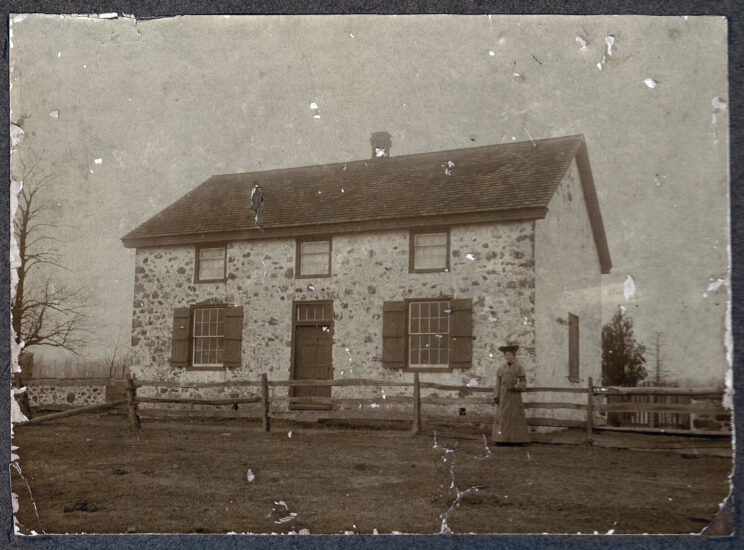
The church was built as this two-story fieldstone Quaker meetinghouse in 1845 and renovated to a one-story Gothic Revival style building in 1906. The woman is Ms. Emma Weldin, who rests in the Newark Union Cemetery.
Restoration work has been led by Bob and Anne Daly, two DuPont retirees, who seven years ago moved from Middletown to the house across the street from the church and cemetery — the original home of Valentine Hollingsworth. They soon met Jean Weldin and her husband, Ray, a member of a prominent Brandywine Hundred family that had been responsible for managing the church and cemetery since 1845. The Weldins were ready to pass the torch, and the Dalys gladly accepted.
Since then, the husband and wife, both history buffs, have spent countless hours researching and acquiring items for the museum and spearheading a group of volunteers who, in a remarkably short period, have transformed the site into a hub of community pride. Bob is president of the nonprofit Newark Union Corporation and Anne is treasurer.
Unearthing History
Restoring the properties and opening them to the public was no small task. The cemetery had become overgrown, the church’s interior outdated and worn. But volunteers set to work, clearing brush, unearthing and cleaning gravestones, painting walls, and installing electricity and the church’s large lancet windows.
In February of 2020, the church and cemetery were placed on the National Register of Historic Places, a pivotal event that made them eligible for grant money. Government and foundation grants followed, along with individual donations of both money and items for the museum.
Carefully Curated
Today, the site is more than a historic church and burial ground. The former Sunday School room has been transformed into a small but carefully curated museum — a time capsule of local and American history.
Under the Dalys’ direction, many of the items on display reflect the lifestyle of ordinary people from the mid-to-late 1800s and early-1900s. They include a spinning wheel, a sewing machine, a broadax, a children’s sled and chairs, a Civil War medic’s kit, and Brandywine Hundred tax records and property deeds. There’s a Civil War-era canteen, a 19th-century collection plate, and an 1880s coffee grinder.

Some of the crowd at the museum’s grand opening ceremonies on May 31. Despite its name, the museum is in Brandywine Hundred, off Baynard Boulevard near Marsh Road.
From a time when churches also served as de facto community clinics, there is an antique medicine bottle marked “Newark Union Church.” Other pharmaceutical bottles purport to hold elixirs that alleviate all manner of ailments: “Dr. Kilmer’s Swamp Root Kidney, Liver and Bladder Cure,” “Dr. B.J. Kendall’s Pectoral Elixir for coughs, colds, and all lung troubles,” and “Blackberry Balsam for dysentery and all summer complaints.” A sign for a Philadelphia firm proclaims: “J.C. Hurst & Sons Standard Remedies: Brighter hours will come.”
Among the more unusual items is Harden’s Hand Grenade Fire Extinguisher — a glass globe that contained a mixture of carbonic acid and sodium bicarbonate.
One of the more fascinating antiques is an extremely rare 1868 bicycle — “the boneshaker.” Made of steel alloy, including its wheels, the bike weighs nearly 80 pounds. It was donated by Karlis Adamsons, who paid $3,000 for it at the annual bike auction in Copake, N.Y., about 15 years ago. Considering the cobblestone and crushed stone roads of the 1860s, the boneshaker is well-named.
Adamsons and his wife, Cathy Andriadis, who live in Greenville, have been among the major supporters of the museum and cemetery. Andriadis is a board member and also handles publicity for the group.
Another major contributor is Gavin May. A resident of Unionville, Pa., the 20-year-old May has to qualify as one of the youngest history buffs around. He met Bob Daly when both of them had booths at an antique bottle show 12 years ago — when May was 8. Nowadays, the two often make field trips together to seek out artifacts for the museum.
Stories Set in Stone
Anne Daly calls it “an honor” to help maintain the cemetery, where 88 veterans representing every war from Revolutionary to Vietnam are buried.
A Victorian memory garden, with benches and native plants, and a Military Memorial occupy the center of the cemetery. There is also a marker to commemorate Delaware’s first Medal of Honor recipient, Alexander Hand, who served in the Union Navy during the Civil War.
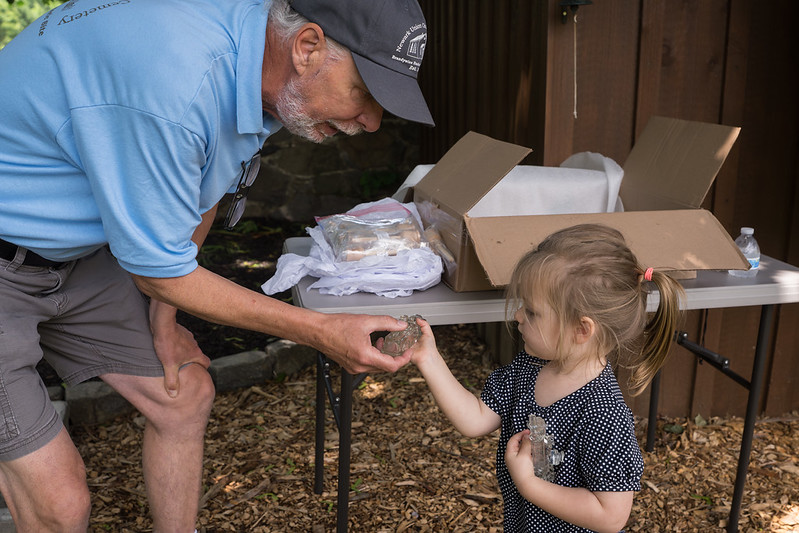
Bob Daly, a long-time antique bottle collector, gave vintage glass candy containers to children during opening ceremonies.
With help from several grants from the Distressed Cemetery Fund, more than 225 headstones, footstones and corner plot markers have been raised, repositioned, repaired and cleaned, and 95% of the stone wall around the perimeter of the cemetery has been repaired and repointed.
Still legible after centuries of exposure to the elements, many of the markers tell a local history etched in marble and granite. Some familiar Brandywine Hundred names — Carr, Grubb, Sharpley, Talley, Wilson — can be found here. There are Quakers, abolitionists, farmers and merchants. And there are records of long lives as well as tragically short ones — children lost to early illness, soldiers who never made it home.
Volunteers have digitized burial records, mapped plots, and installed interpretive signs, turning the cemetery into an educational experience. School groups have visited, and the Dalys have conferred with Winterthur Museum to plan more such visits.
The cemetery is still active, and three or four burials have taken place there for the past few years. The biggest event is the Wreaths Across America ceremony, held annually throughout the nation on the second Saturday in December. During the ceremony, each veteran is honored with a ceremonial wreath.
Meanwhile, families have begun to use the church for weddings, baptisms, and memorials.
A Future Rooted in the Past
Newark Union continues to raise funds for ongoing maintenance and hopes to expand programming, including guided tours and educational events. Volunteers are also working with local historical societies to uncover more stories. And there are sure to be several special events during the country’s 250th anniversary next year.
In the meantime, word-of-mouth has spread about this historic treasure, and the number of volunteers and drop-in visitors is increasing. “People just fall in love with this place,” says Bob Daly.
The Dalys plan to establish regular museum hours soon. For now, tours and drop-in visits can be scheduled by emailing NewarkUnion@gmail.com or by calling (302) 377-0960. The website is NewarkUnion.com.