

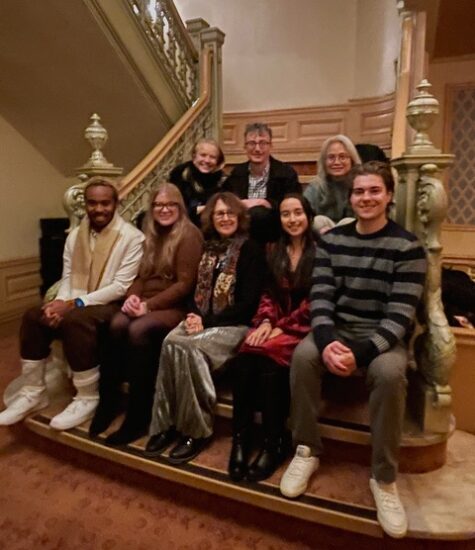
Above: Susan Stroman (center) with fellowship students (l-r) Natalie Milligan, Yves Allen, Zack Cable and Erin Munoz. Photo courtesy University of Delaware.
By Andrea Smith
Few twenty-somethings in Delaware are writing scripts that’ll end up onstage as successful, lucrative plays, but a Tony Award-winning artist from the First State wants to change that.
Director and Choreographer Susan Stroman, who graduated from the University of Delaware in 1976, says she “owes [her] career to great writers.” Her love for performing arts began as a child in Wilmington, and she developed a deeper appreciation for literature as an English major at UD. Stroman has won five Tony Awards plus a myriad other accolades for her work in theater, and according to Playbill, she’s tied with Bob Fosse as the most Tony-nominated choreographer in Broadway history. Now she’s directing the musical SMASH, which opens on Broadway this month.
Even while living and working in New York City, she can’t say she never looked back. Stroman has kept in touch with the university for decades, and her most-recent contribution to UD funds the new Susan Stroman Playwright Fellowship.



“Whatever I can do for young people to introduce them to great writers, to expose them to great theater, I feel that’s important,” Stroman says.
The fellowship program launched in the fall to unite playwriting educational efforts in both the English and theater departments and to connect ambitious students with professional mentors. The inaugural cohort consists of four students who are aspiring writers with diverse interests. They have spent the school year creating an original script with help from UD Associate Professor Chisa Hutchinson, who is a playwright and screenwriter, and playwright Michael Gotch, who’s a member of the university’s professional acting company, the Resident Ensemble Players (REP). In May, it all culminates with readings of their plays at the UD New Play Festival, supported by Jim and Kathleen Hawkins.
“The students get to work with professional playwrights that they would not have encountered at UD and get advice on the plays that they’re working on,” explains professor John Ernest, chairman of the Department of English. “These are not inexperienced students, but they’re also not seasoned playwrights, so the mentors guide them through that process.”
Stroman believes young writers also benefit from leaving the classroom setting “to be in the room where it happens,” she says, alluding to the song in Hamilton on Broadway. “I wanted to bring them to New York to interview playwrights, to interview people who contribute to playwrights in the field of collaboration, and also to experience shows that are running.”
 The students visited New York each semester, met Stroman at various theaters, and picked her brain over dinner. During their visit in February, they got a peek behind the curtain through watching a SMASH rehearsal and talking shop with two of the show’s playwrights.
“We’re just in a small room talking to these exceptionally famous, influential, and accomplished people,” Ernest says, noting that they spoke with professionals at a few shows. “They are giving us the full hour of their time and just talking as openly and casually as you can imagine about their own writing process, how they got into this, how they think about plays, and the students ask questions about [their] particular challenges.”
Fellow Yves Allen, an English major graduating this spring, agrees that leaving campus and practicing their craft provides a clearer path forward.
“Understanding that everything going on came from someone sitting at a computer and writing, at least to me, that was … the main thing that I took away from that experience,” Allen says. “It was nice to see that one day these [scripts] will be acted out. These aren’t just gonna rot on a PDF forever.”
For Fellow Erin Muñoz, a double major in English and Women and Gender Studies graduating next spring, the SMASH experience cured a case of writer’s block: “It kind of reminded me what I was working toward. I was sitting there thinking, ‘This is where I want to be. I want to be sitting in this rehearsal space the rest of my life.’”
 “It is truly our goal through this, not simply to help them write plays, but to help them become savvy theater insiders so that they know what it actually takes to get from dream to reality,” Ernest says. “It’s also a program that is, to some extent, designed to start connecting them with people who might take an interest in them and then might facilitate that journey.”
Steve Tague, chairman of the Department of Theatre and Dance, says they’re inviting artistic directors from New York Stage and Film, PlayPenn, and other organizations to attend the UD New Play Festival. Tague is also the REP’s producing artistic director, and he’s ecstatic about how this festival will grow and promote budding artists in Delaware in years to come.
“These students will be exposed to people whose whole life is about producing new work,” he says, “and it’s mostly due to the generosity of Susan Stroman, but also Kathleen and Jim Hawkins, who are funding the New Play Festival and will help bring these people in to see them. …Their mission, with their donations, is to have plays become visible — to be seen and heard by the public.”
Stroman anticipates watching their scripts come to life at the festival and sharing feedback but doesn’t plan to critique them at length.
“This is a young generation,” she says. “They are writing in a different way, seeing the world in a different way, and have different ideas. I don’t want to put my generation on them. I want them to create this new generation of playwriting.”
Stroman’s support has allowed Fellow Natalie Milligan, an English major graduating this spring, to consider playwriting for a living.
“It’s probably my favorite form of writing, but I never saw a future with it,” Milligan says. “Then the fellowship came along. There are actually opportunities out there.”