

A recent UD grad does her home state proud on the 2,180-mile Appalachian Trail
Margaret Pierse was in third grade when she gaped, fascinated, at a female guest speaker during one of her Girl Scout meetings. The woman wove a story of adventure and excitement about her experience of completing the legendary Appalachian Trail—solo.
That she was a woman who had completed the A.T. alone inspired the young Scout. It’s estimated that only one out of every four potential “thru-hikers” (those who aim to walk the whole Trail in one continuous journey) succeed. And no wonder: the Trail stretches 2,180 miles, from Springer Mountain in Georgia through 14 states to the northern terminus, Mount Katahdin in Maine.
“Yeah, I’m going to do that someday,” Pierse told herself.
More than a decade later, in 2013, the Wilmington native graduated from the University of Delaware, and, with no immediate plans, revisited her childhood dream of thru-hiking. She was well-versed in nature, having grown up exploring trails and pitching tents with her family, who encouraged her love of the outdoors.
She decided to go for it. For the next year, at the age 23, she saved money from her barista job at the Trolley Square Brew HaHa! and researched the A.T.





Because of her parents’ concern for her safety, Pierse says, she reached out to another female hiker on an official A.T. forum, and they agreed to walk together.
Says Pierse’s father, Terry: “When I realized she was very serious, I had a lot of questions. I think that, for a time at least, I was probably too quick to offer advice. I was concerned about her personal safety and wanted to know what she was doing to make sure she would be safe on the Trail.”
Despite his concerns, Terry Pierse describes his daughter as practical, strong and able to “see things through to a conclusion,” so he had no doubt she would succeed. And he and her mother, Marie, were reassured when Margaret took proactive safety steps like purchasing tracking and location devices in case something went wrong.
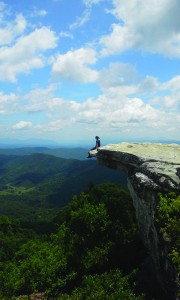
Pierse, pictured, describes the Trail as a “romance with nature.”
Generally, though, the 78-year-old A.T. is considered extremely safe. Hikers tend to look out for each other, and most female hikers make it through without an issue. The first A.T. solo female thru-hiker was Emma Gatewood, mother of 11 children and grandmother of 23. When she completed the Trail in 1955, she was 67. She was famous for carrying a small knapsack and wearing a pair of Keds instead of hiking boots for the entire trip.
On April 10 last year, Pierse and her traveling companion stuffed each of their backpacks with a rain jacket, sleeping bag, a water filter, a hammock (that’s what the Girl Scouts speaker used), and typical trail foods (Snickers bars, instant mashed potatoes, Clif Bars, peanut butter, tortillas, Ramen Noodles). Then, with just one set of clothes, which they had on, the young women were dropped off near the Trail and started north from Springer Mountain (Most hikers, like Pierse, start in the south and work their way north as the weather warms; it takes most thru-hikers about half a year to complete the Trail).
The hike quickly settled into a routine. When the women ran low on food and supplies, they would hike off the Trail or hitchhike to one of the hundreds of towns dotting its outskirts, replenish, then hike back out, following the white blazes on trees leading to and through the entire the A.T.
But just two weeks in, her companion dropped out, leaving Pierse to make the rest of the journey by herself.
However, the A.T. is supported by a tight-knit community of hikers. Even though she was technically solo, she was rarely totally alone. Like many hikers, she formed friendships and walked with others for months at a time. And solitude was a rarity: an estimated 2-3 million people visit the Trail every year and approximately 1,800 people attempt to thru-hike annually.
Hikers adopt trail names, which usually stay with them for the entire journey. Typically, a trail name is given to a hiker by another hiker as a sort of rite of passage, although the recipient can keep it or find another.
“It has a lot to do with the person you are on the Trail, building a new identity, forming a whole new persona,” says Pierse.
On her first day, a hiker named Ritz asked where she was from, and soon he was jokingly calling her “Delaware.” Others overheard and the name caught on. She gladly accepted representation for her small, far-away state.
“As much as I love to travel, I like coming back home. I liked the idea of people knowing where I was from; that’s important to me,” she says.
Usually, at first, she didn’t learn other hikers’ real names, but if they grew closer, they would learn all about each other.
Atlas, Gadget, Shay, Sassafras and Engineer were just some of the strangers who would eventually become Pierse’s pen pals and anticipated lifelong friends post-Trail. They would hike together for months, forming groups with names like Barbarian Kings. “At that point we were pretty feral,” Pierse jokes about the last stretch of the journey, when they foraged for food, looking and feeling a little crazy.
Pierse says she got in better shape as she progressed along the Trail, which acted as her personal fitness trainer. During the first days she made seven to nine miles. By the time she hit Virginia, she was often doing a marathon (26 miles) a day.
Backpackers can burn up to 6,000 calories daily on the A.T. Her friend Sassafras was extremely overweight when he started, Pierse says, and was “really slow”, hiking from first light until dark. But he ultimately finished the Trail, losing 46 pounds along the way.
The journey understandably got rough—really rough at times, pushing Pierse to tears and mental and physical exhaustion. But according to her father, her “strength of character, fortitude, goodness, strong moral compass, and the ability to ‘make do’” helped her continue.
The Trail ultimately boosted Pierse’s confidence. “I have no doubt in my capability to do things now,” she says.
Once back in Wilmington, she found that this self-assurance helped her in many areas of life: interacting with customers as assistant manager at Brew HaHa!; traveling to Namibia, Africa, to hike with friends; concluding that one day she’ll thru-hike the renowned 2,650-mile Pacific Crest Trail.
Continuing on despite blistering feet, weight loss, and an “unbelievable, unquenchable hunger,” Pierse reached Mount Katahdin in October, six months after she started in Georgia. That’s the equivalent of hiking Mount Everest from sea level and back 16 times.
It was well worth the hardship, she says.
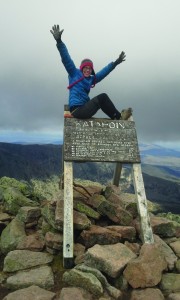
Hiking 2,180 miles in six months, Pierse reached Mount Katahdin last October.
“Mountains burst up out of the earth. You’re climbing up through pine and deciduous forests, then it’s bare and rocky, and you feel like you can see the whole planet at the tops of those mountains. It’s almost like a romance with nature. It was the best thing I ever could have done, and I learned more hiking the A.T. in six months than I did in college in four years.”
Trail Tips
Margaret Pierse offers a few A.T. words of wisdom:
Everyone had the Sawyer Squeeze water filter; it’s unanimously considered the best.
I used the Z Lite sleeping pad.
I was divided between tents and hammocks, but I went with hammock because the woman with Girl Scouts had talked about that and I was really enamored by it. And I used a tarp and bug netting. I really liked it.
I would also sleep in shelters or “cowboy camp” under the stars.
When you are outside all day every day, you learn to know when it’s going to rain. I didn’t anticipate how in-tune I’d become with the weather.
If you have blisters, put duct tape on them, or moleskin.
It’s important to hang food in a bear bag. Otherwise, bears will eat your food.
A rule of thumb is to get rid of anything you won’t need for two weeks. I say get rid of it if you don’t use it for two days.
My first-aid kit was narrowed down to duct tape, moleskin, ibuprofen and a needle.
I saw six or seven bears. They’re not as cool as people think. They’re kind of scaredy-cats. They lumber around. Then you yell, and they run away.
You think you need clothes, but you don’t. You only need what will keep you alive. One set is fine, along with warm gear, a sleeping bag, a water filter, food, and a hammock/tent.
Everyone should quit their job and go on an adventure sometime.