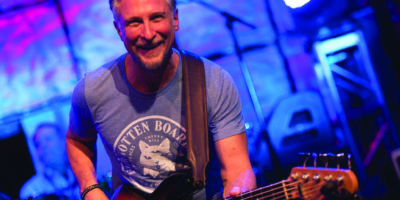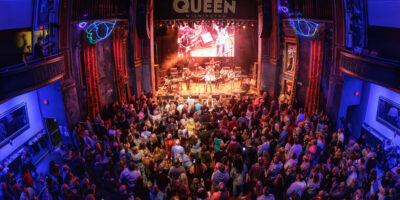

Above: A crowd enjoys a performance at Freeman Arts Pavilion, where more than 100,000 experience the arts each year. Photo courtesy Freeman Arts Pavilion.
By Out & About Staff
“The Arts Matter,” has been an unofficial slogan of the National Endowment of Arts (NEA) for at least a decade.
The slogan has not convinced the White House. After suddenly denying hundreds of NEA-related arts grants in early May, the Trump administration has added the 60-year-old organization to the chopping-block list of “small agency eliminations.” At a time when communities are still recovering from pandemic-era losses, and trust in public institutions is fragile, eliminating one of the most democratic forms of cultural investment undermines our shared civic infrastructure.
This decision is painfully short-sighted.

As staffers for a magazine that has advocated for the Arts since the late ‘80s, we at Out & About have been consistently insisting that we all should be doing more to support the Arts — not less. And certainly not the idea of doing virtually nothing.
Why so pushy?
Because, put simply, the Arts deliver outstanding value to the American way of life.
A whole host of our nation’s values, including education, community, and economic development, are drastically improved via the Arts in ways that experts have been able to demonstrate quite clearly.
The problem is most Americans — many serving in government — simply have not been paying close attention.
ARTS AS AN ECONOMIC DRIVER
Let’s look at the positive economic impact, first: At a relatively low cost, the Arts have been a quiet economic boon here in Delaware, dramatically boosting revenues and job-creation from Claymont to South Bethany.
According to the Arts & Economic Prosperity 6 (AEP6) study conducted among 373 participating communities nationwide in 2022 and 2023, Delaware’s economy has benefitted tremendously from grants to the nonprofit arts and culture community.
In fiscal year 2021-22, Delaware arts organizations received $5 million in grants from the state via the Delaware Division of Arts ($3.9 million) and federally via the NEA ($1.1 million). For roughly that same fiscal year, AEP6 determined that the state’s nonprofit arts-and-culture sector generated about $209 million in direct economic impact.
In other words, for every dollar that was invested by the government to nonprofit agencies, more than $40 was pumped back into the state’s economy. No matter what school of economics you subscribe to, that is an outstanding return on investment.
Even if the ROI in the Arts is much less impressive in other states than it is in Delaware, the idea of cutting the NEA entirely seems odd, if not illogical. The agency is currently funded at $207 million, which is only 0.003% of the total federal budget.
If the cuts are simply a matter of the Trump administration looking to save every penny — without any consideration of ROI — then why did a Republican-led House committee recently propose a six-fold increase of spending to the Kennedy Center to the tune of $257 million?
That’s not saving money. Nor is it good sense. Instead of funding the NEA to support the Arts in more than 14,000 communities across the country, we essentially would be spending roughly $40 million more on one arts location that most people will never see.
Contrary to outdated stereotypes, NEA grants overwhelmingly support community-based programming — not elite institutions. In fact, 40% of NEA-funded projects serve high-poverty neighborhoods and underserved populations. Even more impactful, NEA grants fund projects in each of the 435 congressional district in the country.
While we can’t specifically speak to the impact on all 14,000 of those communities, we can point to other economic statistics that support NEA funding and the Arts in Delaware, such as:
- In 2021, Delaware’s creative economy (including for-profit businesses) generated $3.7 billion in total revenue and contributed $2.2 billion to the state’s economy after expenses.
- In 2022, the activities of nonprofit arts and cultural organizations supported the employment more than 3,300 people in Delaware (creating $40.2 million in tax revenue) in industries like hospitality, tourism, retail, and transportation.
- Recent studies have shown one in four attendees at Delaware arts and cultural events and attractions are visitors who traveled from outside the state. On average they spend $67.50 per person per visit.
ARTS AS COMMUNITY BUILDERS
The impact goes beyond economics. The Arts strengthen positive perspectives about community as well. Beyond festivals and performances, the arts reduce social isolation — a known contributor to poor health outcomes — and have been linked to lower neighborhood crime rates through increased foot traffic, beautification, and community cohesion. Events like the upcoming Clifford Brown Jazz Festival and St. Anthony’s Italian Festival boost our collective spirits in ways that have long-lasting benefits.
AEP6 showed that 88% of attendees of arts-and-culture activities and venues say these events and places inspire “a sense of pride in this neighborhood or community” with 90% saying they would “feel a great sense of loss if this activity or venue were no longer available.”
This is not just a First State feeling: Eight out of every 10 Americans agree that arts and community improve their community’s quality of life and livability.
Nor are these positive feelings fleeting ones; they help improve community over the long term. In 2017, University of Pennsylvania researchers demonstrated that higher concentrations of the arts in communities promote higher civic engagement, more social cohesion, higher child welfare, and lower poverty rates.
Similarly, the Arts offer an effective way of strengthening mental health by reducing depression and anxiety and increasing life satisfaction.
ARTS AS EDUCATION
If, as a nation, we are adhering to the notion of looking back in time to find ways to make America great again, we should consider the world’s first democracy, ancient Greece, when and where Music was considered an essential science.
In fact, in the 500 B.C. era of Pythagoras, Music stood with Arithmetic, Geometry, and Astronomy as the four scientific-based areas of study that would become known as the liberal arts — fundamental pillars of classic education for centuries to come in Western Civilization.
That is, until about 40 years ago…
Here in America, Music began to inexplicably lose value among educators in the mid-1980s. What was once one of the pillars of classic education is offered today — in the best of circumstances — as an elective in many public schools if it’s even offered at all.
This devaluation of music education has persisted in America despite fact that eight out of every 10 Americans believe government has a role in providing arts education to students K-12. Studies support this belief:
Music education elevates learning. Studies show that student musicians on average perform better in math, science, and language. Those studies go hand in hand with others that show music education also boosting emotional development in young students. Moreover, arts education has been shown to narrow the achievement gap for students from low-income communities and fosters critical 21st-century skills — such as collaboration, communication, and innovation — that today’s employers demand.
In addition to Music, the Arts in general help improve academic performance. Studies show students engaged in the Arts have higher GPAs, standardized test scores, and college-admission rates as well as lower drop-out rates.
The Arts help foster creative thinking. Research has shown that Nobel laureates in the sciences are 17 times more likely to be actively engaged as an arts maker than other scientists.
DELAWARE’S STATE OF AFFAIRS
Thankfully, when it comes to the Arts, Delaware fares better than most states. Due largely to the persistent advocacy of the Delaware Division of the Arts and the Delaware Arts Alliance, the First State ranks in the top five across the country in Arts spending per capita.
However, recent federal cuts have both organizations scrambling to find ways to bridge the gap for arts and cultural organizations suddenly left in the lurch.
“NEA dollars reach every congressional district in the country, supporting arts access in both urban centers and rural towns where other resources are often scarce,” says Jessica Ball, Director at the Delaware Division of the Arts.
“Eliminating this funding would pull vital support from classrooms, main streets, and community centers — and in doing so, strip away economic opportunity, creative expression, and civic vitality from the places that need it most.
“Defunding the NEA isn’t just an arts issue — it’s a community issue. It means fewer opportunities to gather, express ourselves, and enjoy the cultural life that makes everyday moments meaningful.”
For local arts advocates like Ron Ozer, the Trump administration’s threat to eliminate the NEA looms large.
Grants help support diverse musical offerings at the Arden Gild Hall, which Ozer has programmed for 23 years. He has brought in bands from all over America’s landscape — in terms of both genre and geography. It’s not uncommon for the venue to showcase acts from as far away as Africa or Asia as well.
Ozer sees the recent cancellation of congressionally appropriated arts funding as “an overtly political takeover of creative expression in this country” and suggests we take action.
“Publicly funded art is a crucial aspect of outstanding performance spaces in Delaware such as the Grand Opera House, the Freeman Arts Pavilion and Arden Gild Hall,” Ozer says. “We must all let our representatives know that we are strongly against these cuts, which represent a tiny portion of the federal government, but which pay huge dividends in our communities.”
If we want to preserve the cultural vitality and economic impact the arts bring to our communities, we must raise our voices now. Contact your congressional representatives and urge them to preserve NEA funding. Our shared cultural future depends on it.
Indeed, with all the community-building benefits to consider, it seems like an understatement to simply say, “The Arts Matter.” Instead, we suggest a more fitting slogan moving forward:
“The Arts Are Essential.”