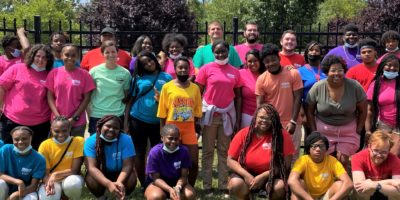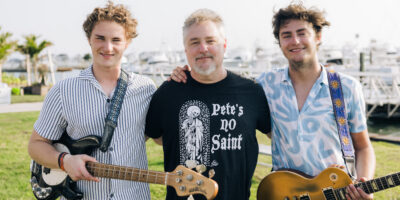


Above: Zeniah Holland shown here participating in the GROW program at Bright Spot Farms. Photo by Jim Coarse.
By Catherine Kempista
The Delaware Urban Farm and Food Coalition (DEUFFC) was created to solve a simple problem: Where do you go for help when you want to start a community garden? In the mid-2000s, the answer wasn’t clear.
“People weren’t quite sure where to go for the assistance, or they were calling everyone,” says Carrie Murphy, who is an extension educator in horticulture with University of Delaware (UD) Cooperative Extension.
While many people begin the process of creating a community garden with the best intentions, starting a garden requires horticulture knowledge, physical materials, soil testing, and (in some cases) funding assistance. Because there wasn’t a single hub through which these connections could be made, every organization remotely associated with plants and gardens fielded the same calls, creating a duplication of effort for horticulture and agriculture professionals in Delaware.


DEUFFC co-founders Murphy and Ann Mattingly — who was the urban agriculture manager at the Delaware Center for Horticulture (DCH) — knew there was a way to better coordinate efforts and conversations across agencies and nonprofits, especially as interest in urban agriculture and community gardening boomed.
Today, DEUFFC serves the interests of gardeners, activists, urban farmers, and community leaders as a public forum and agricultural network that connects people to the resources they need.
Moving The Dial
DEUFFC’s role in Delaware’s sprawling agricultural movement was born out of the vastness of the groups in need of assistance.
“I sum it all up as community agriculture instead of urban agriculture because the groups can be so individualized, and everybody has very specific goals and intents,” says Madison Walter, chair of DEUFFC’s steering committee and urban agriculture specialist for the New Castle Conservation District. “Our goal is to support them wherever they are because there’s not a one-size-fits-all approach if it’s going to work.”
Its broad objective? To help community-oriented urban agriculture projects increase healthy food and nutrition for underserved areas. The effort took hold when it became the Urban Farm Coalition and adopted a more formal structure in 2007. At the time, DCH was in the process of convening partners to develop E.D. Robinson Urban Farm — the city’s first urban farm — at the corner of 12th and Brandywine streets in Northeast Wilmington.
“Our philosophy was let’s come together,” says Mattingly. “Let’s share what we’re doing. Let’s support one another, and let’s elevate all of our efforts and complement one another.”
This moment collided with a surge in the national community gardening movement spurred by the creation of the White House Kitchen Garden by First Lady Michelle Obama in 2009.
“All of a sudden, there were all of these different organizations and individuals who wanted to start a community garden,” says Mattingly.
The calls came in, and the partnerships in the coalition expanded. Organizations like Delaware Department of Agriculture, Healthy Foods for Healthy Kids, UD Cooperative Extension, New Castle Conservation District, Delaware Nature Society, DCH, and others were communicating about resources they had access to individually and were happy to share collectively. The work of the coalition started moving the dial for urban agriculture in Delaware, and the number of community gardens at schools, community centers, and churches expanded.
Community Ag’s Big Tent
The mission of DEUFFC is intentionally broad, as it aims to make a space for everyone under its big tent. The proof of this effort is on full display at its annual meeting, which doubles as the urban agricultural session for Delaware Ag Week each January.
Membership in DEUFFC, which is a volunteer-run organization, is free and open to anyone who is interested and/or engaged in community agriculture. And that covers a wide range of entities.
In its simplest form, community agriculture in Delaware can be broken down into two categories — community gardens and urban farms. Within community gardens, the vast majority are either associated with schools, churches, community centers, workplaces, neighborhoods, or senior living facilities.
“We think about it in terms of the type of structure the garden takes and the users that are going to be in that space,” says Walter. “They all look very different, but when you break it down, a lot of management similarities start to shake out.”

Volunteers at DCH’s E.D. Robinson Urban Farm located at 12th and Brandywine. Photo by TC Davis.
On the urban farm side, there are also important distinctions at play but one commonality.
“Typically, we classify anything as a farm as anyone who is growing with the intent to sell,” says Walter.
Bright Spot Farms, Conscious Connections Farm, and Shovel & Forks Farm are some of the farms that occupy the entrepreneurial space, and Penn Farm — an agricultural pathway program at William Penn High School — and DCH’s E.D. Robinson Urban Farm are primarily educational and demonstration spaces. Regardless of categories, many of the urban farms have youth training programs, regularly donate to food pantries, and have a socially-driven mission around food equity and security.
On its website, DEUFFC provides a community garden toolkit, grant writing templates, and an urban ag map, providing locations of gardens and farms throughout the state. In person, it facilitates conversations between gardeners looking to find seeds, advice on plot planning, volunteers, and more.
To help focus its ability to help the most members and the most gardens, DEUFFC has a committee structure that aims to solve problems for the gardening public and advocate for change.
For example, DEUFFC’s policy committee has been successful in pushing for changes in law and local policy in two areas that significantly affect gardeners — water access and zoning codes. A decade ago, the coalition finalized a water access agreement with the City of Wilmington for community gardens, standardizing a previously cumbersome and inconsistent process. Through this agreement, the city committed to providing all community gardens within its jurisdiction a water service line.
Most recently, the policy committee is focused on updating the city’s zoning code to establish urban agriculture as a permitted use and has teamed up with Sarah Everhart, assistant professor of law and director of the Environmental and Natural Resources Law Clinic at Widener University Delaware Law School.
“It’s been ongoing conversations with the City of Wilmington for the last two years, and we’re not going to give up because we think it would be beneficial to the growers and create a multitude of benefits for all residents of Wilmington,” says Everhart. “We’re hopeful that once the zoning is amended, not just current growers will be able to benefit, but it will draw other folks interested in urban agriculture into that use, as well.”
A Rising Tide
As a facilitator and connector, DEUFFC has been a catalyst for change in urban agriculture and provided organizational support in the early days of some of Wilmington’s most successful community gardens. The momentum created by DEUFFC members and the successful evolution of community garden trailblazers have set the stage for the next chapter in Delaware’s community ag revolution.
In October 2025, the city and the residents of Wilmington’s west side cut the ribbon on Rodney Park, which stands as one of its most innovative and dynamic green spaces with 500 native trees, an acre of meadow, outdoor classrooms, rain gardens, educational signage, walking trails, a lookout point, and a community garden. The park in its current iteration was only possible through the steadfast dedication and civic might of Jamila Davey and neighbors like her who fought for what exists today, like they fought to create the Rodney Reservoir Community Garden in 2010 on the same site.
“The original garden launched things like the Cool Spring Farmers Market, Bright Spot Farms as an urban ag project, and even West Side Grows as a neighborhood revitalization strategy,” says Jamila Davey, co-founder of Green for the Greater Good, an advocacy group for the Rodney Reservoir Park and community garden that was founded when the garden was slated for destruction by the city in 2022.
Rodney Park is now the first city park to offer community garden plots to the public, and many of policies for the new garden were derived from the old garden’s by-laws and governing documents. This park has essentially rewritten the rules for what’s possible in community agriculture in Wilmington.
“While I can’t speak to a timeline, I’m positive that there will be more because there has been so much interest in the Rodney Reservoir,” says Dr. Melody Phillips, director for the City of Wilmington Parks and Recreation Department.
For local greening and urban agricultural organizations like DEUFFC, Rodney Park marks a shift in city policy and points to a bright future for urban agriculture in Delaware.
— To learn more DEUFFC and to find community agriculture near you, visit DeUFFC.org