

By Ken Mammarella
Skin cancer related to sun exposure is a big deal.
“Skin cancer is the most common form of cancer in the United States,” the Illinois Department of Public Health writes. “More than 90 percent of skin cancers are caused by sun exposure.”
“One in every three cancers diagnosed is a skin cancer,” the World Health Organization says in citing Skin Cancer Foundation statistics, “and one in every five Americans will develop skin cancer in their lifetime.”
That’s why Out & About spoke to Dr. Bobby Buka, a dermatologist who founded The Dermatology Specialists, a practice with 50 locations, including ones in North Wilmington and downtown Wilmington, and a helpful blog at TheDermSpecs.com/blog. He co-wrote one textbook on skin care and co-edited another, and he is a clinical instructor at Mount Sinai Hospital.


What’s your personal skin-care regimen for when you go outside?
I’m a pretty simple regimen kinda guy. I wake up, brush my teeth, then find a moisturizer with SPF 30 that stays on all day. I personally love Fig 1 and DUNE as my go-to brands.
How should people apply sunscreen? What application mistakes concern you?
The classic teaching is a shot glass full (2 ounces) per area — for example, 2 ounces for arms, 2 ounces for chest, etc. — but no one really measures that way. I’d like a thin coat across body surface areas, which should easily blend without any “whitening.”
Sunscreens either block the sun physically (zinc oxide, titanium dioxide) or chemically (avobenzone, ecamsule, homosalate, octisalate, octocrylene). What are the pluses and minuses of each type?
My favorite kind of sunscreen is the one that gets used. Physical blockers like zinc and titanium act as tiny mirrors reflecting light off the skin’s surface. They are more notorious for the chalky effect many of my patients can’t stand. Alternatively, chemical sunscreens (avobenzone) interact with UV rays through absorption, causing a molecular shift in the active ingredient. These go on smoother but typically wear off a bit sooner than their physical counterparts.
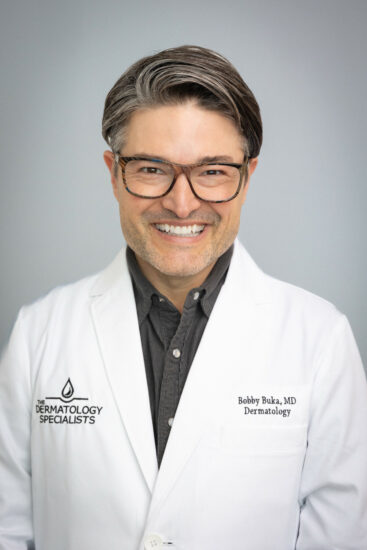
Dr. Bobby Buka says its important to think about skin protection year-round.
What other ingredients should consumers seek out — or avoid?
I would avoid two chemical sunscreens, oxybenzone and octinoxate. These are older agents that have been banned in several states and other countries based on their harmful impact on coral reefs.
Most sunscreens are creams. What do you think about aerosol sprays, foams, sticks and powders?
Here again, my favorite vehicle is the one that gets used. True, sprays and foams can be a bit quicker to apply to a full body or a squirmy 3-year-old, but find a formulation that best matches up with your day.
What misconceptions about sunscreens do you hear the most and want to correct?
The biggest myth is that sunscreen only needs to be applied when you go to the beach or in the summer months. The same UVA and UVB rays are shining down on us wherever we are, even on rainy days! The Dermatology Specialists have placed free sunscreen dispensers in Rodney Square near the farmers market to help encourage sun protection and skin cancer prevention every day.
Besides sunscreens, what else do you recommend to protect the skin when outdoors?
I’m a big fan of some of the newer insect repellants, namely Picardin. This was used in the Australian Army for years, and just recently became available in the U.S. While there is minimal toxicity from low percent DEET, picaridin is safer and is superior in its ability to keep away all versions of flying and crawling pests.
What do you recommend as relief for sunburn?
Topical cooling agents like aloe and even menthol-creams can be helpful with the symptoms of pain and itch, but my most novel suggestion here is the use of anti-inflammatories like ibuprofen (Advil) or acetaminophen (Tylenol) after a sunburn. Not only will these over-the-counter analgesics help with pain, but they also stave off free radical damage caused by ultraviolet rays. This is critical to preventing chromosomal damage at the cellular level, which data suggests may help prevent the development of early skin cancers.
— Physician-founded and physician-led, The Dermatology Specialists was established in 2019 and has since grown to become the largest dermatology group in New York City. With over 100 providers, they manage 500,000+ patient visits annually across 50 locations. Bobby Buka is a board-certified dermatologist, founder and CEO of The Dermatology Specialists. Visit online at TheDermSpecs.com.