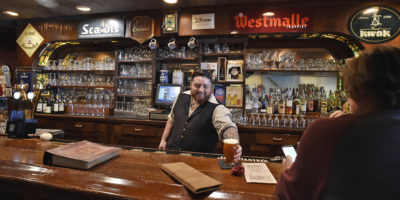

Above: Steak is benefiting from today’s focus on high-protein diets, but availability and price always come down to the cattle cycle.
By Pam George
Eating a steak is a sensory experience, from the intoxicating scent — at once savory, rich, and buttery — to the beefy taste and satisfying chew. The sight of a burnished sear, a rosy center, and an ivory curl of salt-sprinkled fat is enough to make the mouth water. It’s a fitting Valentine’s Day entrée, when indulgences abound.
New Castle County has no shortage of restaurants that feature steak. Brandywine Hundred boasts Harry’s Savoy Grill, Snuff Mill Restaurant, Butchery & Wine Bar, and Sullivan’s Steakhouse. The city has Bardea Steak, Tonic Seafood & Steak, and Walter’s Steakhouse, while Hockessin is home to RedFire Grill & Steakhouse.
South of the city, there’s Ted’s Montana Grill, The Marshallton Steakhouse & Seafood, and High Steaks Brewery in Delaware Park Casino & Racing. Even the beaches are rife with steakhouses; 1776 is now under new ownership, and a Brazilian steakhouse, Nossa Casa, just opened in Millsboro.


However, getting beef to the table in 2026 is a balancing act. Supplies are tighter than they were five or six years ago, and prices can move quickly. Yet restaurants still must deliver the same tenderness and marbling guests expect.
“What matters most to me is that every steak eats the way it’s supposed to — the same tenderness, same marbling, same cook — every single time,” agrees Antimo DiMeo, executive chef of Bardea Steak.
Demand Puts Beef on the Rebound
Beef sales have fluctuated over the years depending on whatever study — or diet — is making news. When low-fat eating dominated the 1980s and 1990s, many consumers shifted toward poultry and leaner proteins. Beef clawed its way back as low-carb, high-protein approaches (keto, paleo, and macro-based eating) gained traction.
Today, steak is part of the broad protein fad. Cargill’s 2025 Protein Profile found that 61% of consumers increased their protein intake in 2024, up from 48% in 2019. Granted, many protein-forward influencers tout eggs, cottage cheese, and powders more than rib eye. Still, diners who scale back beef at home often order steak when they go out.
“Ultimately, I think it’s one of those premium proteins that people still enjoy,” says John Constantinou, owner of Walter’s Steakhouse in Wilmington’s Little Italy section. DiMeo would agree. “People still come to a steakhouse to have a steak.”
Consistency and Quality are Key
Many people want to order steak because they don’t cook it at home. Anyone can slap meat on a grill or into a cast-iron pan, but it’s harder to produce a juicy, well-flavored cut with a proper crust and a perfect medium-rare center.
Then there’s the quality. Restaurants buy to tighter specs than many shoppers do, notes Joe Tis, who oversees culinary operations for Harry’s Hospitality Group, including Harry’s Savoy Grill.
The USDA’s quality grades — mainly based on marbling, or fat within the muscle — are part of that conversation.
• Prime has at least a “slightly abundant” degree of marbling and is often associated with upscale restaurants.
• Choice has at least a “small” amount of marbling.
• Select has at least a “slight” amount of marbling; it’s typically leaner and can be less juicy.
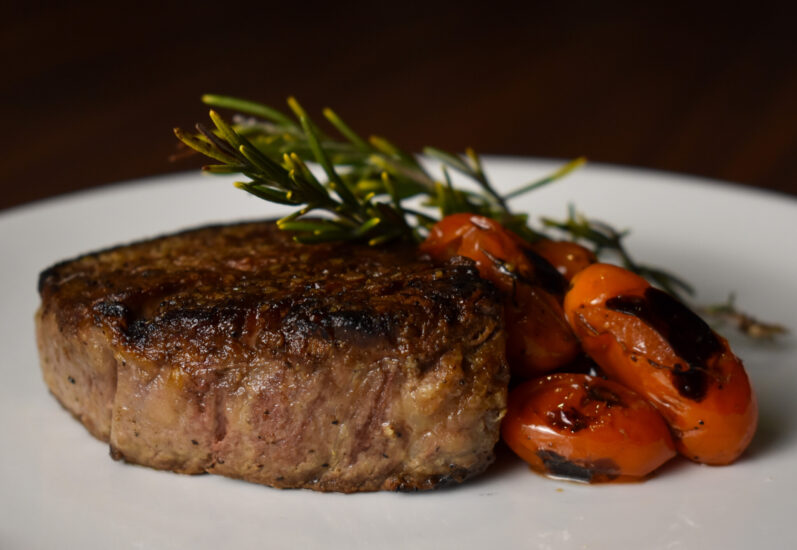
A filet at High Steaks Brewery at Delaware Park.
Aging influences tenderness and flavor, but the timeline depends on the restaurant’s program and purchasing model. At Harry’s Savoy Grill, the kitchen breaks down beef on site and holds prime rib for about 45 days as part of its in-house program, Tis says. Walter’s, meanwhile, receives beef that’s already aged about 21 days before it arrives. Constantinou says the restaurant typically keeps it another week or two.
Space and labor are part of the equation. A chain with 10 or more restaurants may not have the space — or the trained staff — to butcher meat at a high level across multiple locations, Tis says. Space is the primary issue for tiny Snuff Mill, which contracts with a third-party to age the beef. Owner Bill Irvin says he’d add more room for dry-aging if the restaurant expanded.
Supply and Demand
Even when steak’s popularity surges, availability and price still depend on the cattle cycle. It’s a marriage between slow agriculture — most beef cattle reach slaughter age in about 14 to 22 months, while grass-finished animals often take closer to 24 to 28 months — and a fast-moving market. Beef is a commodity.
USDA data projects per-capita beef availability dropping from 58.5 pounds in 2025 to 56.9 pounds in 2026, reflecting tighter cattle supplies and higher prices even as protein demand remains strong.
The cattle inventory numbers show the longer arc. On January 1, 2025, U.S. cattle and calves inventory totaled 86.7 million head, down from 94.4 million on Jan. 1, 2020, the year before a U.S. drought led farmers to liquidate a good portion of their stock. Rebuilding herds takes time.
“We are all doing our best to weather the storm until it gets caught up,” says Steve Demilio, vice president of food and beverage at Delaware Park Casino & Racing, where High Steaks Brewery is located. “However, we haven’t had any issues with availability or consistency, and our vendors have been excellent at managing inventory.”
Meanwhile, prices can change weekly. “Sometimes it feels like it can swing any given day depending on the cut,” DiMeo says. Harry’s Savoy Grill paid 50 percent more for prime rib than in January 2025.
“The old man in me wants to scream out: ‘Back in my day, I could get a whole side of beef for that price!’” says Patrick Bradley, culinary director of Jamestown Hospitality, which owns Tonic.
Perfecting the Pivot
Snuff Mill cuts volatility by buying direct from farmers. “You’re not waiting on a company like Cargill to get you your product on the 18-wheeler coming from Kansas or Texas,” says owner Bill Irvin. “The farmer sets his price, so he makes money and leaves it there for up to five months.”
So, why don’t more restaurants work directly with farmers? Supply is one limitation. Constantinou doesn’t want to worry if a small farm will have enough of the right cuts, week after week, to meet demand. For many restaurants, especially higher-volume operations, it is also easier to work with a limited number of vendors than to manage a long list of specialty suppliers.
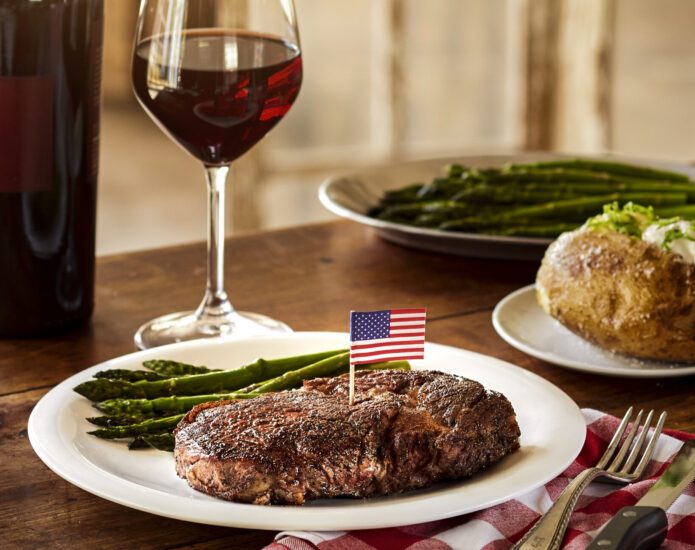
The Delmonico ribeye at Ted’s Montana Grill.
Steakhouses are adapting in different ways. They can raise prices, though that’s usually a last resort. At Snuff Mill, Irvin may increase the cost of specific cuts partly because they sell out, and the small restaurant is consistently booked.
Sides are another lever. Many steakhouses charge extra for them. High Steaks recently transitioned from á la carte to entrées with a choice of two sides — an adjustment that may increase the overall price but deliver more value.
Offering other proteins is a safety valve for cost-conscious diners. Harry’s Savoy Grill has long been known for seafood, and Tis says the group also features alternatives such as a high-quality pork chop. Constantinou, for one, is reluctant to put too many non-beef items on the menu. After all, the word “steakhouse” is part of Walter’s name.
Making the Cut
Restaurants can also reduce portion sizes and expand their portfolios. “We keep a small section of exclusive steaks for special occasions, while making other beef offerings more price-accessible,” Bradley says.
Some operations lean into cuts that are satisfying and more affordable than, say, filet mignon. Think skirt, hanger, bavette, and other butcher’s cuts, which are frequently marinated to boost tenderness and flavor. High Steaks offers a 10-ounce wagyu bavette steak. Also known as sirloin flap, bavette is an extended, flat, flavorful cut commonly used for steak frites.
If you think short ribs are an answer, think again. They’re indeed less expensive than other cuts, but they take time and talent to tenderize and develop flavors. Plus, their popularity has led to higher prices, Constantinou says.
At Bardea Steak, DiMeo says the restaurant rotates featured cuts depending on availability and guest interest. Cuts, including picanha (sirloin cap) and zabuton (often associated with Denver steak), pique customer curiosity. Many are part of the restaurant’s “Butcher’s Feast,” a multi-cut tasting experience.
Granted, familiar cuts still anchor the category — ribeye, filet mignon, and New York strip. (Prime rib, despite the name, is a rib-section roast, not a USDA grade; you can find select, choice, and prime versions.)
In a tight market, chefs and restaurateurs say the guest experience matters as much as the protein. “We’re going to focus on our hospitality,” Tis says. At Harry’s Savoy, he adds, a blushing slice of prime rib comes with attentive service and a beverage program that completes the occasion.
Demilio agrees. “From what we hear, 2027 should bring some more consumer-friendly beef pricing, so we will just have to wait and see, keep our fingers crossed and continue to get creative for our guests.”
If the last five years has taught the steak business anything, it’s that the market can move, the herd can tighten, and the costs can climb, but diners still expect the same bite every time. The restaurants that will win are the ones that keep the experience predictable, even when the supply chain isn’t.