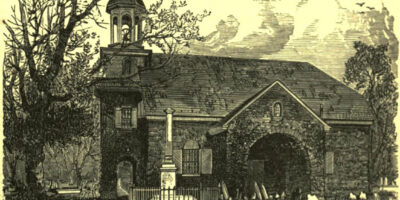


Above: Old Swedes Church is Wilmington’s oldest building. Photo courtesy Old Swedes Church.
By Laini Farrare
Historic places that help tell Delaware’s story
In late March 1638, two small ships sailed up the Delaware River carrying a group of settlers whose arrival would leave a lasting mark on the region now known as Delaware. Those vessels, the Kalmar Nyckel and the Fogel Grip, are often remembered as the ships that brought Swedish colonists to establish New Sweden, a short-lived colony that stretched along both sides of the Delaware River. Yet the story of that landing is much richer than a simple tale of flags planted on unfamiliar shores. It is a story of Swedes, Finns, Dutch influences, Indigenous diplomacy, and the practical building traditions that helped shaped life in the Mid-Atlantic.
The landing of the ships and the founding of Fort Christina near present-day Wilmington marked the start of New Sweden, the short-lived colony established by the Swedish Crown in 1638. About two dozen people including one enslaved African sailor, Antonius or “Black Anthony,” formed the original settlement.
The settlers were much more diverse than the title “New Sweden” suggests. Many passengers were Finnish people, then subjects of the Swedish Empire. At that time they were known as “Forest Finns” for their skilled lumber work. Others, including Belgians and Germans, arrived later from different backgrounds as political control shifted from Swedish to Dutch to English hands. From its earliest days, the Christina River settlement was a crossroads of languages, loyalties, and peoples.





The settlement would later grow north and west into what is now Pennsylvania and New Jersey. In 1643, the capital was moved from Fort Christina to Fort Nya Gothenborg on Tinicum Island. The colony’s other major settlements included Finland (Marcus Hook), Crane Hook (Wilmington), Wicaco (southern Philadelphia), Upland (Chester), and Fort Elfsborg (Salem, New Jersey).
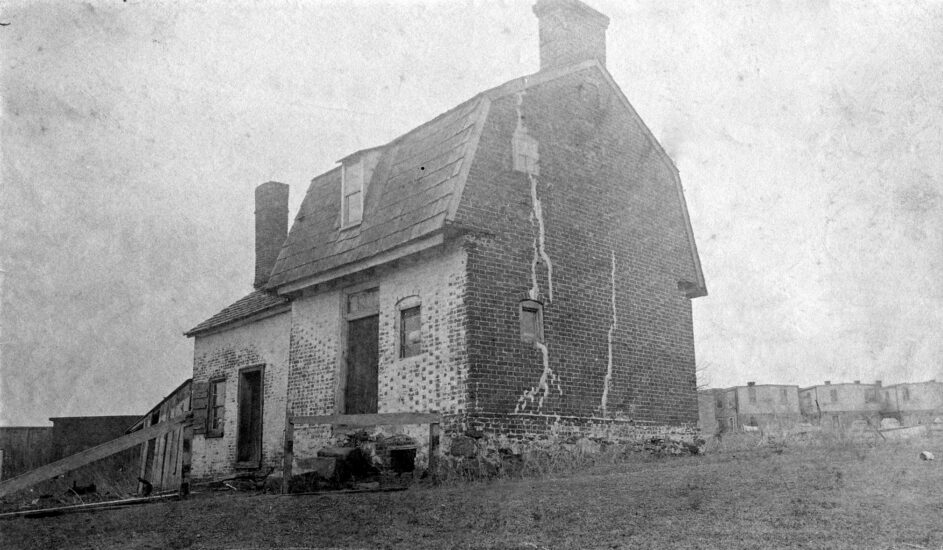
Dr. Tymen Stidham house, circa 1885. Photo courtesy Delaware Historical Society.
Aside from the Rocks at Fort Christina, the colony’s legacy in Delaware can still be felt at Wilmington’s oldest building, Old Swedes Church. Officially known as Holy Trinity Church, the congregation dates to the beginning of the colony. The present building was completed in 1698. The church and burial ground occupy a Lenape burial ground that is estimated to have been used for thousands of years prior to European settlement. One of New Sweden’s most famous residents was Wilmington’s first doctor, Tyman Stidham.
Perhaps New Sweden’s largest contribution to the United States was its log architecture. Finnish settlers helped popularize practical log construction in the Delaware Valley. The “v-notching” characterized Scandinavian log construction by cutting and shaping logs to fit together at the corners. English, French, and German settlers would later replicate this architecture with stylistic variations.
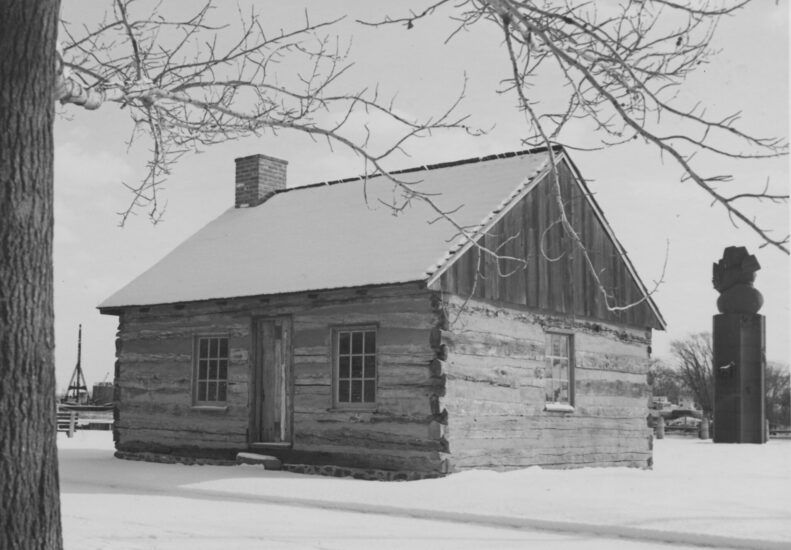
According to Delaware Public Archives, log cabins like this one (from the 1600s) were among the first to have been built in America. This one was moved to the Fort Christina Park in 1962 and existed there until the early 21st century. Photo courtesy of Delaware Historical Society.
Wilmington was home to many cabins during the early period. Though many are now gone due to wood’s fragile nature, Front Street, French Street, Market Street, and Walnut Street were still home to several cabins during the early 20th century. Not many people know that the romanticized imagery of log cabins on the rowdy American frontier was born out a transatlantic tradition in Wilmington, Delaware.
The history of New Sweden matters as Delaware prepares to mark the nation’s 250th anniversary. Too often, early American history is told through neat origin stories: one ship arrives, one group settles, and one town begins. Wilmington’s history is much more interesting than that. Its founding landscape was shaped by Indigenous people. Its colonial period included Swedes, Finns, Dutch, English, and Africans. Its institutions rose on ground already marked by earlier communities.
Today, visitors can tour the replica Kalmar Nyckel, walk through Old Swedes’ Churchyard, or stand near the site of Fort Christina. But they should also imagine the people whose names are often less centered. Wilmington did not begin with a single landing in 1638. It emerged from layers of human presence. That is the story worth telling and retelling as Delaware reflects on its past.
— To learn about upcoming DE250 events, visit Delaware250.org