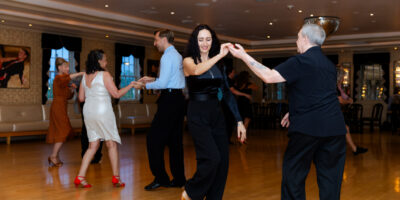


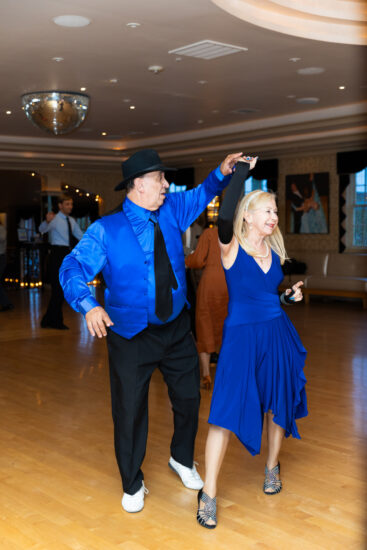
Above: Tania Sopit (front) and Denis Parfyonov (blue shirt) work an instructional session at the BlueBallRoom.
By Andrea Smith
Photos by Andrea Smith
Despite their status as ballroom dance champions, Tania Sopit and Denis Parfyonov’s careers as dance instructors were never secure in their home country of Ukraine.
Nationally, there were seasons of conflict and uncertainty even before the full-scale Russian invasion in 2022, often resulting in tense situations at their dance studio in Kyiv. People didn’t come to classes with the same optimism and joy as they do here in Delaware, Parfyonov says. How could they? War was imminent.
Now in Wilmington, they come to work at the BlueBallRoom Dance Studio with an expectation that what they build may last and that there’s space for hope and happiness.



“For us, it was very unusual that people were always smiling,” says Sopit. “Life is good, and there is always something to be grateful for… If you don’t feel like smiling, but you smile anyway, then you feel better automatically. That’s what I actually like about American culture and American people.”
Sopit and Parfyonov have been married for seven years and dance partners for 13. Making the leap together, they moved to the United States in late September of 2022 at the invitation of BlueBallRoom directors Ken and Roseanna Richards, who have connections throughout the ballroom dance world and felt compelled to help those who were interested in leaving Ukraine.
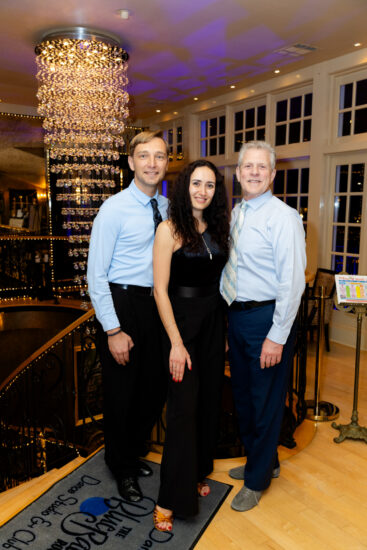
Denis Parfyonov and Tania Sopit with Blue Ballroom director Ken Richards.
“There was a lot of support for [Ukrainians], but not everybody knew what they could do,” says Ken Richards. “We knew that there were talented dancers in Ukraine, and that maybe we could provide an opportunity for a career, or a chance to escape the war and maybe also to make a new life here in America.”
Getting the job offer felt like winning the lottery, says Parfyonov. They didn’t know anything about Delaware — initially, an internet search for “Wilmington” diverted them to North Carolina and further confused their expectations — but they felt confident in the studio being a safe place to land.
The Richards sponsored Sopit and Parfyonov’s application through the Biden administration’s Uniting for Ukraine program and opened their home throughout the resettlement process.
“We took them to get their working papers, to get their social security cards, to get their driver’s licenses — all of those things helping them establish themselves so that they could work and pay taxes,” says Richards. “They’re making contributions to the community, just like everybody else, so they’re shopping here, working here, playing here, and you know, they’re a regular part of Wilmington.”
Dance With Me
Both Sopit and Parfyonov were born and raised as dancers in different Ukrainian cities and met as adults while training and teaching in Kyiv. As professional dance partners, they placed first in multiple Ukrainian dance competitions, first in a European Standard Showdance Champion, and were finalists in two world championships. Since moving to Delaware, they’ve retired from competing but still enjoy performing at regional events — such as last month’s Field & Fête: Winterthur Celebrates 75 Years — while teaching group or private lessons six days a week.
Additionally, their jobs involve fostering a community at the BlueBallRoom by hosting club dance parties in collaboration with other staff members. These typically occur twice a month and they welcome non-members to visit the studio, too. People of all ages come with partners, friends, or alone — knowing they’ll find someone to dance with before the night ends.
The space is set up more like an events venue than a traditional dance studio. A Frank Sinatra radio station plays on outdoor speakers 24/7, greeting guests from the parking lot. Inside, a chandelier sparkles above a curved staircase and leads dancers to the lobby and an open studio, where a disco ball glitters over the dance floor. There are tables and a small bar at the center that allow space for socializing, snacking, and people watching.
“My wife and I wanted to build a beautiful place where people could feel special when they come in the door — not just a dance floor and a ceiling with fluorescent lights,” says Richards. “We recognize what dance does for people. We have a number of students who are psychologists, who are teachers, or who are medical professionals, and they take from this a reset in their lives — their busy, busy lives with helping people. They come in here and they do something for themselves.”
At a club party, there’s no pressure to perform with perfect technique, although it does provide an opportunity to practice the styles of dance taught in various classes. Dancers take their cues from the mix of music playing throughout the evening: Is the beat conducive to a cha-cha, swing, salsa, or waltz? They listen, find their rhythm, and move across the floor accordingly.
All BlueBallRoom instructors are well-versed in a variety of ballroom, Latin, and other social dance genres, so their students learn how to partner with another dancer and either lead or follow cues. Students have opportunities to test these skills and earn medals in bronze, silver, and gold, which represent the levels completed through in-studio training. At a party in late April, Richards and the instructors awarded certificates to those who had recently performed in front of judges to complete their Medalist Achievement Exams.
Students test new moves during a recent dance class at the BlueBallRoom.
Students range in age from elementary-aged kids to older adults. Some come for professional training and compete across the country, while others join classes as a hobby or to practice for an upcoming wedding. It’s a popular studio for engaged couples or brides and their fathers who want to learn a dance routine, as well as for couples seeking a unique date experience.
Joanie Thayer, one of Parfyonov’s students, joined the studio after her husband passed away, and in retirement, she reignited a love for dance.
“When I walk in the ballroom, I feel special, and I feel young,” says Thayer. “It’s just a very special feeling. And when you learn these dances, it’s a very good health situation, as well. It keeps your brain going and your body going.”
Kyle Turner began lessons shortly after moving to the area, hoping to meet people and also learn ballroom dance.
“He’s really good with the details, and he knows how to work within my capabilities,” Turner says of Parfyonov’s teaching strengths. “He’s so advanced, of course, but he never makes you feel [behind].”
“People need our knowledge, our skills. They appreciate it,” says Parfyonov, adding that he learns something new from his students every day.
The American Dream
After nearly four years in the United States, Sopit and Parfyonov have bought a car, adopted a dog, and started looking for a house to buy. They admire the white-picket-fence neighborhoods and ample parks, but most of all, they’re grateful to make a living as dancers.
“It’s the American Dream,” says Parfyonov. “If you’re a professional in something, you can reach everything if you want it. In Ukraine, unfortunately, it’s a little bit different.”
It’s more feasible to support their families while they maintain steady jobs in Delaware, he says. Still, it stings to remember the danger and uncertainty that loved ones endure back in Ukraine.
“My mom calls me to say, ‘I’m in the shelter again,’” says Parfyonov. “And we’re sitting here, sitting in a beautiful studio, and somebody in the shelter cannot sleep because there’s no electricity, bombs falling … It’s tough.”
At least 5.6 million Ukrainians have tried to leave, and approximately 3.7 million remain “internally displaced within Ukraine, navigating precarious living conditions often marked by overcrowding, inadequate shelter, financial insecurity, and limited access to basic services,” according to the United Nations’ International Organization for Migration.
They talk with their family regularly, and Sopit’s parents have been able to visit them in the United States. But while the couple continues to work through ever-changing immigration requirements to maintain their legal status here, they must stay in the United States and wait for an opportunity to visit in the future.
“Even if the war stopped tomorrow, we would still stay here,” says Parfyonov. “We feel like we’re in our country, and we feel at home here.”
Their goals are to “travel, have fun, teach,” and “make our dance community bigger,” says Parfyonov. They hope to see the BlueBallRoom busy all day, every day.
“All our students are just so uplifted. They all have their troubles and problems, you know, but they always look happy,” says Sopit. “Dance also helps all of us be a little happier, a little more grateful.”