
By Mark Fields
Vatican Melodrama Follows Election of a Pope
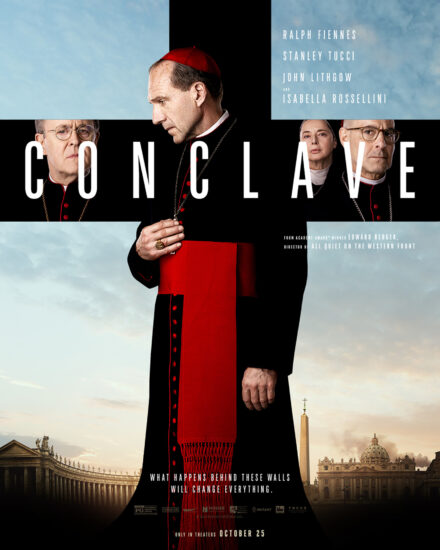 A sturdy melodrama, Conclave charts the traditions and machinations of the election of a new pope upon the death of the previous one. Built largely on the nuanced performance of Ralph Fiennes as Cardinal Lawrence, the dean of the College of Cardinals, the film takes place almost entirely within the sequestered confines of the conclave gather to select the next leader of the world-wide Catholic Church. It will not surprise anyone who has paid any attention to either Catholic current events or modern movie plotting that the process is not entirely (or even substantially) divinely inspired.
Quickly, Lawrence must contend with the conflicting theologies and worldviews of the various contenders, plus a raft of unexpected intrigues that complicate the secretive process. The various players include the moderate American cardinal Tremblay (John Lithgow), the liberal Bellini (Stanley Tucci), the warm but conservative African Adeyemi (Lucian Msamati), and the firebrand Italian reactionary Tedesco (Sergio Castellitto). Each has a conflicting aspiration for leadership of the Church, and some have wounding secrets that they wish to keep buried.
Peter Straughan’s screenplay (based on the original novel by Robert Harris) reflects the duality with which many approach the Catholic Church, entranced by the century-old rituals that guide the faith and yet sadly, painfully aware of the Church’s numerous failings. Similarly, the story is conflicted, albeit somewhat sympathetic about the challenges of clerical life, which calls on men (yes, sadly, mostly men) to defy their baser, selfish human instincts.
Nowhere does this latter drama play more than in the anguished face of Fiennes’ Lawrence, a decent man wracked with doubts about his own faith and about his ability to negotiate the treacherous cross-currents of his fellow cardinals in the conclave. Fiennes has never gotten the full accolades warranted by his long and extremely varied career. Perhaps Conclave will address that issue.


Director Edward Berger quite intentionally takes a deliberate pace to the story here, which is heavy on repetitive rituals and heady, tense and oft-whispered dialogue. The story resolves itself in a manner that is surprising, satisfying, and yet highly improbable. It’s easy to get carried along by the melodrama here, and ignore the troublesome flaws in the screenplay (largely reflective of the need to appeal to modern American audiences).
See Conclave for the rich performances and the beautiful Roman pageantry, but try not to overthink the details in the way that the characters do.