
By Mark Fields
Zendaya Can’t Save This Tiresome Love Triangle of Disagreeable Tennis Players
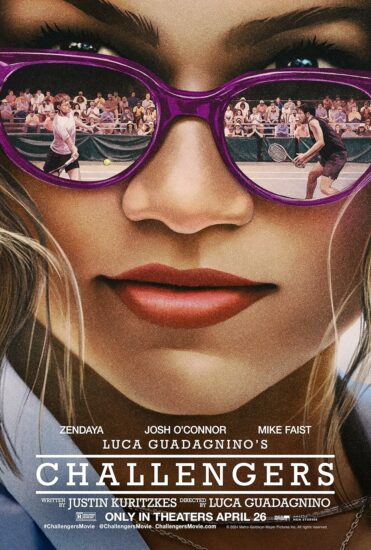 Director Luca Guadagnino has made his filmmaking reputation with movies focusing on unconventional, society-defying characters, often with a psychosexual component. Call Me by Your Name (his most acclaimed film), A Bigger Splash, Suspiria, and A Bigger Splash all feature characters that rebel against the strictures of polite society, often with a loud flamboyance used to mask their inner insecurities. Challengers, set in the world of professional tennis and featuring Zendaya in her first starring film role, continues this trend, and suffers from flaws similar to his earlier films: in making his primary characters outliers, he also makes them difficult to sympathize with and sometimes even understand. The result is that the viewer is left adrift.
Zendaya plays Tashi, an extremely promising teenage tennis player seemingly destined for professional greatness. Her talent and her beauty catch the attention of two male aspirants to the game who also share a friendship/rivalry, Art (Mike Faist) and Patrick (Josh O’Connor), and Tashi seems to welcome the attention of both. The story of their love triangle is told mostly in time-jumping flashbacks over the course of a late-career match between Art and Patrick. A clever, even subtle element of Justin Kuritzkes’ screenplay is that the respective romantic fortunes of the two men is reflected in the score of their current match.
The problems with Challengers show up very early, the first of which is that none of these characters evoke any endearing feelings on the part of the audience. They are all self-absorbed and some degree of unhappy or dissatisfied. All three spend a good deal of the film merely scowling or pouting. I struggled to care about the various shifts in their situations, individual or coupled. Second, Zendaya has a difficult time holding the center of this film. It’s unclear whether that is the fault of the screenplay or of the actress’s limitations. Faist and O’Connor also strain to overcome the dislikability of their characters.
Neither the director or the screenwriter of Challengers have any faith in the audience. Even the few moments of genuine invention are telegraphed long before the payoff that we filmgoers don’t feel exulted but instead mildly peeved by the delayed gratification. Finally, the movie tries so hard to be unconventional in its sexual politics that it sacrifices any sense of sincere connection with the viewer.


The greatest challenge in this movie is caring about the outcome when it finally arrives.