
Above: Posing with a map that tracks the progress in Hilltop are Wilmington Councilwoman Maria Cabrera, Ray Saccomandi of the Wilmington Neighborhood Conservancy Land Bank, project manager Bud Freel, Councilwoman Bregetta Fields, and Captain Matthew M. Rosaio of the Wilmington Police Department.
By Ken Mammarella
Close to a hundred times, Bud Freel has been leading Delaware’s movers and shakers (including the governor twice and staffers from all three offices of Delaware’s congressional delegation), bankers, business leaders and other interested parties on tours of a few blocks of Wilmington’s disadvantaged Hilltop section.
He gives out a map marking the focus of the new Lower Hilltop Affordable Housing Initiative — N. Franklin to N. Van Buren streets, Fourth to Pleasant streets — and its future focus, expanding out to Jackson and Broom streets. Lines outline dozens of vacant properties (often magnets for decay and crime). Introductory research found that 69% of housing in the area is rented (as a rule, absentee landlords and renters care less about their buildings and their neighborhoods than homeowners).
Freel, who was a city councilman for 24 years, is now working part-time for the Wilmington Neighborhood Conservancy Land Bank on these blocks. “I always wanted to focus on one small area and really get into it,” he says during a tour. “Work hard and see if you could revitalize it. It’s not just about bricks and mortar. It’s about stabilizing a community.”



“He’s doing a great job,” Wilmington Mayor Michael S. Purzycki says of Freel. “He takes a personal interest in every property that he’s adopted. He’s like a little neighborhood mayor, and we need people committed like that.”
The initiative launched in August 2022 and since then has bought 31 homes, rehabbed and sold 10, and is planning for the rest.
The goal: more homeowners. “Homeowners have a stake in the community,” says Ray Saccomandi, director of operations for the land bank.
“You’re not going to have a stable community with 70% renters and absentee landlords,” Freel says.
“They’re not going to fix up their house. They’re not going to make it beautiful,” Saccomandi says of absentee landlords. “Homeowners aren’t going to let nonsense happen in front of their house. They want to protect their investment.”
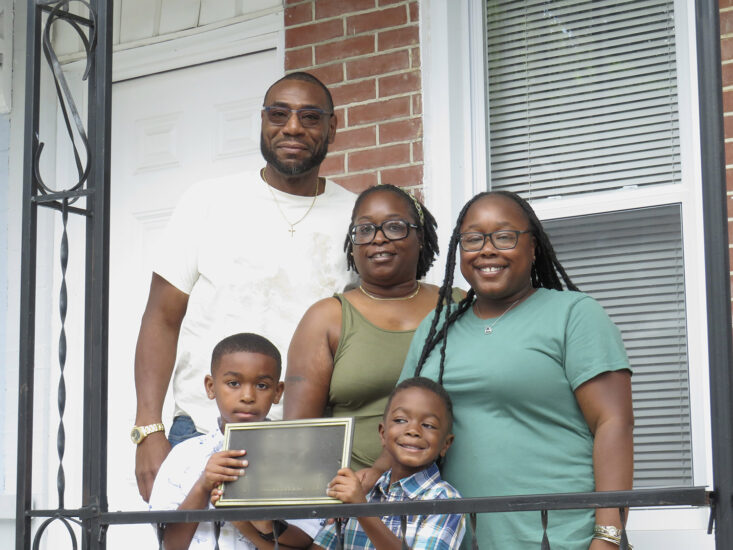
Pictured with her parents and sons, Tabria Pinkett (right) is one of several new owners who have purchased restored homes in the community.
The land bank is making serious investments itself, subsidizing renovations by thousands of dollars. For instance, one of the first houses, on the 300 block of N. Harrison St., cost $85,000 to buy, took about as much to renovate and was sold for $140,000, Freel says. The initiative’s costs are supported by $1 million in federal American Rescue Plan Act funding and $850,000 in the state’s bond bill, Freel says.
The initiative, as much as possible, hires minority contractors to take these century-old houses down to the studs and build them back up. A peek inside one completed house shows off new windows, quartz kitchen countertops, a new first-floor powder room (a land bank goal, Saccomandi says), tile in the bathroom, a newly fenced back yard and fresh paint everywhere. Bronze address plates near the front door finish each project. “We’re not chintzing on the material,” he says. “I want it to look nice.”
Elva Martinez, who grew up in the neighborhood and moved back in 2021, is thrilled by what’s happening around her. “It’s phenomenal,” she says. “I feel most comfortable right here.”
Will Figueroa, a Hilltop resident since 2005, is also happy, citing fewer loiterers and less crime. “We need every single block to look safe,” he says.
Wilmington Police Department Capt. Matthew M. Rosaio offers a telling stat on crime: In the department’s 17th District, which includes the Lower Hilltop area, overall Part 1 crimes (including murder, rape, robbery, aggravated assault, burglary, felony theft and auto theft) are down 53% so far this year compared with the same period in 2023.
Freel feels that passion is spreading, with other homeowners inspired to fix up their properties.
They and other Wilmington homeowners can get renovation help through multiple programs, such as the West Side Grows Aging and Staging Repair Program, the Façade Improvement Program and the Neighborhood Stabilization Program.
Maria Cabrera, a member at-large of city council, wants more help to be available, say by the city establishing a fund where residents can get simple-interest loans for home repairs. For those who qualify by income or age, the funds would be grants.
To discourage vacancies, she also wants to increase the city’s fee assessed on vacant houses, which starts at $500 after the first year it’s vacant, hits $5,000 at 10 years and goes up $500 a year after that.
I always wanted to focus on one small area and really get into it. Work hard and see if you could revitalize it. It’s not just about bricks and mortar. It’s about stabilizing a community.
– Bud Freel
She and councilwoman Bregetta Fields, who represents the area, want to establish a “legacy home” effort to encourage families to sell houses that they have great emotional attachments to but no longer live in.
“Let’s put a little plaque on them,” Cabrera says. “That way, when they drive by, they can show their grandchildren ‘That’s Grandma’s first house. That’s where I grew up.’ It’s as simple as that.”
When asked which Wilmington neighborhood he would like to see a similar initiative, Purzycki calls out the area along Market Street from 20th Street north to 40th Street. “The North Side could use attention,” he says. “It’s healthy but challenged.”
Another group is taking a different tack nearby. The Be Ready Community Development Corp., founded in 2003 to revitalize Hilltop, dedicated a mixed-use complex in 2023 that replaces a block of vacant properties on W. Fourth Street. Solomon’s Court, when complete, will have 18 affordable rental units and 5,600 square feet of ground floor commercial space for small businesses.
The Lower Hilltop Affordable Housing Initiative is doing more than rehabbing houses. It’s gated the alleys between properties to keep out drug dealers who had been using them. It’s knocked down buildings too far gone to save. On the 1200 block of W. Second Street, “the former site of considerable drug activity and loitering,” the land bank bought 12 parcels, demolished three deteriorated adjacent units and created a large, well-lit and fenced-in green space nicknamed “the corral.”
Although ideas have been proposed — wouldn’t new homes with off-street parking be nice? Cabrera suggests — Freel says there’s not yet a big-picture vision for the corral.
Throughout the tour, Freel showed that he is concerned about every detail to make the initiative successful. One Hilltop resident says that he’s seen Freel on his hands and knees picking up trash off the pavement.
“I joined him for a few minutes,” Figueroa says, “and then I had to go to work.”