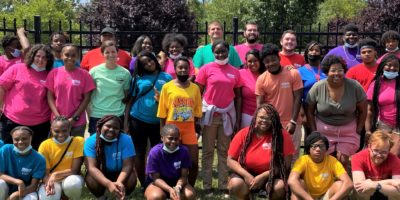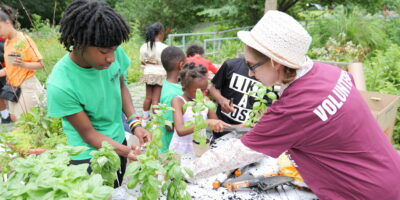


Above: A DCH volunteer assists Urban Promise summer campers planting herbs and making a healthy salads recipe using vegetables grown on the premises. Photo provided.
By Andrea Smith
It’s easy to appreciate a tree in the summer when seeking respite from the sun’s unabated heat. But beyond shade and slightly cooler air, trees offer year-round air pollution removal, mitigate flooding, and boost wellbeing for those in their vicinity. Thanks to the Delaware Center for Horticulture (DCH) and its partners, hundreds of trees are popping up or being replaced across Wilmington every year — and that’s just a small part of the nonprofit’s work to protect the environment and residents’ health.
“Helping to improve the environment — whether it’s through greening efforts, through planting more trees, through planting habitat gardens — it’s not just beautification,” DCH Executive Director Joanne McGeoch says. “These [efforts] are actually essential to developing resiliency and adaptation for a changing climate in our community.”
Like a tree, the DCH serves locals in more ways than are visible at first glance. Its building in the Trolley Square area features a nature-inspired art gallery, events space, plant nursery, public classroom and public garden. Across the city, DCH has planted seeds for urban farms, community gardens, public green spaces, and corporate and private landscapes. Its programs teach people of all ages about sustainability and how to grow their own food, with an emphasis on career development for those interested in horticulture or agriculture jobs.



This year, the DCH was selected to participate in a prestigious capstone cohort with American Public Gardens Association, the Urban Agriculture Resilience Program, a nationwide program promoting public garden participation in collaborations that combine food growing and education while addressing food security challenges facing communities. As one of five organizations chosen to participate, DCH received $55,000 and expects this funding will expand DCH’s impact across Wilmington — particularly in urban areas lacking access to fresh, nutritious foods.
“Communities that are most vulnerable to environmental challenges are predominantly in areas where there is a lack of access to green space and healthy, fresh food,” McGeoch says. “In this way, greening and urban farms can be a tool for environmental justice.”
For the Community’s Health
According to the Delaware Department of Natural Resources and Environmental Control, environmental justice “seeks equity for minority and low-income communities that may be disproportionately exposed — and vulnerable — to adverse environmental impacts.” DCH connects environmental challenges with health and wellbeing, which results in urban agriculture projects such as the E.D. Robinson Urban Farm and Shearman Street Community Garden.
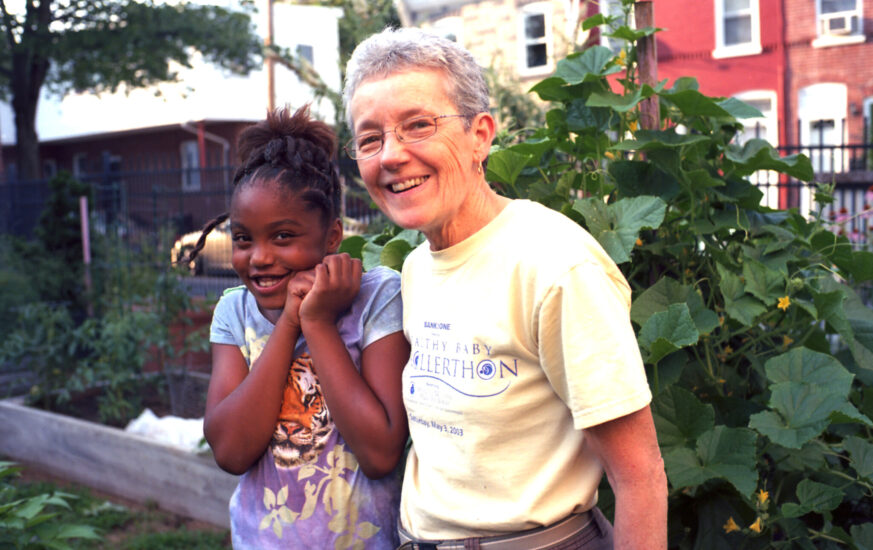
A long-time volunteer, Alice Davis with a young neighbor at the Shearman Street Community Garden. Photo provided.
Both green spaces are located in the state’s Equity Focus Areas where the poverty percentage is twice that of the state average. According to the Tree Equity Score map, a national resource that tracks environmental and social factors impacting different neighborhoods, the Shearman Street Community Garden is in a neighborhood with 23% canopy cover and meets its goal of 20%, but the E.D. Robinson Urban Farm neighborhood is at 16% of its 40% goal.
“[E.D. Robinson Urban Farm] was founded by a community member that said, ‘I’d love to see a garden here that feeds the people in our neighborhood,’” McGeoch explains, referring to the farm’s namesake, Eric D. Robinson, in 2009. “Ideally, when we’re working on these green spaces, it’s community-led and community-driven. It’s responsive to a desire by the community to do the work with us.”
DCH helped found the Delaware Urban Farm and Food Coalition in 2007 to streamline efforts by various neighborhoods, community advocates, and nonprofits to start and maintain these local food sources. McGeoch estimates that, since DCH opened in 1977, it has contributed to 50-plus community greening and urban agriculture projects.
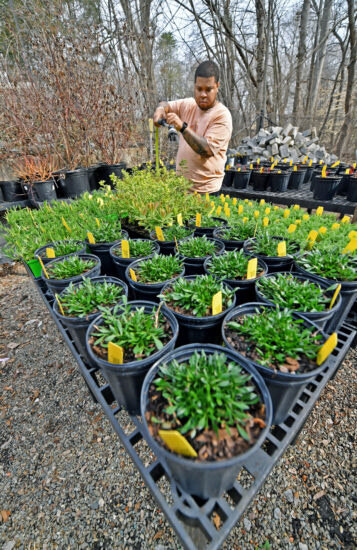
A Branches to Chances trainee tending the plants in DCH’s nursery in Trolley Square. Photo by Butch Comegys.
The Urban Agriculture Resilience Program will improve DCH’s targeted efforts as its team answers the question, “How can urban agriculture be used as a tool, not just for engagement and introduction to horticulture and gardening, but also really to help serve a greater good for the community through nourishing food?” McGeoch says. She looks forward to the networking opportunities to come, including a sponsored visit to Chicago Botanic Garden, where those in the cohort may learn about how other organizations are excelling in urban agriculture across the country.
The award money benefits existing urban agriculture projects and will help support educational programs and use of a “high tunnel” which allows season extension for growing vegetable plants and seed starts for DCH gardens and community gardens. At Shearman Street Community Garden, DCH Urban Agriculture Manager Jamie Shanklin-Spencer will lead a new workshop series, “Eating Smart & Moving More,” starting this spring.
The five weekly sessions are for those who receive food from the community garden and teaches them how to eat healthy on a budget, plan and prepare meals with food safety in mind, and stay active as a family. The location of the workshop is key, as it’s within walking distance of homes in “food deserts” where fresh, whole foods aren’t always accessible. Many residents here struggle to afford groceries, so produce from the garden is often donated to families in need.
To Shanklin-Spencer, urban agriculture creates an understanding of where food comes from and how that impacts wellbeing. She previously led a similar workshop at her shop in Wilmington, Messiah’s Market Herbs & Horticulture, and saw the need for a seed-to-plate connection.
“I’ve had kids say to me, ‘Wow, I can’t wait to show my mom or my dad that carrots come from the ground,’ she says. “That sounds so simple, but if we don’t know where our food comes from, how do we really know how it’s helping or hurting us?”
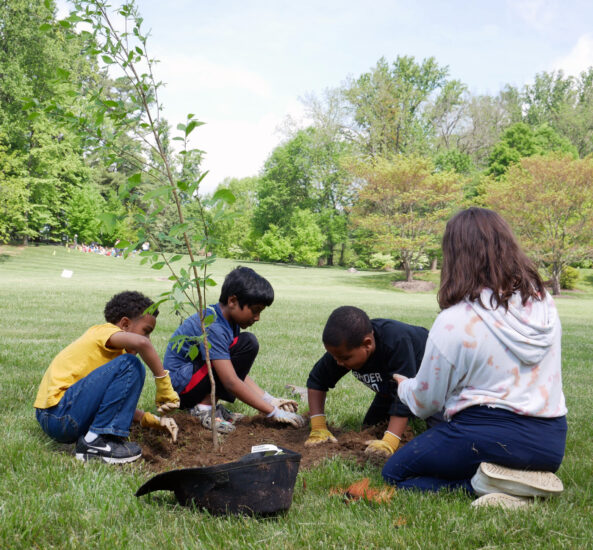
Elementary school students help plant a tree at DCH annual Arbor Day event at Rockwood Park. Photo provided.
DCH has partnered with Urban Promise, a faith-based school and youth organization in Wilmington, with a similar goal to educate kids on how they can grow plants and food. Shanklin-Spencer is also working on a newer partnership with The Warehouse, a teen center just steps away from the E.D. Robinson Urban Farm. She points to the Urban Agriculture Resilience Program as an opportunity to improve partnerships and learn from others in the cohort.
“[We can find] better marketing strategies, because our programs are great and a lot of times we’ll have workshops or we’ll have series and then find out later on that not everyone that could have been impacted was [reached],” she says. “They’ll say, ‘Oh, I didn’t even know that that was happening,’ and they would live like the next block over. We’ve got to do better with our marketing efforts and tracking our impact–those are basically the two things that I want to improve.”
For a Sustainable Future
DCH is continuing its educational efforts at its building and across the Greater Wilmington area through the Branches to Chances employment development program and by adding a new training program this summer. Since 2009, Branches to Chances has prioritized applicants who are unemployed, underemployed, recovering from addiction, or previously incarcerated. It provides them with nine weeks of paid work, hands-on job training, and personal counseling throughout the spring. Applications for the new, 12-week Urban Conservation Corps are now open to anyone ages 18 to 25 with an interest in green jobs.
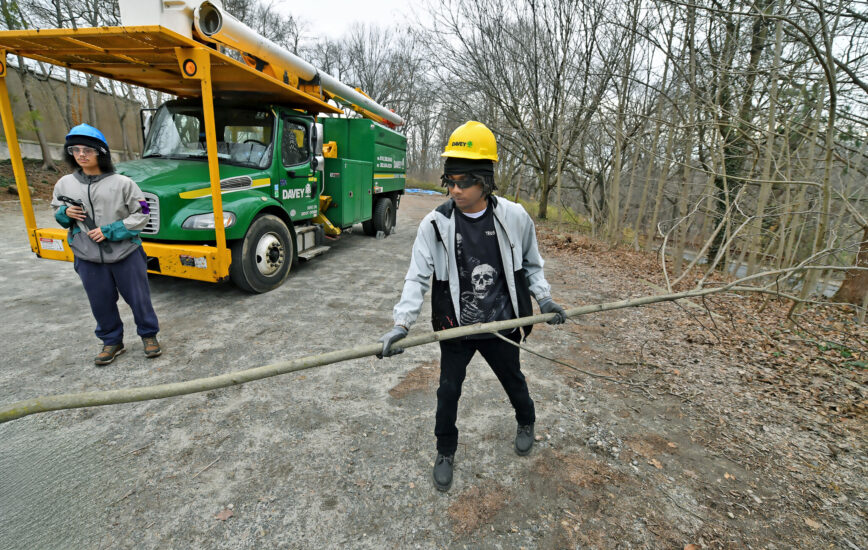
A Branches to Chances trainee participates in a tree pruning lesson with arborists from Davey Tree Company. Photo by Butch Comegys.
“This program will be just like Branches to Chances in that it will provide paid training in horticulture, so they’ll be working with us on community forestry, urban agriculture, and then with our community greening program,” McGeoch describes. “The goal, in addition to exposing them to these types of jobs that are possible, is to help them with gainful employment. We think there’s a real incredible opportunity here, in particular, because we are in the garden capital of the world. There are so many great institutions nearby — from Winterthur and Longwood Gardens to Mt. Cuba Center, just to name a few — that really are looking for rising leaders.”
McGeoch sees the field as a viable career path with diverse positions for those with college degrees and for those without. “I think now more than ever, young people are aware of or understand the complex challenge that we’re facing in climate change,” she says. “They’re already really tuned in and understand the impact — or the potential impact — of not doing anything. So why not mobilize and capitalize on that excitement, that enthusiasm, and that awareness by providing opportunities to do something about it?”
DCH is a member of the American Horticultural Society and the American Public Gardens Association and was recently accredited by The Corps Network.
“By having this accreditation, we’re joining a network of over 150 conservation corps nationwide,” McGeoch says. “It also helps us provide a framework that measures and evaluates the effectiveness of the program in context with all the other corps programs throughout the country.”
Longtime DCH board member Ann Wick has been involved with the Garden Club of Wilmington since 1973, just a few years before the club helped to establish the DCH in 1977. She’s seen the area grown in green spaces and in horticulture opportunities and credits DCH for its collaborative nature. Sustainable communities require partnerships, she affirms.
“The future of the organization is very important to the Garden Club of Wilmington, and it is to me, and I think it’s very important for the city of Wilmington,” Wick adds. “This is really a rich horticultural area, so I think the opportunities are tremendous.”
Delaware Center for Horticulture Helps Our Communities Grow
Four ways how DCH helps improve environmental health and resiliency in our neighborhoods.
-
Community Greening & Urban Agriculture
-
The Delaware Center for Horticulture (DCH) founded the first urban farm in Wilmington, which has been a cornerstone of the organization’s work for nearly two decades.
-
More recently, DCH has become increasingly focused on building capacity through partnerships and connecting organizations that work in food distribution and nutrition education with other urban farmers. The organization is piloting a new series focused on growing, cooking and preparing healthy food using ingredients that can be sourced from small urban gardens and kitchen gardens.
-
In DCH’s work in Community Greening, it leverages community organizations, community activists and elected officials to champion projects led by the community to make the changes they wish to see in their neighborhoods. From tree stewardship training to emboldening beautification efforts along sidewalks using planters, small gardens, and street trees, the driver of this work is community members.
-
-
Branches to Chances® & Urban Conservation Corps
-
Launched in 2009, DCH’s Branches to Chances® (BTC) program has trained more than 110 individuals in our back-to-work program. Using horticulture to help participants regain stability, BTC offers paid training and education,
exposure to green jobs, and fosters a deeper connection to the environment. -
“I was hopeless, and Branches to Chances gave me hope,” says Robert, a recent graduate. “I learned to relate plants to my life — they needed water and food and sun, and that’s what I needed.”
-
In summer 2026, DCH will launch the Urban Conservation Corps, a 12-week paid program geared towards young adults aged 18-25, providing hands-on training in horticulture and green job readiness. Participants will gain experience in urban and community forestry, ecological gardening, and urban agriculture, with opportunities for advancement through community field service projects.
-
-
Preparing Wilmington for Climate Change
-
DCH believes that there will be growing need for expertise in resiliency planning — adapting to climate change as global temperature shifts, and unusual weather patterns increase.
-
Climate change is producing higher sea levels and more volatile storms, increasing flooding across the U.S. After the historic flooding event in 2021 from Hurricane Ida, community stakeholders launched a comprehensive study to better inform the impacts of unusual weather events, and how it may impact communities in Wilmington.
-
There are over 5,000 properties at risk of flooding in Wilmington over the next 30 years, which represents nearly 20% of the properties. Resiliency planning through the use of green infrastructure, greening initiatives, and training individuals to tackle these challenges is essential.
-
-
Offering Assistance in Our Own Backyards
-
Most people want to see more trees in their community. According to the 2025 Canopy Report from the Arbor Day Foundation, 73% of Americans surveyed said they wish their neighborhood had more trees. 87% said trees and greenspace have a noticeable impact on their mental wellbeing.
-
Helping local residents grow native plants and trees provides so much more than beauty in the landscape — it also helps provide habitats for essential insects including such pollinators like butterflies and honeybees.
-
In addition to helping provide shade from the summer sun, native trees also act as purifying filters for better air quality. A single tree absorbs
between 10kg and 40 kg of carbon dioxide per year; that’s roughly one ton of CO2 in its lifecycle.
-
— To find out more about how you can get more involved with Delaware Center for Horticulture, visit TheDCH.org.