
Above: Otis (left) and Jules playing another game of tag among the hills of West Virginia.
By Jim Miller
This is a story about joy, pain, life, death, and a dog named Otis.
It’s also a story about us…
I first saw Otis nearly 11 years ago in a photo posted online by the husband of a longtime friend. Their family had been fostering a litter of puppies in their home.

Small, brown and furry, Otis and his five siblings were cuddled together in a pile of cuteness. All six would soon be available for adoption.
I tried to resist the temptation, but it was relentless.
I already have a dog, I said to myself. A three-year-old mutt at the time, Jules resembled a mix between a mini-Dobermann and petite-sized heat-seeking missile. She was incredibly athletic and active. She was also alone at times when I was at work.
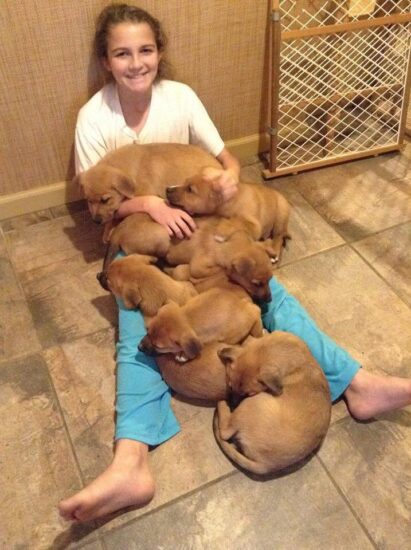
Otis and his puppy siblings in December, 2014 with one of the family members who fostered them.
Perhaps she could use a friend…
There was a second reason another dog felt right. A month prior, my father had passed after a 25-year struggle with Parkinson’s. It dawned on me that a door had closed, and now another, albeit much smaller one, was opening. I filed the paperwork the next day.
Jules and I soon found out Otis was a rascal. Moments after meeting him, the little bugger scampered off with Jules’ leash in his mouth, taunting her to chase.
And she did…
In fact, the two reenacted this scene hundreds of times in the years that followed. Otis would buzz by in a subtle dare, and Jules would oblige, launching in hot pursuit. It was as if her deeply engrained stalking instincts found the perfect symbiotic match to his innocently wily nature.
Yet as deft as Otis was as the artful dodger, there was something that eventually proved to be more cunning. At the end of August, an aggressive form of lymphoma came out of nowhere — one Otis was unable to out-juke. Just one week passed between first symptoms to the moment the two of us had to say goodbye.
I was devastated: Otis was gone.
Three days earlier, the two of us went on our regular walk through our neighborhood. For the first time, we left Jules at home. Although suddenly upbeat, Otis was weak and needed to proceed at his own pace.
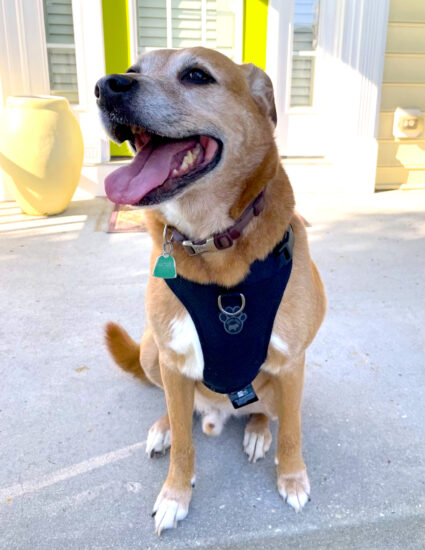
Otis ready for a long walk in Milton, Delaware, in 2022.
It was a Sunday morning, sunny and peaceful. As we passed familiar houses, I wondered how many neighbors we’d met on our daily walks over the years: the young parents sending off their kids to school, the middle-agers heading back and forth to work, and the retirees doing the rounds for their health. Then, there were the countless other dog owners we’d met walking their pups. Would I ever have known these people and dogs without first knowing Jules and Otis?
As we made our way home, I felt grateful for the walk. Frail but doggedly persistent, Otis had insisted we go… and kept going. I was so proud of him. In my head, I’d been telling myself: If he’s leaving me soon, I want one more walk.
Somehow, it felt he wanted the same.
As humans, we thrive on connections. We need our family, our friends, our neighbors. Dogs seem to want these connections, too. In this way, they may be more like us than we previously thought. That might surprise some people, but recent studies offer interesting insights.

Otis on the day he was adopted at Delaware Humane Association in 2015 (left), and then again earlier this summer.
“One theory about dogs is that they are primarily Pavlovian machines: They just want food, and their owners are simply the means to get it,” says researcher Gregory Berns in a piece published by Emory University. “Another more current view of their behavior is that dogs value human contact in and of itself.”
Berns, a professor at Emory University’s Department of Psychology, used MRI brain scans to show strong neural responses in dogs. Published in the journal Social Cognitive and Affective Neuroscience, Berns’ study offers evidence that dogs respond more strongly to praise from their owners than they respond to food.
In other words, love is thicker than gravy.
It’s all reciprocal: We give dogs our homes; in return, they give us their hearts. In exchange for teaching them to sit and heel, dogs teach us loyalty and unconditional friendship. And long after we train them not to pee in the house, they train us to cope with the tough goodbyes. Because we all have to say goodbye at some point. They just say it sooner.

Otis (left) and Jules playing another game of tag among the hills of West Virginia.
Naturally, when Otis left, I wondered where his wonderful spirit would go exactly.
My faith has told me there’s an afterlife. I speculated if that means there’s a doggy-door at the Pearly Gates. I hope so, because I enjoy the idea of Otis being adopted again… somewhere up there by the greater family of celestials, all smiling as they watch him lead a pack of canine spirits in eternal chase, a shower of comets blazing across the darkness of space.
It’s a lovely thought.
On the other hand, science can neither confirm nor deny life after death. Definitive proof remains elusive.
That said, there is the Law of Conservation of Energy, which offers this fundamental scientific principal: Energy cannot be destroyed.
This gives me hope.
For of all the things on Earth we see, hear, smell, touch, know and love, what else can dogs be but the living embodiment of loving, free-running energy?