
By Adriana Camacho-Church
Jeremy Hebbel agrees with Shakespeare. “The eyes are the windows to the soul,” he says.
And so he begins there. With a No. 2 graphite pencil, Hebbel, 40, gently sketches the pupils, the eyelashes. “If I don’t get the eyes just right, nothing else matters,” says the Wilmington artist. “Even with people’s pets I need to clearly see the eyes.”
When Hebbel sketched Steven F. McAvaney, 22, it took him more than 10 hours instead of the usual two to complete the black-and-white portrait. In the photograph, McAvaney wore a hat that cast a shadow over the eyes. But with the help of McAvaney’s sister, Hebbel ultimately captured the personality. “That’s my little brother,” she said.
Hebbel, a visual artist and recovering alcoholic, made the drawings of McAvaney as part of the INTO LIGHT Project (ILP).




Jeremy Hebbel with Theresa Rann, holding a portrait he created of her daughter, Stephanie Dawn Rann. Photo courtesy Jeremy Hebbel.
ILP is a nonprofit that holds nationwide public exhibitions of framed graphite portraits of people lost to drug addiction. Next to each portrait hangs a short narrative about the individual’s life, as a son, daughter, friend, wife, sister, brother, husband, father, or mother.
“INTO LIGHT ties in with my own recovery journey,” says Hebbel, who also serves as a social media/marketing coordinator for the group. “It’s become an important part of my recovery, as I can see myself in each of the people I am drawing.”
Founded by North Carolina artist Theresa Clower in 2019, ILP uses art activism to inspire social change through legislation, bringing awareness to a soaring drug epidemic, and educating the public about substance use disorders.
500 Portraits
The art exhibits also serve to honor the lives of those lost. They are held in galleries, museums, and universities, and artists from the state where the exhibits are held help with the project.
ILP hopes to hold an exhibit in each of the 50 states and create more than 2,000 portraits by 2029. So far, 12 states have participated and about 500 portraits have been drawn and given to their families.
Last June, the Delaware Art Museum, in partnership with the Office of Lt. Gov. Bethany Hall-Long, held a six-month exhibition that highlighted the lives of 40 Delawareans who died from substance addiction.
Hebbel and Delaware artists Shawn Faust and Maia Palmer joined in that effort. Hebbel and Faust —initially brought on to create portraits only for the Delaware exhibit — are now part of ILP’s art team, creating portraits for other states.
“It’s important to have someone like Jeremy involved,” says Clower. “First of all, he is a wonderfully talented artist. Secondly, Jeremy values the work of the INTO LIGHT Project. Living a sober life is important to him and he approaches the work he does for us as part of his service to others. Having that depth of feeling and understanding influences the connections he has with the families.”
Clower, whose son, Devin, 32, died in 2018 from an accidental drug overdose, is included in every exhibit. She says that one of the group’s goals is to highlight the stigma, prejudice, and discrimination that people with drug addiction experience.
Drug addiction, Clower explains, is not a moral failure or character flaw. It’s a brain disease, as defined by the American Psychological Association. “Opioids (painkillers) can be especially difficult,” she says. “They alter the brain, making it nearly impossible to take back control.”
A Cathartic Process
The stigma of drug addiction can be especially devastating. “About 94 percent of people suffering with drug addiction do not ask for help or get help because of stigma,” Clower says.
The idea to start ILP came after Clower, who has a degree in fine arts and a background in non-profit management, drew a portrait of Devin. She found that the process was cathartic.
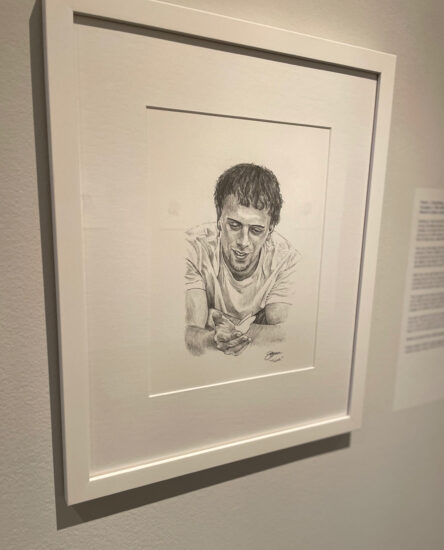
This portrait of Trevor L. Armstrong holding a butterfly was Hebbel’s first ILP drawings.
“I couldn’t stop drawing people,” she says. “I found that I had to.”
She was inspired to find others who had died from addiction and to use art to bring awareness to the drug epidemic. “Art goes beyond words,” she says. “The black-and-white portraits are a metaphor to show we are all made of light and dark and we are not defined by our dark moments.”
Hebbel, the owner of Hebbel Portraits, says that he is able to talk openly about his recovery because he is self-employed and doesn’t need to worry about the ramifications. He opened his studio in a spare bedroom of his home in 2020, after COVID severely limited operations for his music production company, Gable Music Ventures.
For almost 11 years, as co-founder and co-owner, he ran Gable Music Ventures with Gayle Dillman. They created the Ladybug Music Festival, an annual downtown block party in Wilmington celebrating women in music. The event helped revitalize the downtown area.
He says he “always loved drawing,” and he earned an Illustration degree from Delaware College of Art and Design in 2003. When his music business shut down, he says, he took up his pencils and began looking for commissions via social media.
Two years after he opened Hebbel Portraits, he learned about ILP from Molly Giordano, executive director of the Delaware Art Museum. At that time, he was working for the New Castle County Chamber of Commerce as a project management and event specialist.
“I emailed Theresa and she asked me to participate,” he says.
Sober Five Years
Whether working for ILP assignments or other clients, he draws at night in his studio while music plays in the background. “It’s meditative; it’s recovery work for me,” he says.
Being part of ILP confirms to Hebbel that his decision to go sober five years ago is paying off. He now has a sense of independence and pride, owns his own home and business, and is husband to Noelle Picara and father to their 2-year-old, Jasper.
Hebbel says he has struggled with addiction most of his life. “I have a family history of addiction and I have always had a difficult time finding balance with anything even remotely addictive or habit forming.”
It was his beloved dog Pumpkin that motivated him to fix his life. Before sobriety, Hebbel drank to numb emotional pain, including the loss of friends and loved ones lost to substance abuse. When Pumpkin died, nothing mattered to Hebbel anymore. He retreated and poured tequila down his throat as fast as possible.
“My reaction after I lost Pumpkin shook me enough to realize that something needed to change,” he says. “I had no coping skills to deal with the process of loss.”
Four years into sobriety, he lost a second dog, Baci, when she was hit by a car. This time, his reaction was very different. He allowed himself to experience the loss without using a substance. He mourned her, stayed sober, and felt like he did right by her.
“I reached out to my family, my support system, and I cried and grieved more than I ever had in my life,” he says. “I believe I grieved every loss I had never been capable of processing in my life up to that point. It was one of the most difficult experiences I have lived, but it was also an eye-opening moment of how much I had grown and changed as a person through sobriety. Today I have more to lose than ever and yet I feel confident that I won’t self-destruct as a response to loss.”
He says drawing, self-care, therapy, “soul searching,” reading books such as Addictive Thinking: Understanding Self Deception, along with the support of family and friends, have healed and helped him in his sobriety journey.
“I work every day on myself,” he says. He exercises, does home improvement projects, eats healthy, and prays. “I had no idea that faith and a spiritual community were something I would need when I started this process,” he says.
One of Hebbel’s ILP subjects was MaryBeth Cichocki’s son, Matt, who died at the age of 37 from an accidental overdose in 2015. He became addicted to prescription painkillers after undergoing back surgery.
Cichocki, who lives in Bear, says she feels blessed that her son’s photograph ended up in Hebbel’s hands. “He’s an incredible artist,” she says. “He created a masterpiece.”
Cichocki has played a crucial role in passing six bills in the Delaware Legislature related to treatment for those experiencing substance abuse. She says that as painful as it was to see her son’s portrait on the exhibit wall, she feels INTO LIGHT humanizes addiction.
“The exhibit tells the stories of everyday people,” she says. “People loving life, attending school, working, and starting families. Seeing Matt among all those beautiful people broke my heart, as no one wants their child to be included in an exhibit honoring the dead. But I knew in my heart I needed him to be there. I needed the world to see the beautiful boy he truly was in life.
“I want him remembered for who he was, and what he accomplished, rather than his addiction. I think the most impactful part (of the exhibit) were the beautiful portraits. The hauntingly beautiful eyes staring back at you.”
— For information about INTO LIGHT Project visit IntoLightProject.org.
INTO LIGHT Project major sponsors include Blue Cross Blue Shield of Delaware and The Delaware Division of Substance Abuse and Mental Health.