
By Mark Fields
Already Overwrought Romantic Drama Amped Up in This Somewhat Contemporized Remake
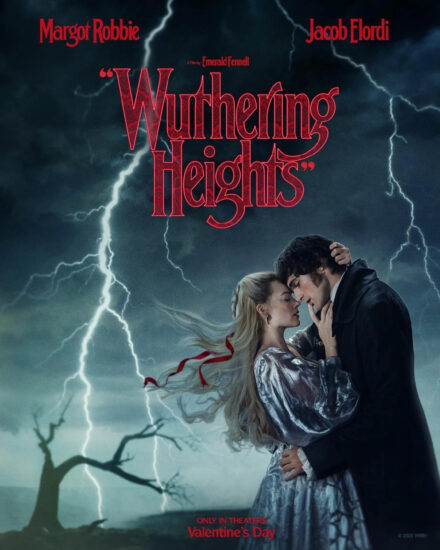 Wuthering Heights, Emily Bronte’s Victorian novel about love in defiance of societal norms, has always seemed overwrought for my tastes. The intense (and destructive) relationship between its hero, Heathcliff, and its heroine, Cathy, feels incendiary to the point of being lurid. There’s romance and then there’s ROMANCE!
So it is a little unsettling that in this current remake, “Wuthering Heights,” director/screenwriter Emerald Fennell has found it necessary to further amp up an already baroque story and to also contemporize it in ways that seem calculated merely to make it more accessible to modern audiences. Although Fennell captures some stunning visual moments in this new film, the overall impact of her doctoring makes the central romance, and therefore, the entire film more laughable than compelling.
Set in the early 1800s, Fennell’s version of “Wuthering Heights” tells of a decades-long romance between the high-born Catherine Earnshaw (Margot Robbie) and the urchin Heathcliff (Jacob Elordi), who is rescued from a life of squalor by Cathy’s tender-hearted father (Martin Clunes). Cathy and Heathcliff initiate an unlikely but passionate relationship that dares to transcend their different stations in English society. The Earnshaws, however, thanks to Papa’s fondness for gambling and drink, are barely managing to maintain their household. Cathy is married off to a more wealthy neighbor, but she can’t quit her feelings for Heathcliff. After years of separation, he mysteriously returns, now wealthy. And the two embark on an ill-advised yet torrid affair that will likely not turn out well for anyone involved.
Though Robbie and Elordi have undeniable chemistry, the narrative can’t paper over the reality that Heathcliff and Cathy are both deeply flawed, even dislikable characters. They are so reckless in their mutual infatuation that they do great damage to each other and everyone around them: Cathy’s earnest husband, Edgar; Edgar’s innocent ward, Isabella: and Cathy’s companion, Nelly. I found it hard to sympathize with either of them.



Without buy-in to the love drama at the heart of this story, the audience is left to find satisfaction with the visual storytelling. Here, Fennell has more success. There are many powerful images in the movie and individual scenes that resonate. Moreover, Linus Sandgren’s photography of the Yorkshire moors setting is beautiful and mystical. And, Anthony Willis’ score is fittingly sumptuous. Both Robbie and Elordi are strong enough actors to hold the viewer’s attention, and they are well-supported by Hong Chau, Shazad Latif, and Alison Oliver in secondary roles.
Fennell, in her prior films Saltburn and Promising Young Woman, found ways to flaunt cinema conventions that felt fresh and surprising. Here, she gooses the story with anachronistic touches like modern language, excessive sex, non-period set decoration and costuming (sunglasses? Really?) But these do not give further resonance to the drama. They are just unnecessary extra flourishes on an already over-decorated cake.
Official Trailer