
By Mark Fields
Ridley Scott’s Follow Up to Original Hit Cops Out with (Fallen) Hero Worship
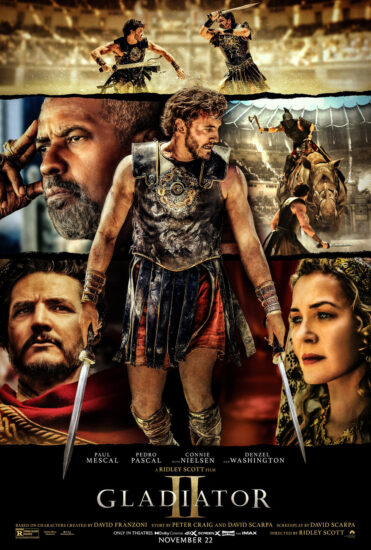 In Hollywood parlance, Roman and Greek-set epics are referred to as “sword-and-sandal” pictures. Extremely popular in the 1950s and early ‘60s (Ben-Hur, Spartacus, Quo Vadis, etc.), they had largely fallen out of favor until 2000 when director Ridley Scott recaptured the visceral power of such movies with the powerful and visually-stunning Gladiator. It’s surprising that it took 24 years to try to capitalize on that film’s success with a sequel. It seems to have taken the emergence of young Irish actor Paul Mescal (All of Us Strangers, Undersun) and his distinctive blend of brooding charisma and rough physicality to make a follow up viable.
In Gladiator II, Mescal plays Hanno, a resident of a Northern African city-state called Numidia. When the acclaimed Roman General Acacius (Pedro Pascal) sacks the city on the orders of the dissolute twin Emperors Geta and Caracalla (Joseph Quinn, Fred Hechinger), Lucius loses her warrior wife and is taken prisoner. Hauled back to Rome, Hanno is recruited for the gladiator ranks because, as Master of Gladiators Macrinus (Denzel Washington) says, he fights successfully because of his rage. Of course, Hanno turns out to be something more than first believed, and the numerous and impressive battle take on more significance for Rome and its corrupt empire.
There is a great deal of talk, and intrigue, and ancient-days politics; and everybody gives flowery speeches about freedom and the future (while protesting that they don’t like to give speeches). One supposes this is all to unnecessarily lend a bit of moral justification to the carnage. But let’s face it, we come to these movies for the “sword and sandals” bits: the epic fights, both in and out of the arena.
Here, Ridley Scott reminds us of why he has remained a vital and successful film director for all the years, not just back to the original Gladiator but earlier with classics like Alien and Blade Runner. Scott knows how to take a genre picture – whether horror, sci-fi, or Roman epic – and zhuzh up the set pieces to make them and the overall film memorable. The fights here, starting with a massive battle at Numidia and leading up to a wished-for one-on-one confrontation between Hanno (later Lucius) and his nemesis. Mescal’s intensity draws you to his place in these fights, and Scott executes them all, predictable as they may be, with originality and panache.





Pescal and Washington make nice additions to the cast, and Connie Nielsen returns from Gladiator in the same role. Apparently, the screenwriter thought two odious emperors upped the ante, but neither actor makes these characters anything beyond stock villians. Regardless, Gladiator II really succeeds on the dynamism of lead Paul Mescal.
Unfortunately, two-thirds of the way through the movie, everyone seems to lose their confidence, and Gladiator II becomes a full-throated throwback to the original film, with too many unnecessary and hagiographic references to the previous characters and plot machinations. Even the final credits will sound dismayingly familiar. Yes, I have fond memories of Gladiator; it was a really good movie. But that was over than two decades ago, and today, I would prefer something fresh and free-standing.
Gladiator II, despite its derivative title, could have stood on its own merits, but the filmmakers decided to fall back far too much on the prior film, and this update suffers for the comparison.