
Above: Postcard from Lewes beach from the 1970s. Image from Delaware Public Archives.
The Third in a Three-Part Series: The Route Along Sussex County
By Jim Miller
Heading to the beach this summer?Take in these sights along the way — and ponder the related tales about the war hero Admiral Dewey, Milford’s subchasers, and the treasure of Captain Kidd.
From Schooners to Subchasers
As we cross the Mispillion River in Milford, and drive into Sussex County, we realize that the town straddles two counties, Kent and Sussex.
It’s poetic that the Mispillion River splits Milford the way it does considering the area’s log-splitting roots. Settled in 1680, this area was eventually built upon the success of sawmills constructed along the river’s shores and powered by its flowing waters. Hence the town’s name: Mill-ford.
With a river-born timber industry established, it was just a matter of time before someone thought about starting a boat-building business, particularly one just a few miles from the Delaware Bay. That person was John Draper, who built Milford’s first shipyard in 1782 with the help of his son, Alexander.


In addition to constructing 22 wooden ships over 27 years, the Drapers built a proven business model. Between 1782 and 1927, more than 300 wooden ships would be crafted in Milford. At one point, more than seven shipyards employed three-quarters of Milford’s population.
But the rising popularity of both steel and steam brought a sea change. By 1930, the Vinyard Shipbuilding Company was the town’s sole survivor. In fact, Vinyard was the last wooden-ship builder in Delaware.
Thirteen years earlier, at the height of World War I, Vinyard became one of 30 wooden-ship builders in the country to be commissioned by the U.S. Navy to help counter an enemy lurking in the deep. Germany’s elite fleet of U-boats had become a dangerous threat and would end up killing more than 15,000 Allied sailors and sinking 5,700 merchant ships.
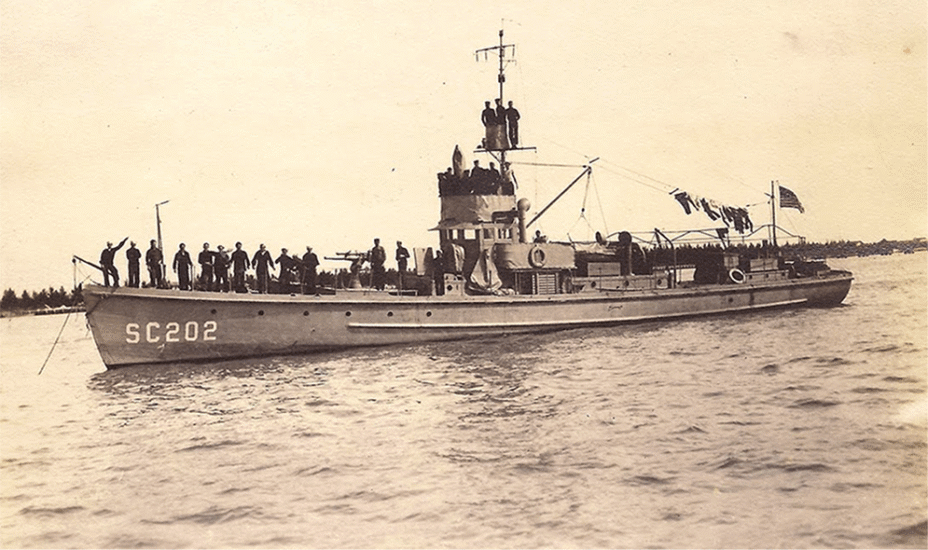
A photo of a subchaser, the types of ships built in Milford in WWI
and WWII. Image from National Archives.
The U.S. Navy’s response in 1917? Subchasers.
Yacht designer A. Loring Swasey was hired to develop the first subchaser: a 110-foot-long, wooden-hulled vessels created to drop depth charges loaded with 400 pounds of TNT onto German U-boats.
Vinyard completed three boats by March 1918. But by November the war was over, and Vinyard went back to making yachts. Twenty-three years later, when German U-boats returned as a prime menace, the navy turned to Vinyard again. The second time around, they managed to complete 14 boats in just 27 months.
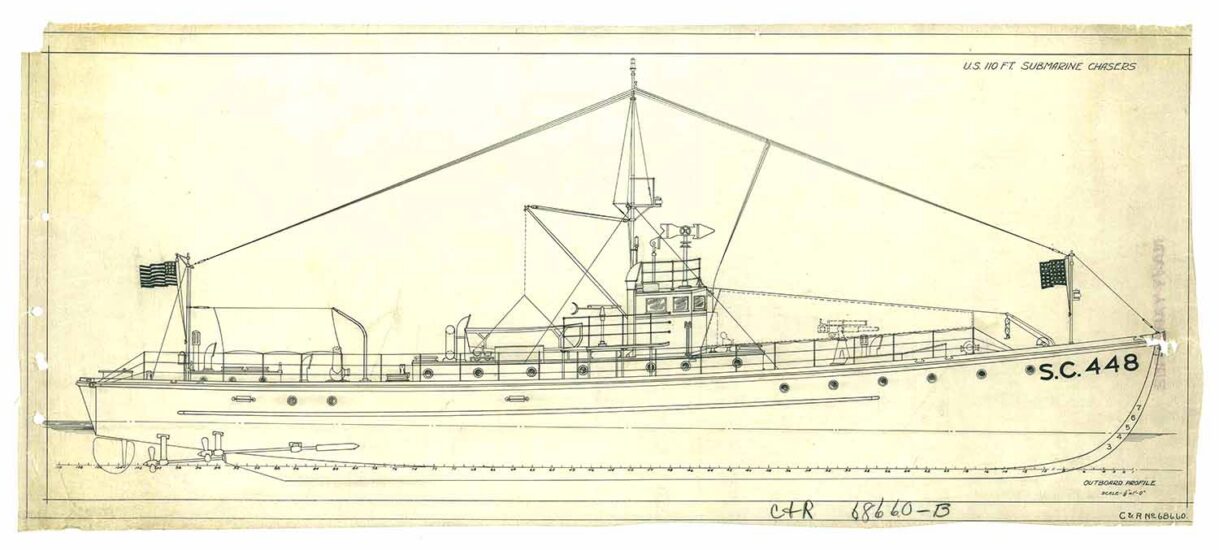
Outboard profile design of the subchasers that
Milford’s Vinyard built in WWI and WWII. Image from National Archives.
Of the 44 wooden-ship builders across the country charged with the task of building the subchasers for WWII, only 11 produced more than Vinyard, according to the Naval Marine Archive.
Although Vinyard went out of business in 1973, Sudler and Joan Lofland bought what was left of the abandoned shipyard in 1995. In the three decades since, the Loflands have renovated the shipyard, restored three of Vinland’s original ships, and created a small museum honoring Milford’s lost tradition — and the story of Delaware’s last wooden shipbuilder.
Captain Kidd Comes to Lewes
South of Milford and its country cousin, Milton, Route 1 passes over Red Mill Pond. At the top of the next overpass, we see it coming: the shops, restaurants, and strip malls. And, naturally, the crowds. We are entering the western edge of Lewes.
Going east down Savannah Road from Route 1, we meet the historic downtown area of Lewes, where it seems like a super-dense amount of history is packed into every corner of every quaint block. Yet, among all the thousands of characters who have inhabited this town — whether for a day or a lifetime — few deliver the color or drama that comes with Captain Kidd.
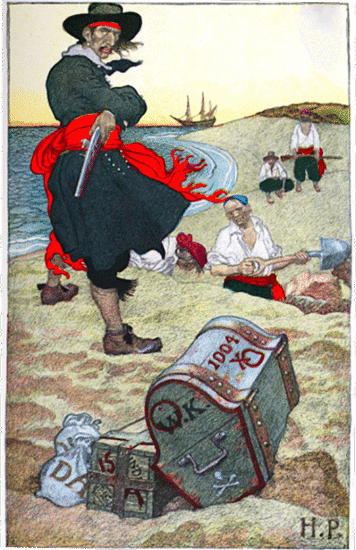
Delaware artist
Howard Pyle’s depiction of Captain William Kidd and his crew burying treasure on Gardiner Island; note the “W.K.”
on the chest. Image from Library of Congress.
By the time William Kidd was 45, he had become captain of his own ship, the Blessed William, and was fighting the French in the colonies of the Caribbean, where he served the English as one of many privateers — mercenaries commissioned by sovereign governments to raid enemy ships.
Years afterward, in 1696, Kidd partnered with Richard Coote, the newly appointed governor of New York and Massachusetts. With Kidd’s success as a privateer and Coote’s clout, they got the backing of a group of anonymous investors in London — including some high-ranking British officials — who saw the economic and political upside to Kidd battling French and pirate ships in the Indian Ocean.
But things did not go well for Kidd’s expedition. Author and Kidd’s ninth-great-grandson, Samuel Marquis, writes about the challenges his ancestor faced in his book, Captain Kidd: A True Story of Treasure and Betrayal.
“He and his small band of loyalists had managed to survive two Royal Navy impressment attempts; raging storms; a tropical disease outbreak; repeated attacks by the Portuguese and Moors; severe thirst and near starvation; and a full-scale mutiny,” Marquis writes.
Two years of misfortune came to a crescendo when Kidd and his crew plundered the Quedah Merchant off the coast of India. The ship’s capture would end up putting Kidd at odds with an insurmountable enemy: The British East India Company. The resulting trade disputes and negative political ramifications would become too much for Kidd’s investors. They began cutting ties with the privateer, whom they now viewed as a liability.
Kidd was soon labeled a pirate, and a warrant was issued by the British government for his arrest.
When he learned of the warrant, Kidd thought of his partner, Gov. Coote, who he believed could issue him a pardon. Sailing back to the colonies and up the Atlantic Coast, he anchored off the coast of Lewes. According to Michael Morgan’s Hidden History of Lewes, Kidd spent at least 10 days there, entertaining select townsfolk on his ship and selling cargo to some local merchants.
“George Thompson, Peter Lewis and William Orr were among the Lewes residents who boarded the pirate ship, where they were dazzled by the calico, muslin, sugar and other goods,” Morgan writes. “In addition, they reported there were tons of gold aboard the ship.”
With the help of the research team at the Lewes History Museum & Archives, we found a copy of William Penn’s arrest orders for the three merchants on the grounds of doing business with a known pirate — all of which helps verify that the three were indeed aboard Kidd’s ship.
Yet the men’s testimony brings up a vital question: If a vast amount of Kidd’s gold existed aboard that ship, where did it go?
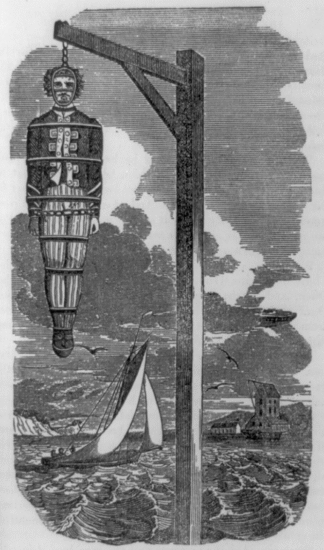
Kidd’s dead body was strung up at the mouth of the Thames River to serve as a warning to sailors. Image from Library of Congress.
We do know that Kidd was one of the few pirates to actually bury treasure, which he did after departing Lewes. Believing it might come to his aid later — as a bribe or insurance — he famously buried treasure on Gardiner Island on his route north. In fact, the later reports of Kidd burying the treasure would serve as inspiration for Robert Lewis Stevenson’s Treasure Island.
But even when Kidd did offer up the location of that treasure to Coote, the political pressures were too much for the governor to grant his pardon.
Marquis and other historians offer evidence that Kidd was the victim of a sham trial, citing shoddy lawyers, abrupt changes in witness testimonies, and the fact that the former privateer served six months in jail without the privilege of visitation.
Regardless, Kidd was found guilty and sent to London where he was hanged.
“After his execution, Kidd’s body was encased in an iron giblet cage and strung up at the mouth of the Thames River to serve as a warning to sailors,” writes Marquis.
And what of all the gold?
If there was as much gold on Kidd’s ship as the three Lewes merchants claimed, it’s hard to account for it all. Certainly, some could have ended up in Coote’s pocket after authorities dug up Kidd’s stash on Gardiner’s Island. But could that have really been all of it?
Maybe, just maybe, a secret stash of gold sits in a tightly-sealed wooden chest somewhere long concealed by the windblown sand dunes of Cape Henlopen — the lost location of Kidd’s first buried treasure.
The Legend of Admiral Dewey
Our journey nears its end as we arrive in Dewey. Though small, the town’s reputation as a party destination is, of course, legendary.
As it turns out, the town’s namesake also had a legendary reputation, albeit for much bigger feats: Admiral George Dewey was a celebrated war hero, a close friend of Theodore Roosevelt, and, for a brief moment, a candidate for President of the United States.
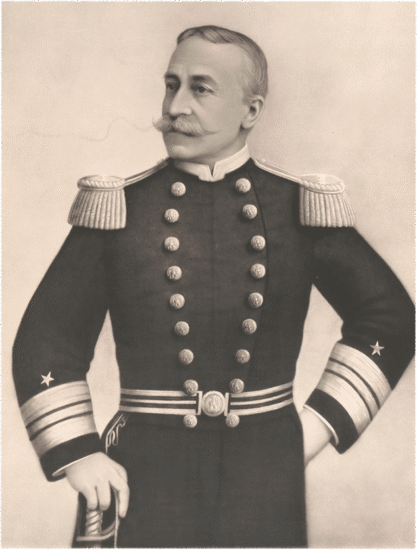
Admiral George Dewey. Image from Library of Congress.
That said, a young George Dewey might have been a perfect fit in the town that bears his name. After two years at Vermont’s Norwich University, 17-year-old Dewey was expelled for drunkenness and herding sheep into the barracks. As a result, his father sent him to the United States Naval Academy.
After graduation, Dewey served as executive lieutenant aboard the USS Mississippi during the Civil War. He participated in the capture of New Orleans and helped secure victory in the Siege of Port Hudson.
But Dewey’s greatest feat was his victory at the Battle of Manila Bay, which would come 33 years after the end of the Civil War.
In April 1898, then-Commodore Dewey led a squadron of U.S. warships to the coast of the Philippines and, within six hours, pounded the occupying Spanish forces into surrender. According to U.S. figures, Dewey’s forces suffered only seven casualties and one fatality — a chief engineer who suffered a heart attack.
Today, Dewey’s victory is considered one of the most decisive battles in naval history.
It certainly was celebrated back then, too. Dewey was promoted to rear admiral the following month and was given a hero’s welcome when he returned to the states in 1899 with a two-day parade in New York City. Medals, awards, honors, and more parades followed. Soon afterward came rumors of a presidential run.
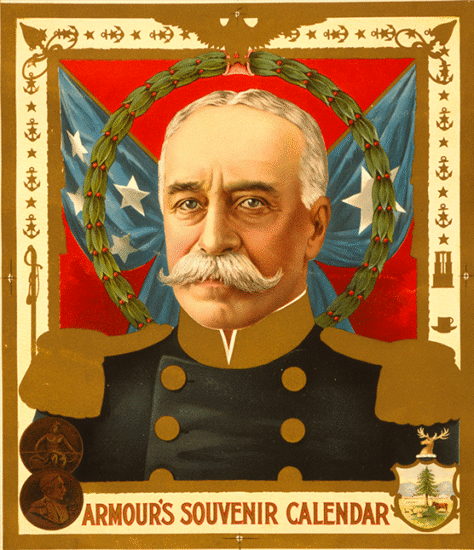
Cover for the Armour’s 1899 souvenir calendar honoring Admiral Dewey. Image from Library of Congress.
“If the American people want me for this high office,” Dewey said in 1900, “I shall be only too willing to serve them.”
However, it was not meant to be. Dewey withdrew in May that same year. [Note: Some readers may remember George Dewey’s distant cousin Thomas E. Dewey, the governor of New York from 1943 to 1954, who also had an unsuccessful run for president of the United States —twice! (1944 and 1948)]
Although his name is not nearly as well-known as his friend Roosevelt, George Dewey left a legacy to be admired: To this day, he is the only person to have attained the rank of Admiral of the Navy.
And, of course, he’s the only admiral to have a lively little Delaware beach town bear his name.
– On that high note, this series comes to an end. I hope these stories have brought you a smile or at least offered something to ponder the next time you are heading down Route 1 on the way to Dewey or elsewhere… Cheers and Safe Travels!
“The Wild Waypoints of Route 1” series is brought to you by: