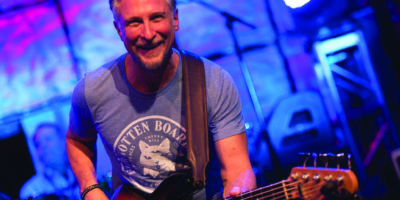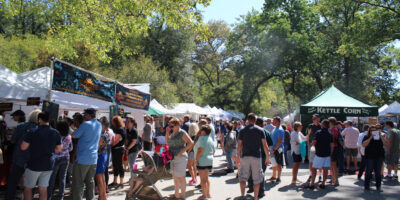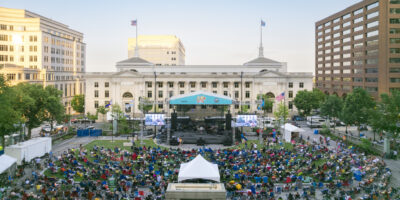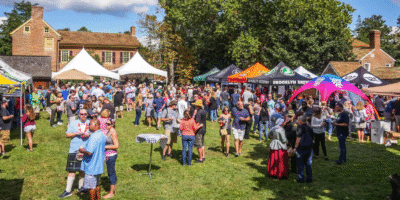


Above: An overview of the Clifford Brown Jazz Festival held annually in Rodney Square. This year’s festival is Aug. 2-8. Photo by Joe del Tufo.
By Jonathan Whitney
A Wilmingtonian who changed the face of jazz
We can’t have a discussion about America’s 250 anniversary and not celebrate one of the most influential Delawareans in the arts — Clifford Brown. In the short 25 years he spent on this earth, “Brownie,” as he was known, had an outsized impact on one of our nation’s greatest exports, jazz.
He is celebrated in Wilmington, Delaware, with a listening garden, a statue, and a marker where his house once stood. By far the greatest celebration of Brownie is the Clifford Brown Jazz Festival, the largest free jazz festival on the East Coast, presented each year by the City of Wilmington.
Although Brown is best known for the recordings of his legendary quintet with Max Roach, his story doesn’t start there. It starts with his participation in his school band program, which led to his father buying him a trumpet at age 13. That is when he began taking lessons with Robert “Boysie” Lowery, a multi-instrumentalist who had developed a unique approach to teaching jazz improvisation.


This method can still be heard today in the playing of Gerald Chavis and Ernie Watts. Vibraphonist Lem Winchester and woodwind specialist Vernon James, Sr. (Gil Scott Herring) — both Wilmingtonians — were also pupils.

A rare performance photo of Clifford Brown. O&A archive photo.
Brown attended the prestigious Howard High School and was famously featured at his graduation playing the technically advanced “Carnival of Venice” with Howard’s symphonic band. After stints at Delaware State College (now University) and Maryland State College, Brownie began his professional career playing with the who’s who of jazz — Tadd Dameron, J.J. Johnson, and Lionel Hampton, to name a few. He was also a founding member of the legendary ensemble Art Blakey and the Jazz Messengers. Young Brownie toured the United States and Europe and became known for living a life as clean as his playing, shunning the temptation of drugs and alcohol.
In 1954, he formed a band with drummer Max Roach that would take the jazz universe by storm. The Clifford Brown/Max Roach Quintet recorded seven albums between 1954 and 1956, producing several jazz standards still performed worldwide today. They include “Sandu,” “Joy Spring,” “Daahoud,” “Jurdu,” and “Blues Walk.” Their fresh take on hard bop brought together blistering tempos and immaculate cleanliness at a level never heard before.
During this time, Brownie continued to record with artists like Sarah Vaughn and Dinah Washington. All of this was accomplished before he completed his 25th rotation around the sun.

Clifford Brown (center) had a prolific run in the mid 1950s, recording seven albums in a two-year span as the Clifford Brown/Max Roach Quintet. O&A archive photo.
On June 25, 1956, Clifford Brown’s life was tragically cut short in a car accident while traveling from Philadelphia to a gig in Chicago. In true Brownie fashion, he and pianist Richie Powell stayed in Philadelphia to play a jam session for a friend. They left Philadelphia after midnight to make the drive to Chicago in the rain. Near West Bedford, Pa., Powell’s girlfriend lost control of the vehicle and it flew over an embankment, killing all three passengers.
Brownie’s melodic approach to improvisation continues to enthrall generations of new jazz artists. During his brief professional career, he brought together the teachings of Robert “Boysie” Lowery and the great classroom that is the bandstand. He showed the world that one could take the range and technical facility of Dizzy and produce long, clean melodic lines in a way that hadn’t been heard before. Through Clifford Brown, Delaware made an indelible mark on our nation’s classical music — jazz.
— The 39th Annual Clifford Brown Jazz Festival will be held August 2-8 in Rodney Square, Wilmington. To learn about upcoming DE250 events, visit Delaware250.org.
In celebration of Delaware 250, this monthly series will spotlight historic people and sites unique to our state.