
Above: An aerial photo of Dewey Beach in 1931. The arrow shows the location of The Big House. Photo courtesy Noonan family.
By Kevin Noonan
It was the harbinger of summer. Throughout the 1950s and 1960s, we’d come home from school in early June and see boxes stacked on the dining room chairs, boxes filled with food and clothes and sheets and blankets and towels and clothes pins and toothpaste and all the bare-bone essentials we’d need for the next three months.
The sight of those boxes brought joy to our hearts like nothing else, even more than seeing the Christmas tree lit up, because those boxes meant that soon we’d be in Dewey Beach for the next three months.
Summertime and the livin’ is easy . . .

I was about 6 or 7 when I realized that everybody in the world didn’t spend their summers at the beach. We were spoiled and didn’t even know it, although “spoiled” is a relative term. We didn’t have a big summer home with a pool and Jacuzzi and four-car garage. We were packed into a two-bedroom cottage (for seven people) with no air conditioner, no dishwasher, no washing machine, no telephone, no indoor shower, no television, not even water you could drink — we had to fill big jugs of water at the Lewes Dairy in Rehoboth Beach for drinking and cooking and even brushing our teeth.
But, as crude as it was, Dewey Beach was heaven on earth. And what made it really special is that most people didn’t even know where it was. We’d have to identify it by saying that it was a couple of miles south of Rehoboth Beach. Then people would say, “Oh, OK …’’
Now, of course, Dewey Beach is “A Way of Life,” but it’s not as good a way as it used to be, unless you’re a 21-year-old bar-hopper. And where was all this stuff when I was 21?
Our family history in Dewey goes back to my grandparents, Timothy and Bertha Noonan. One day in the late 1920s, a friend told Tim about this end-of-the-line resort in southern Delaware called Rehoboth by the Sea, which was a realty company formed by Nathaniel Quillen, William Lynn, Joseph McSweeney, George McMahon, James McMahon and John Redefer. Grandfather leased a lot from them and in 1929 built a house on the southern corner of what is now New Orleans Street and Route 1.
That house — always called “The Big House” — is where my father, Charles Noonan, spent his teen-aged summers, along with his brothers, James and Paul, and his sister, Anne. For many years, it was the only house on the entire bay-side block bordered by New Orleans and Saulsbury streets. The roads were unpaved and the main road going through Dewey (now Route 1) came to a dead end just a block away, at the current site of the Bottle & Cork.

The Big House in 1935. At right, the same location today, now home to Starboard Sauced. Photo at left courtesy Noonan family.
Imagine what Dewey must have looked like then. And Rehoboth Bay. There might not have been a lovelier spot on the planet. My father, who died in 1998, used to tell us how clear the bay was, how you could see right to the bottom and just reach down and snatch a couple of soft-shell crabs for lunch. Everything was blissfully primitive — they didn’t even have electricity — and it took five hours to make the drive from Wilmington in the family’s Model-T Ford.
Of course, it can still take five hours to get to Dewey, but not for the same reason.
Time Marches On
As the years passed, Dewey Beach grew. From a few cottages it became a small village that still had few amenities. In the 1930s, Grandfather built another house behind the Big House, with an upstairs apartment and downstairs garage.
World War II ended the carefree summers for a while, and instead of lounging on Dewey Beach, my father was storming Omaha Beach, where, as a First Lieutenant in the 29th Division, he was part of the assault wave on June 6 and was awarded the Bronze Star Medal for his “outstanding qualities of courage and leadership.”
After the war, Charles and his brother, James, opened a general store, Noonan Brothers, across the road from the Big House. After a couple of years, they sold the store to Bill and Thelma Wilson, who operated it as Wilson’s Variety Store for three decades. That site, originally owned by my father and uncle, now houses Vavala’s Beach Things and Woody’s Dewey restaurant (remember that the next time you buy a Dewey T-shirt at Vavala’s or order one of Woody’s crab cakes).
Also in the early 1950s, a dramatic shift occurred: My grandparents and Uncle Jimmy died, and my mother and father and aunt and uncle — Anne and Harvey Moore — decided to sell the Big House to finance the homes they were building in the new suburbs being carved out of the farms and forests of Brandywine Hundred.
But we still had the two-story cottage behind it, and the bottom was converted into another apartment. So, the Noonans and Moores still had our Dewey connection. And that’s where I spent my Huck Finn summers, along with my brothers, sisters, cousins and our summer friends.
And that’s what made Dewey really special — the people. Over the years, many other families shared our no-frills paradise: Carney, Duggan, Judge, McMahon, Redefer, Lindsay, Baldo, Vaughn, Conaty, Wilson, Ulsh, Rodgers, Burton, Vavala, Walsh, Steele, McPhail, Mandio, Vignola, Peake, Quillen, Mezick, Seimes, Murdock, Wisniewski, DeMarco, Stokes, Forrest, Flynn, Bogart, O’Hagan, Carr, Hopkins, Fagan, Lambert, Martin, Shaud …
Many of them held onto their Dewey roots. Some remain summer guests; some moved there to stay. Some retired there,; some died there. And all of them loved it there.
Happy Days
As kids and teenagers in the ‘50s and ‘60s, two places were special to us. One was Wilson’s Variety Store, where we would spend our nightly “treat money” of a dime, which was enough to buy an ice cream cone or a cherry Coke (with real cherry syrup squirted into it) at their soda fountain.
The other special place was The Flat Top restaurant at the corner of Route 14 (now Route 1) and Saulsbury Street. Now, that location is home to Dewey Beer Co., but back then it was our main hangout. The joint, owned by the Hopkins family of Harrington, had pin ball machines, a juke box and, most importantly, tolerant management.
We would also hang out at Duggar’s Esso Station, where I worked when I was 12 until 16. It, too, had pin ball machines and a pool table. “Duggar” was the late Ed Rodgers, and his family still owns and operates what is now an Exxon station, and it’s the only business in Dewey that hasn’t changed owners in the last 60 years.
Back then, there were few rules or regulations in an unincorporated Dewey Beach. We could have bonfires whenever we wanted (now you need a permit) and we could sleep on the beach any time (now it’s forbidden). We would even play in the observation towers at Tower Beach (now they’re closed to the public).

At left: Dewey Beach landmark the Bottle & Cork, as it appeared in 1957. Photo courtesy Shaud Family Photo Collection.
Of course, we didn’t just jump right back into our life in Dewey Beach. First, we had to get our feet toughened up. We took our shoes off the day we got down there and didn’t put them back on until the day we left, with the exception of Mass on Sunday. But after nine months of living the easy life in shoes and socks, our feet were white and soft. So, everybody walked gingerly for a couple of weeks until they toughened up to Dewey Beach standards.
The other thing you had to do was burn. As an adult, when I went to a dermatologist for the first time, he asked me if I ever got sun-burned as a kid. I laughed. Are you kidding? It was an annual ritual in those pre-sunscreen days. Heck, girls used to coat themselves with baby oil and literally cook themselves under the sun.
The key was that first layer of tan, which meant you had to endure your first layer of burn. The idea was that you’d get a little browner when the sunburn wore off and you peeled, and then you’d add on more and more tan (and peel some more), until you looked like a Polynesian god. Little did we know that decades later we would make those dermatologists rich.
It wasn’t all play, however, and I got my first summer job when I was 10. My cousin, Maryanne Moore, and I wheedled jobs on the jeeps that used to drive along the beach, renting umbrellas, chairs and rafts and selling sodas and snacks. We were the envy of the other kids, and all for the grand sum of one dollar per day.
I had many other summer jobs over the years, but that first one, and my last one, were the two best. When I was in college I got a job, along with my friend, Mark Carney, on the maintenance crew at Delaware Seashore State Park. The maintenance crew had its headquarters in the old lifesaving station near the inlet, which is now a museum. We would drive four-wheel-drive vehicles on the beach, often with miles of open sand all to ourselves. The pay wasn’t much, but the experience was priceless.
Those idyllic summers tend to blur together in your memory, but one summer stands out, and in Delaware it’s simply known as the Storm of ’62 — a Nor’easter slammed into the Atlantic coast and destroyed dozens of homes and businesses, causing millions of dollars in damage and giving insurance brokers nightmares.
For kids, however, it was a bonanza, because we suddenly had lots of torn up houses in which to play and we spent the next couple of summers exploring them and using them as clubhouses and forts. If we got chased from one, we just broke into another. It was better than Disneyland.
Modern Times
Dewey Beach went through dramatic changes after it incorporated in 1981, and they weren’t changes for the better, at least for us. Suddenly, everybody knew where Dewey was, and it seemed like everybody was headed there, especially on weekends. That meant that the trip from Wilmington to the beach also changed dramatically. What used to be farmland and marshes along the highway became an endless line of fast-food restaurants, outlet stores and red lights — there used to be one red light between Lewes and Dewey, at Route 24; now, there are too many to count.

An aerial view of a very sedate Dewey Beach in 1956. Photo courtesy Dewey Beach History & Tales.
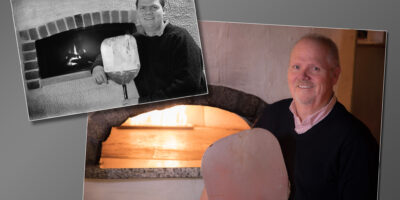
Throughout the years, the Big House went through changes of its own, first as Ulsh’s Bakery in the 1970s, then Bunny’s Mo-ped Rentals, then Mama Celeste’s Pizza, and now it’s owned by Steve Montgomery and his Starboard enterprise.
What bothers me the most about the changes in Dewey Beach — and, really, all Delaware beach towns — is that ordinary people can’t afford to own a summer home anymore. Dewey was a place that used to be filled with mostly small, ramshackle cottages, some of them owned by old, grizzled watermen who persevered throughout the winters in drafty shacks heated by coal stoves.
Over the years, most of those shacks were bought up and knocked down, and in their place, people built — and are still building — huge mcmansions that lack character or soul. And many of the people who gave Dewey its character and soul have been priced out.
But it’s still Dewey Beach, the paradise of my youth. My wife and I are retired now, so we can stay in Dewey in the spring and fall when it’s not so crazy. And even now I get excited about the prospect of a week at the beach. It’s still a pleasure to sit on the upstairs porch and watch the world go by, even though it’s going by a lot faster now and making a lot more noise.

An aerial photo of Dewey Beach in 1931. The arrow shows the location of The Big House. Photo courtesy Noonan family.