
Could Delaware eventually legalize recreational marijuana? If so, there may be some lessons the First State could learn from one of the two states that have passed such legislation.
Every day, people in certain areas of Colorado are casually walking into stores and purchasing marijuana: easily, openly, legally, and purely for recreational use.
What’s more, they are growing cannabis plants—also legally.
In the General Election of November, 2012, a majority of Colorado voters approved Amendment 64, which legalized the recreational use of marijuana. (Washington also voted for legalization, but Colorado has been much quicker to implement the legislation.) “Fifty-five-percent of the voters said, ‘We want to try this social experiment: We think we should regulate and tax marijuana,’” says Rachel K. Gillette, a Colorado attorney and executive director of Colorado NORML, the state chapter of the National Organization to Reform Marijuana Laws.
According to the new law, any resident over the age of 21 can purchase marijuana at a licensed store, travel within the state with as much as an ounce of pot, and grow up to three immature and three mature cannabis plants privately in a locked space.
“It’s a bold move,” Gillette says. “But I do think it’s the right way to go.”
In terms of regulating and taxing marijuana, the “Colorado experiment” has generated some promising results, giving the Centennial State a much-needed economic lift.
According to the Colorado Department of Revenue, since Jan. 1 of this year (when stores were first allowed to sell recreational marijuana) through July, sales generated more than $37.5 million in taxes, licenses and fees.
Of course those figures also include this year’s sales of medical marijuana, a practice that became legal in 2000 but only began happening in earnest in 2008, after a five-patient limit that the Colorado Department of Health initially imposed on caregivers was challenged and overturned in court.
Medical marijuana dispensaries were the first outlets in the state allowed to apply for licenses to sell recreational (otherwise known as “retail”) marijuana. For those that did, it was a good move: In just eight months, retail marijuana sales have already begun to eclipse medical marijuana sales. Starting this month, other non-marijuana businesses can begin to apply for the retail marijuana license.



Creating Jobs
Along with the revenues to the state, there are other economic benefits, as pointed out by Mason Tvert, co-director of the campaign supporting Amendment 64 and an advocate for legalization since 2005.
“Not only are the state and its localities generating millions of dollars in new revenues, [but] we’ve seen the creation of thousands of jobs,” says Tvert, who is director of communication for the Marijuana Policy Project, the largest financial backer of the legalization initiative.
According to Tvert, as of August, the Marijuana Enforcement Division had issued more than 13,000 employee badges—certifications required for all employees in Colorado’s marijuana industry.
“Whether it’s cultivation or working at a store or a testing facility, that’s a lot of jobs,” Tvert says.
His enthusiasm is shared by others, including Denver lawyer and entrepreneur Brian Ruden, who owns Starbuds Dispensary, a marijuana store open seven days a week on the north side of town, not far from the Denver Coliseum.
“If we are looking at the financial benefit of having a regulated marijuana system, it’s not just the sales taxes,” Ruden says. “It’s the licensing fees. It’s the bigger-picture impact on the economy because now all the people that work in the industry are earning wages, and payroll taxes are being paid. Architects are hired to build out store fronts. Licensed contractors are used, electricians and HVAC [installers]. Real estate owners now have a whole new market of people [to whom] they can lease space. Real estate itself has been going up. And, of course, tourism. Having marijuana in Colorado is something that attracts people.”
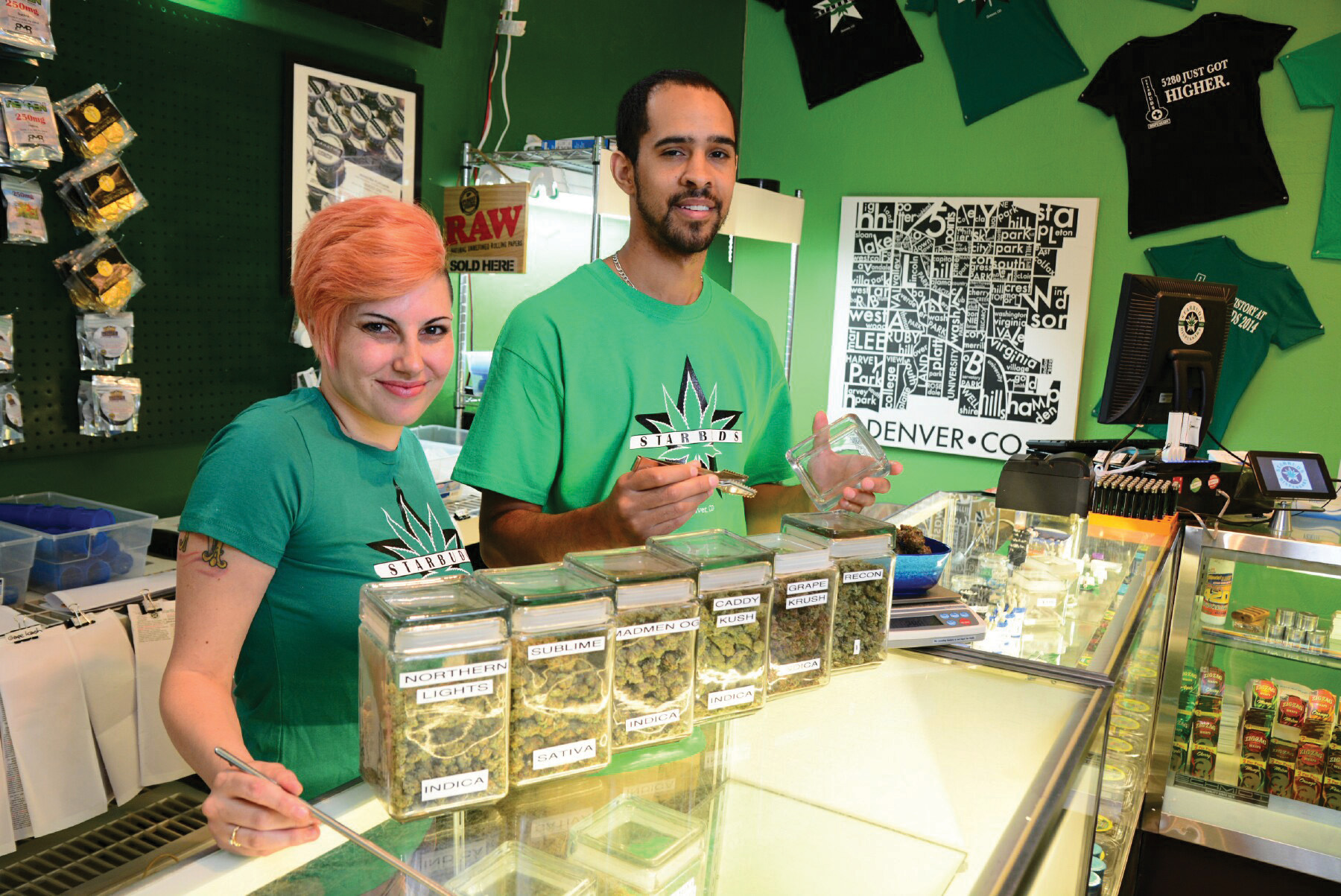
Starbuds Dispensary Manager Anthony Butler, pictured with budtender Amber Tolchin, says tourists make up nearly 80 percent of the store’s customers. (Photo courtesy of Starbuds Dispensary)
Reasonable Prices
At Starbuds, a staff of “budtenders” help customers choose from 16 varieties of marijuana for both medical and recreational use.
Prices are consistent and reasonable, with a gram of any variety costing $20 and an ounce $380, for Colorado ID-carrying residents over 21 only (out-of-state visitors can only buy up to seven grams).
“Our budtenders, [are] very, very knowledgeable and they can walk people through exactly what the products are, how to use them, and how to be safe with them,” Ruden says.
In addition to the sage advice, there are other assurances. “All the marijuana here has been lab-tested so we know there are no molds or funguses on it,” Ruden says. “We know there’s no residual pesticide on it. We know that it’s clean [and not contaminated with other substances]. We also have the potency tested so that people know exactly how strong the marijuana is that they are getting.
“It’s also a very safe environment: You take the criminal element out of it. We also only sell to adults who are 21 or older. Every single person gets ID’d. Whereas on the black market, an illicit-drug dealer isn’t going to check someone’s ID.”
This is a major benefit, according to Gillette, who feels that one of the biggest advantages to legalization is consumer protection.
“I’m not going to say there doesn’t still exist some amount of black market in Colorado,” Gillette says. “But I do think we are transitioning to getting people into the legal market and we’re going to see the benefits of that, including a safer product that is overseen by regulatory agencies and tested in certified laboratories, which is just better for the consumer. You don’t see the benefit of any of that when all the control is with drug cartels, black market drug dealers, and street-level drug gangs.”
There’s another inherent danger to letting the black market set policy, Ruden points out. It relates to why many consider marijuana a “gateway drug.”
“A marijuana store that’s regulated by the state will only ever sell marijuana,” Ruden says. “The illicit-drug dealer may sell you marijuana today and may offer you [a harder drug] in the future.”
Gillette believes regulation will eventually lead to the demise of the black market for marijuana, which, she says, will lead to less crime overall. Tvert tends to agree, but points to the potential of misleading data.

Inside the grow room at Starbuds Dispensary. (Photo courtesy of Starbuds Dispensary)
“The issue is that crime reporting is all over the place, in terms of the federal government’s reporting through the FBI [and] issues with localities reporting accurately,” he says. “What is clear is that [crime] is not going up as a result of these laws.”
In fact, the opposite may be true in Denver. According to the Denver Police Department, homicide, robbery, burglary and motor vehicle theft—crimes typically related to the drug trade—are all down this year compared to the same period in 2013 (January through August). Homicides are down by a whopping 30 percent.
Where There’s Smoke…
Critics point out that while the bump in taxes from recreational drug sales might be promising, tax revenues are still 45 percent below estimates that the non-partisan Colorado Legislative Council submitted to the General Assembly before legalization.
Proponents point to two factors to consider when addressing these discrepancies:
First, revenue from taxes has increased each month in 2014, and figures for the month of July were more than double those of January, indicating a strong potential for growth.
Second, several municipalities—including Colorado Springs, the state’s second largest city—have banned retail marijuana sales despite the state’s approval of Amendment 64. Without full participation from municipalities, the new law’s true impact can’t be accurately measured.
Tvert sees the bans as merely a temporary set-back, saying, “I have no doubt that we will see many of those communities shift toward allowing [retail marijuana] businesses.”
Among those supporting the bans and battling against the recent legalization are groups such as the Drug Free America Foundation, who argue that the gains in taxes, jobs and tourism will never compensate for the risks and losses they believe will eventually result from increased use of marijuana.
“If you look at alcohol and tobacco, at a national level, we are not raising enough in tax revenues to cover the societal cost related to those two drugs,” said DFDA Executive Director Calvina Fay in a recent Huffington Post article.
Likewise, in a USA Today editorial, former Rhode Island Congressman Patrick Kennedy lashed out at Amendment 64 supporters for similar reasons.
“There has been a lot of talk about pot lately,” Kennedy wrote. “Discussions of tax revenue, health benefits, violence reduction, and individual liberty. But one issue got completely lost: the developing brains of our children.
“It’s about time we start focusing on the rights of our kids, not pot smokers…I don’t want another massive, heavily commercialized drug industry targeting them. Because addiction is a disease that starts in adolescence, industries know they have to focus on young people for profits. After all, if you don’t start using any drug by age 21, you are unlikely ever to do so.”
Counter to the predictions of some opponents of Amendment 64, recent studies indicate that marijuana use among Colorado teens has not gone up in the past nine months. In fact, if anything, it appears use has been going down gradually since the first medical marijuana stores opened in 2008.
“It’s too early to determine any sort of causal relationship between the shift in policy and the rate of use [among teens],” Tvert admits. “Although it’s certainly worth noting that use started going down… [When medical marijuana stores opened in 2008], we incurred supporters of marijuana prohibition saying [the new law] would inevitably result in an increase in teen marijuana use. And clearly it did not.
“We then heard that if we expand the system for all adults to use marijuana legally that it would result in increased teen use. Marijuana officially became legal in Colorado at the beginning of December 2012. From 2011 to 2013, it went down again at a statistically significant amount, and again, it clearly did not go up.”
Gillette sees the issue from another perspective.
“Personally, as a parent of teen-agers, I love the fact that I can talk to my children and say, ‘In our state, you have to be 21 before you can go buy marijuana.’” Gillette says. “And I love the fact that now we have a system in place whereby you have to show an ID before you can purchase it.”
While retail marijuana is now legal, it certainly has not been accepted throughout the state. Which raises the question: when Gillette’s daughter reaches the age of 21, will the law still be in force? Or will opponents have convinced residents to repeal it?
Advocates such as Tvert and Gillette think their state’s example will be emulated.
“I do think that Colorado is setting an example for the rest of the country,” Gillette says. “And I think more and more politicians will be more likely to embrace that sort of approach.”