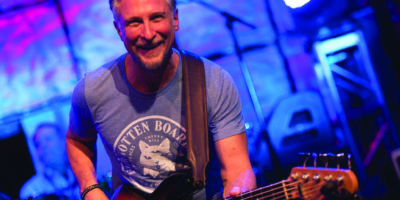

Above: B.J. Muntz (l) and Jake Banaszak in action at the Rehoboth Beach Bandstand. Photos by CorelGroll.
By Kevin Noonan
Jake Banaszak was into music at a young age and one day, when he was a freshman at Hodgson Vo-Tech, he brought his guitar to school. Another freshman, whom Banaszak didn’t know, walked over to him and asked if he could play his six-string. Banaszak readily agreed.
“And, right away, I said to myself, ‘This guy is pretty good,’” Banaszak says.
And, right away, he and B.J. Muntz became best friends, a bond that was cemented by their love of music.




Now, more than a quarter of a century later, they’re still best friends and still making music together with the band they formed 22 years ago — Lower Case Blues.
Lower Case Blues has been one of the most popular bands on the local circuit for many years, especially at the clubs and bandstands at the Delaware beaches. And over the years, Banaszak (who plays guitar) and Muntz (bass) have opened for some legendary acts, including Buddy Guy, Grand Funk Railroad, Kenny Wayne Shepherd, Blues Traveler and Robert Randolph.
For Banaszak, perhaps the most special moment came when he was 22 years old and Lower Case Blues opened for blues legend Buddy Guy at the Bottle & Cork in Dewey Beach.
Another highlight was opening for Blues Traveler. Not only did the boys in Lower Case Blues get to meet the members of Blues Traveler, they got to hang out with them for more than two hours after the gig. Banaszak even walked away with the phone number of John Popper, Blues Traveler’s lead singer and harmonica virtuoso.
In 2025, they’re busier than ever, playing almost every night in various clubs, mostly at the beaches, along with their drummer, Tristan Gilbert.
“They’re an amazing band and they pack this place every week,” says Seth Moran, the general manager at Dockside Marina Bar and Grill at the Indian River Inlet, where Lower Case Blues plays every Tuesday night during the summer.
“They have a loyal following, but we also get a lot of people in here who heard of them and want to check them out for themselves. And those people usually end up coming back,” Moran says. “They get everybody up and dancing and you can’t ask for anything more from a band.”
The Road to Semi-Success
Banaszak says the duo never dreamed of stardom — not that they wouldn’t have embraced it had it happened. But, to them, the music scene was about the music, not the scene.
“I wasn’t trying to get famous. I just wanted to play,” he says. “And B.J. was the same. We just wanted to play our music and write our songs and, hopefully, some people would want to come out and listen to them.
“Then we got some clubs and other small venues to hire us, especially down the beach. It kind of built from there, to the point where we play almost every night now.”
Few people know the local music scene as well as George and Paula Wolkind. They founded and still operate the Delaware Rock and Roll Society and Hall of Fame. And Paula Wolkind says Lower Case Blue’s success is largely because you’re never quite sure what you’re going to get.
“They bring something unpredictable in style and they don’t play the same things the same way all of the time,” she says. “That’s one of the reasons they have such a large following no matter where they go. The fans know that it’s going to be a different experience every time.
“Another reason people love them is because they’re not afraid to play their own music,” she adds. “Sure, they’ll play some old blues standards and covers, but they also play a lot of their own music and their fans love that.”
There’s No ‘I’ in Lower Case Blues
There are a million sad stories of ego-driven friction destroying bands, especially ones that have been together for a long time. And the two men behind Lower Case Blues have had disagreements over the years, but their music and their friendship have endured.
“Obviously, life is like that,” Banaszak says. “We spend a lot of time together and there have been some ups and downs, for sure. But for the vast majority of the time that hasn’t been a problem, because of the respect we have for each other, as musicians and people.”
That respect and cooperation also applies to their song writing, which has always been a collaborative effort. One of them will have the seeds for a song and then they’ll hammer out the rest, with each listening to and appreciating the opinion of the other.
“It’s very much a collective thing,” Banaszak says. “Sometimes I’ll have an idea for a blues tune or a shuffle, and B.J. will say ‘I think it sounds better if we do this . . .’ And I usually agree with him.
“Really, the key is to be open to new ideas and don’t be so stubborn as to think that you’re always right. It doesn’t matter who gets the credit — the only thing that matters is the song. The music always comes first, and I think that’s why we’ve been able to last as long as we have.”
New Album, New Songs
That cooperative spirit is very much evident on their latest album, Take it For a Ride, which features 10 new original compositions. Tristan Gilbert, of Baltimore, plays drums on the album and appears with Banaszak and Muntz at most of their major shows. You can hear the new album, order it, and find their schedule of live dates on the band’s website: LowerCaseBlues.net.

Drummer Tristan Gilbert (center) performs with Banaszak (r) and Muntz on the new album. Photo by Chris Gamber.
Back in the day, a band like Lower Case Blues would hope one or two of their songs would sneak onto radio playlists, which could lead to big record sales and sold-out concerts at major venues. But most people don’t buy records anymore and it’s up to the band itself, rather than a record company, to promote its music.
So, Banaszak and Muntz understand that stardom will probably never happen for them, and they’re content with that.
“There are things we look forward to, like playing at festivals or the bandstand in Rehoboth Beach,” Banaszak says. “But, honestly, it doesn’t matter to me whether we play in a bar or on a big stage — a good night is a good night. If you play in front of 30 people and they all have a great time, then it was a great night.”
According to Dockside Marina’s Moran, Lower Case Blues has good nights every night, and that doesn’t happen by accident.
“It’s pretty simple — they’re really, really talented,” Moran says. “And you can sense that they’re not just playing — they’re really in tune with their music and the people sense that and really respond to it.”
As for the future, the boys in the band don’t look too far ahead. For now, they have their heavy schedule of beach clubs, and they’ll take part in a Rock Legends cruise next year. The cruise, which runs from Ft. Lauderdale, Fla., to Jamaica, lasts five days in February and is already sold out. The musical lineup includes heavy hitters such as The Guess Who, Eric Burdon & the Animals, Uriah Heep, Blue Oyster Cult, Atlanta Rhythm Section and the Gene Simmons Band — and that little ol’ band from Delaware, Lower Case Blues.
But no matter what they do beyond that, no matter what the futures holds for them, they know that music will be a big part of it.
“We just kind of go day by day,” Banaszak says. “But the biggest thing for us is to continue writing and recording original stuff. We love to play [cover songs of other bands], but our focus has always been — and will always be — on our own music.
“And the most important thing is that it’s just as much fun now as when we first started. There are always new worlds to conquer and new songs to write, and that never gets old.”