


By Bob Yearick
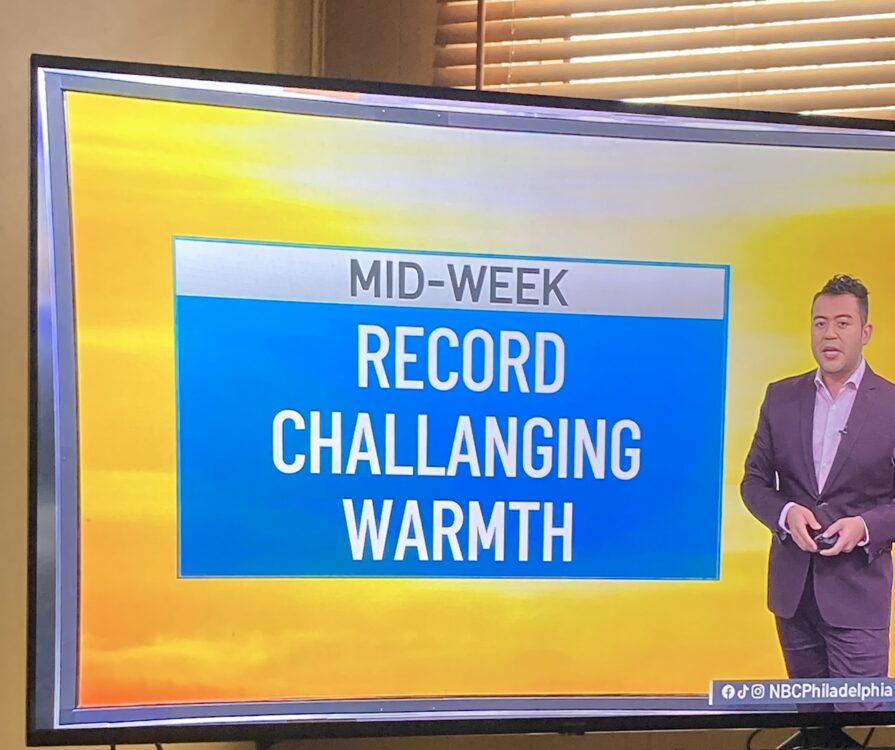
Proofreading proved to be challenging for NBC10 Philadelphia recently.
Media Watch
Many “close, but no cigars” this month.
• Chris Palmer, in The Philadelphia Inquirer: “The woman was not interested in Baker’s advances, they said, and she tried to diffuse the situation by being polite, putting in her earbuds, watching videos on her tablet . . .” Defuse (to resolve; “de-fuse,” if you will) is the correct word here. Diffuse means “to spread over a wide area or among a large number of people.”



• Another example of the defuse/diffuse confusion comes from reader Jane Buck, who spotted a Miss Manners’ column in which the arbiter of etiquette advised a reader to apologize after a dispute with another restaurant patron: “It diffuses his grievance,” misfired Miss Manners.
• Reader Larry Hamermesh spotted this in a Reuters story: “U.S. President Donald Trump evoked Jesus on Monday to urge Republicans ?in Congress to work through the upcoming Easter holiday in a bid to pass a voter-identification bill that Democrats strongly oppose.” The writer meant invoke — to petition for help or support; to appeal to or cite as authority. Evoke is primarily used in the sense “to call forth or up” and often refers to memories, emotions, or sympathy.
• Lochlahn March, in The Inky, writing about Phillies pitcher Greg Wood: “One of his three strikeouts came on his slider, a pitch that he honed in on improving over the offseason.” Substituting honing for homing is, unfortunately, becoming commonplace. Hone means to sharpen; home in on means to target. If Lochlahn had simply written, “a pitch he honed over the offseason,” he would’ve been correct, and less wordy.
• The Awful Announcing Facebook page quoted nationally known sporstcaster Joe Buck as saying that he wrote “the forward” to comedian Artie Lange’s book. Buck actually wrote the foreword — a brief introduction to the book.
• Wilmington’s News Journal reported that in a copy of the affidavit relating to Tiger Woods’ arrest, Deputy Tatiana Levenar wrote, “I believe his facilities were impaired.” The word the deputy should have written is faculties.
• Meghan Hall, in USA TODAY: “The crowd roared with excitement after every move as the Tigers relished in the moment.” One simply relishes enjoyable moments. No need for in. One does, however, revel in such moments.
• Similarly, Clare Mulroy, also USA TODAY, on author Emma Straub: “She wants fans of all ages to relish in what brings them joy.” Just one paragraph later, Clare got it right: “His brother, fellow Boy Talk member Scot, relishes attention and wants to keep milking the cash flow.”
• Washington Post headline: “The government recommended less vaccines for kids.” As everyone reading this knows (Don’t we, gang?), when referring to plurals (e.g., vaccines) we use fewer. Less is reserved for amounts.
• Tyler Dragon, USA TODAY (regarding Fanatics Flag Football Classic): “Team Founders and Team Wildcats are comprised of current and former NFL players and other standout athletes. . .” The whole comprises the parts. Therefore, this should be: “Team Founders and Team Wildcats comprise current and former NFL players . . .”
• The Philadelphia Inquirer reported on the retirement of former Eagles running back Boston Scott with this: “A sixth-round pick by the New Orleans Saints in 2018 out of Louisiana Tech, the Eagles signed Scott off the Saints’ practice squad in December of 2018.” A dangling modifier, this sentence reads as if the Eagles were a sixth-round draft pick, not Scott.
• And finally, file this under Some people are ageless, but come on: A reader noticed that a commercial for Dr. Ala Stanford, who is running for Congress in Pennsylvania’s 3rd District, claims she was “raised by a 14-year-old mother.” A person can be born to, but not raised by, a 14-year-old.
Department of Redundancies Dept.
• Stephanie Farr, in The Philadelphia Inquirer: “Interestingly enough, the voice of the first APS (Audible Pedestrian Signal) system in the city had no Philly accent at all.” Not necessarily a redundancy, but a wasted word. Why enough? Enough for whom?
Word of the Month
incel
Pronounced in-sell, it’s a noun meaning a person (usually a man) who is or identifies as involuntarily celibate and typically expresses extreme resentment and hostility toward those who are sexually active.
 Buy The War on Words book at the Hockessin BookShelf, at Huxley & Hiro Booksellers, or on Amazon. Or email me at ryearick@comcast.net.
Need a Speaker for your Organization?
Contact me for a fun presentation on grammar: ryearick@comcast.net.